
By Mark Longyen
The ECOWAS Parliament says grassroots engagement is crucial to developing more effective regional policies to address the growing menace of irregular migration across West Africa.
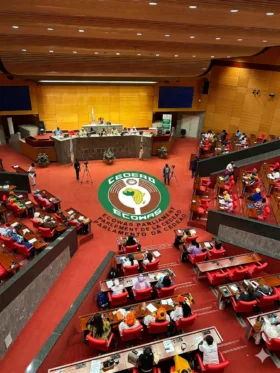
The ECOWAS Parliament’s Director, Parliamentary Affairs, Dr Kabeer Garba, said this at an ongoing delocalised meeting with communities in The Gambia aimed at combating irregular migration and human trafficking across the sub-region on Tuesday.
The News Agency of Nigeria (NAN) reports that the two-country outreach programme, which was officially unveiled in Banjul, The Gambian capital, will proceed to Dakar, Senegal, from July 13 to 17.
Garba noted that direct interaction with community citizens was crucial to providing the regional lawmakers with firsthand knowledge of the realities driving irregular migration across the sub-region.
He also said that the resultant recommendations of the consultations would strengthen parliamentary advocacy and support the formulation of more responsive regional policies against trafficking in persons and modern slavery.
He expressed optimism that the engagement would generate practical recommendations to reinforce the region’s response to irregular migration and human trafficking.
The parliamentary affairs director also commended The Gambia’s delegation to the parliament for their foresight in initiating the outreach.
Similarly, the parliament’s Fourth Deputy Speaker, MP Billay Tunkara, said the programme demonstrated the lawmakers’ commitment to moving beyond legislative deliberations to engaging directly with communities affected by irregular migration.
Tunkura, also the head of The Gambia’s delegation to the parliament, said the engagement complemented The Gambian government’s efforts to address irregular migration, human trafficking and the socio-economic challenges facing the youth.
According to him, sustainable solutions in this regard can only be achieved through active community participation.
In the same vein, ECOWAS Resident Representative in The Gambia, Ms Miatta French, described irregular migration and human trafficking as transnational challenges that required stronger collaboration among member states.
She called for sustained public awareness campaigns and coordinated regional action to protect vulnerable people from exploitation by trafficking networks.
Highlighting the scale of the sub-region’s migration challenge, The Gambia Immigration Department disclosed that migrant interceptions, voluntary returns from North Africa and deportations from Europe increased during the first half of 2026.
It said that The Gambia continued to serve as a country of origin, transit and destination along the Atlantic migration route, with women and children becoming increasingly vulnerable within mixed migration flows.
The Gambian National Agency Against Trafficking in Persons, for instance, warned of emerging forms of exploitation linked to irregular migration, including child labour, forced labour, sexual exploitation and online scam operations.
The agency solicited for greater investment in prevention, victim protection, criminal investigations and cross-border cooperation as part of measures needed to address the challenges.
Also the International Organisation for Migration (IOM) reported that The Gambia was increasingly being used as a transit point along the West African Atlantic Route,
The IOM enumerated the challenges to include overcrowded boats, changing coastal departure points and the growing involvement of women and children in dangerous migration journeys.
NAN reports that the event brought together lawmakers, ECOWAS officials, government agencies, development partners, youth organisations, returnees, and community leaders to promote safer migration and strengthen the fight against human trafficking and modern slavery.
The outcome of the parliamentary engagement is expected to promote safer migration pathways and better protection for vulnerable populations across West Africa.(NAN)(www.nannews.ng)