
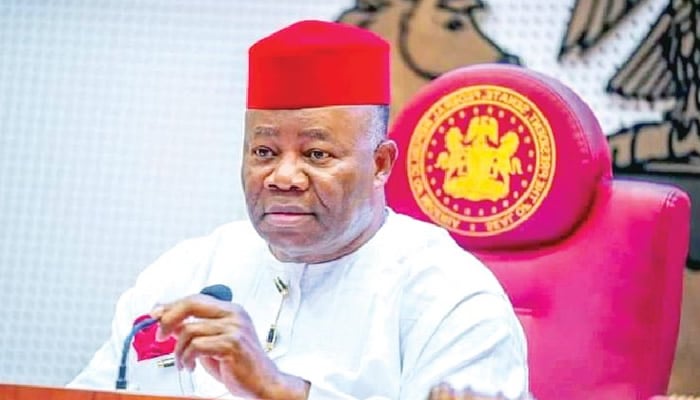
The President of the Senate, Godswill Akpabio, has defended the recent amendment to the Senate Standing Rules.
Speaking via a statement on Sunday by his spokesman, Eseme Eyiboh, the lawmaker argued that the controversial amendment introducing experience requirements for senators seeking certain presiding and principal offices was aimed at strengthening the institution rather than protecting personal interests.
PrimeTimes Nigeria recall that the lawmaker representing Edo North in the Senate, Adams Oshiomhole, publicly demanded Akpabio’s resignation over the amended Senate rules.
The Edo North senator had described the amendment as evidence of a “moral crisis” in the Senate, arguing that the process and content of the changes raised serious concerns about fairness, leadership ethics and eligibility within the chamber.
However, Akpabio insisted that parliamentary leadership demanded competence, institutional memory and procedural knowledge.
He said, “The controversy surrounding the recent amendment to the Senate Standing Rules has generated more heat than light. Unfortunately, much of the public conversation has been framed around personalities rather than principles, and emotions rather than institutional logic.
“Yet the real issue before the Senate is neither about Senator Godswill Akpabio nor Senator Adams Oshiomhole.”
Akpabio argued that parliamentary leadership required more than political popularity, stressing that the office of Senate President demanded deep familiarity with legislative procedures, constitutional interpretation, committee systems and intergovernmental relations.
Parliamentary leadership is not merely ceremonial. The office of the Senate President is one of the most sensitive and technically demanding constitutional offices in Nigeria.
“It requires not only political popularity but also deep familiarity with parliamentary traditions, legislative procedures, negotiation dynamics, committee systems, constitutional interpretation, and intergovernmental relations. Experience matters,” he argued.
The Senate President explained that legislatures across the world periodically review their rules and traditions to strengthen stability and preserve institutional memory, noting that such reforms should not automatically be interpreted as attempts to exclude new entrants.
Akpabio also rejected suggestions that he should resign because the amended rules would allegedly affect his own eligibility if applied under the new framework.
“It is therefore inaccurate to reduce the issue to the suggestion that the amendment was crafted merely to “shrink competition” or protect personal interests. Institutions do not become stronger by permanently freezing their rules in time.
“Even more problematic is the argument suggesting that because the new qualification threshold did not exist when Senator Godswill Akpabio emerged as Senate President, he should now resign if the new rule is adopted,” the statement added.
According to him, such arguments misunderstand the principle that laws and rules are generally prospective rather than retroactive.
“A law or rule takes effect from the point of enactment forward unless expressly stated otherwise. The amendment cannot logically invalidate a mandate that was legitimately acquired under previously existing rules,” he stated.