
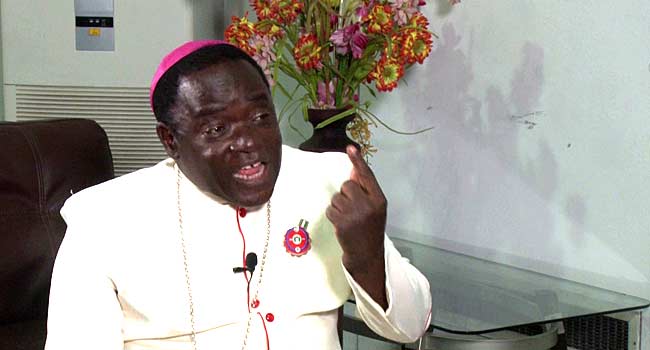
The Catholic Bishop of Sokoto Diocese, Matthew Hassan Kukah, has disclosed that former governor of Kaduna State, Nasir El-Rufai, once revoked a land allocated to former Head of State, Yakubu Gowon, in Abuja.
Kukah made the revelation on Tuesday in Abuja while reviewing Gowon’s autobiography, ‘My Life of Duty and Allegiance’, published by Havilah Group.
The clergyman stated that Gowon owned no property in Abuja after he returned from his exile in the United Kingdom.
He said that the former military leader only secured a plot of land after the intervention of senior military officers, including former military president, General Ibrahim Babangida (rtd).
Recounting some of the hardships Gowon endured after he was overthrown in the 1975 military coup, Kukah said, “He didn’t have a plot of land. And when he came back, it was just out of pity, let me put it that way, that General Babangida agreed. Finally, they named one crescent after him, and after the crescent, they now gave him a plot of land, his first plot of land in Abuja.”
The Catholic bishop explained that Gowon had already mobilised resources and commenced development on the property before the allocation was revoked under El-Rufai’s administration as FCT minister.
“He mobilised resources to try to start building. He begins to build. Then El-Rufai, who was minister of the FCT, revoked the land,” Kukah stated.
Kukah, however, disclosed that the intervention of retired General Theophilus Danjuma and other influential figures eventually helped Gowon recover the property.
The cleric described Gowon’s autobiography as a detailed account of Nigeria’s turbulent political history, noting that the nearly 900-page memoir was divided into 36 chapters covering military coups, exile, governance and personal struggles.
He also disclosed that much of Gowon’s personal records and archives were destroyed in separate fire incidents in Bakori and Kaduna, forcing the former military ruler to rely heavily on memory while writing the book.
“It’s important to underscore the fact that whatever you read in the book is the result of what the author was able to recall.
“You will find in the book evidence of excellent memory and details of things,” Kukah said.
Kukah further highlighted revelations contained in the memoir regarding Gowon’s relationship with former President Olusegun Obasanjo, whom Gowon reportedly described as his “informal guardian angel.”
Quoting from the book, Kukah said Gowon wrote that he trusted Obasanjo “more than any other soldier.”
The bishop also referenced recollections by a former Chief of Staff at Supreme Headquarters about debates within the military over whether Gowon should be allowed to return to Nigeria after years in exile.
According to Kukah, some officials feared political backlash if news of Gowon’s planned return became public.
Beyond politics, the bishop praised Gowon’s wife, Mrs Victoria Gowon, describing her as “the shield, the diplomat, who wore the trousers in the house.”
He recounted how the Gowon family faced severe hardship during their exile in the United Kingdom, with the former Head of State reportedly struggling to secure employment or even open a bank account.
Kukah said Victoria Gowon sustained the family by sewing bed sheets and making pillows for sale.
He himself said in the book that he became what he called a kept man because she was the one looking after everything in the house,” the bishop noted.
The cleric further alleged that a domestic worker sent to assist the family by Nigerian officials was later discovered to be spying on them.
“At the end of the day, the poor man could not find anything to report back home,” Kukah added.