
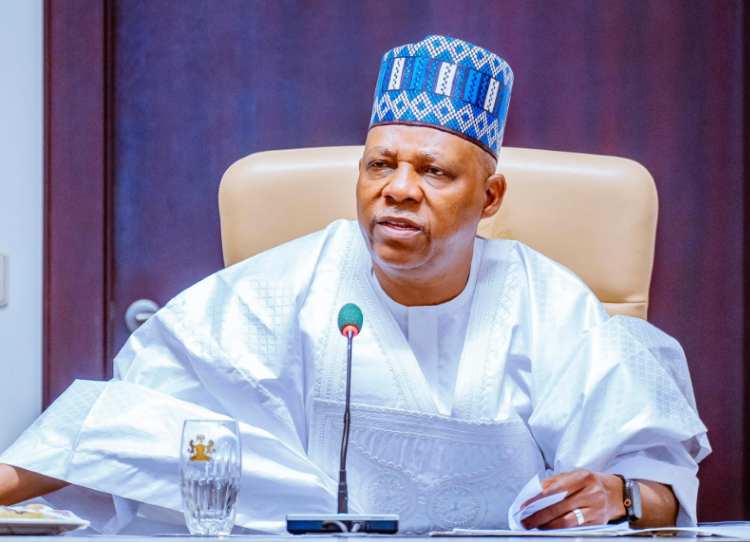
Vice-President Kashim Shettima has revealed that some individuals allegedly attempted to create distrust between him and President Bola Tinubu shortly after they assumed office in 2023.
Speaking on Tuesday in Abuja during the public presentation of the autobiography of former Head of State Yakubu Gowon, Shettima said some persons warned Tinubu against wearing traditional outfits he gave him during the campaign period.
According to the vice-president, the individuals claimed the garments had been spiritually manipulated and could lead to Tinubu’s death, paving the way for him to become president.
“When we were campaigning for him to emerge as the candidate of the APC, we were going round the north. So, I got some materials and caps for him to blend with the northern crowd. It fitted him very well. So his aides said, ‘produce more, it fitted him,’” Shettima said.
“Barely three months when we were sworn into office, some of my people from Borno came to him and said, ‘stop wearing those Shettima clothings. He must have charmed them. And you’re going to die. And he will become the president.’
“And to the eternal credit of the president. When I came back from China, where I represented him, he said, ‘sit down. Your people came to me and said I should stop wearing those garments you gave me.’
“But he said their story did not add up because when you gave those garments, I was an aspirant.
“For one week, to prove to them that he is not fetish, he wore those garments. These are some of the gimmicks that are taking place in power circles in Nigeria nowadays.”
Shettima said the incident reflected the kind of political intrigue often associated with positions of power in the country.
Drawing a comparison with the era of Gowon’s administration, the vice-president said trust among leaders and communities was stronger at the time.
He recalled that the family of the Sultan of Sokoto regularly sent “gallons of fura” to Dodan Barracks in Lagos during Gowon’s tenure, and the former military ruler accepted the gifts without suspicion.
“Here was a Christian son of the north, a child of the north-central, a soldier accepted across lines that others try too hard to harden into walls in Nigeria,” Shettima said of Gowon.
“His life proved that identity can be carried without hostility. History teaches us that the Nigerian project becomes stronger whenever citizens refuse to become weapons in the hands of sectarianism and division.”
Speaking further, Shettima praised Gowon’s contributions to regional integration in Africa, particularly his role in the establishment of the Economic Community of West African States.
“As one of the builders of regional cooperation in Africa, the formation of the Economic Community of West African States remains one of the great acts of political foresight on the continent,” he said.
“It was born out of the understanding that neighbouring nations must do more than exchange flags at ceremonies. They must pursue ideas of security cooperation, diplomatic confidence, and economic opportunity.
“In that vision, General Gowon saw Africa as a community of shared burdens and shared possibilities. That vision remains even more urgent today.
“We need cooperation against insecurity. We need faith that empowers young people. We need diplomacy that prevents conflict from becoming a contagion. We need a region where borders do not become barriers to prosperity.”