
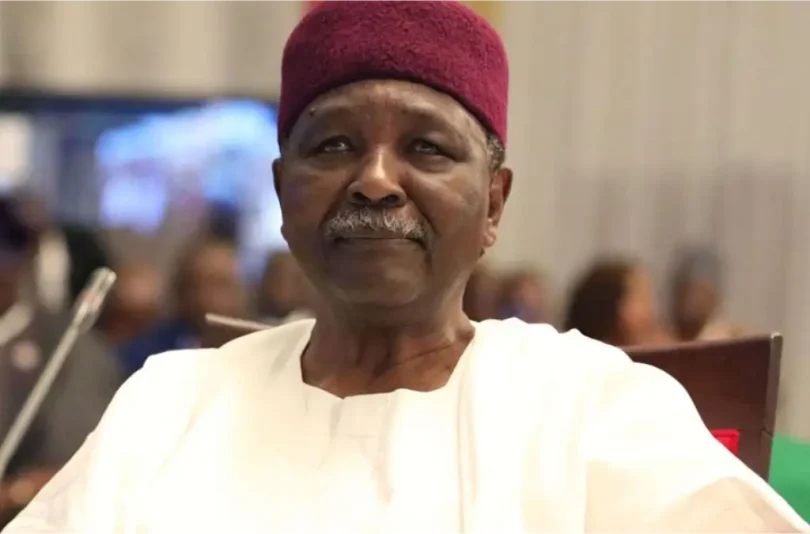
Former Head of State, Gen. Yakubu Gowon (retd.), has revealed that former President Olusegun Obasanjo initially rejected a wartime posting that would have placed him under the command of the late Col. Murtala Muhammed.
Gowon said Obasanjo objected to the arrangement during the Nigerian Civil War, insisting that he would “never” serve under an officer he considered his junior.
The former Head of State made the disclosure in Chapter 14 of his 859-page autobiography, My Life of Duty and Allegiance, titled “No Going Back,” at the book launch in Abuja on Tuesday.
According to Gowon, he had created a Rear Command for the newly formed 2 Division under Murtala Muhammed, with Obasanjo, then Sector Commander in the Western State, expected to serve as Rear Commander in Ibadan.
The role required Obasanjo to coordinate relief materials, equipment and reinforcements, while also helping to secure the Western Region.
But Gowon said Obasanjo opposed the arrangement because it placed him in a supporting role under Murtala.
Gowon wrote, “He believed he was more senior and should not be expected to serve under his junior.
“His reaction made it obvious that he was not well disposed to any idea that appeared to present him as playing second fiddle to Murtala.
“As a result, he strongly stated that he would never serve under Colonel Murtala Muhammed for any reason.”
‘I Stood My Ground’ – Gowon
Gowon said he overruled Obasanjo by invoking his authority as Commander-in-Chief.
He wrote, “I stood my ground that, as Commander-in-Chief, I reserved the right to send people to where I believe they could be most useful to the country at any material time.
“I told him his main task was not to be Murtala’s deputy but to ensure the general security of the Western Region. He relented and took on the role assigned to him.”
The retired general said Obasanjo eventually performed creditably in the position.
He added that Obasanjo particularly impressed him by rejecting an alleged attempt by Nobel laureate, Prof. Wole Soyinka, to persuade him to allow Col. Victor Banjo to enter the West through Benin to Ibadan.
“He performed well to my expectations, especially by rebuffing Wole Soyinka’s attempt to get him to allow Colonel Victor Banjo to come to the West through Benin to Ibadan. I deeply appreciate Obasanjo’s loyalty and sense of patriotism,” Gowon wrote.
How I Became Obasanjo’s ‘Guardian Angel’
Gowon also traced his relationship with Obasanjo to March 1958, when both men were undergoing officer training in the United Kingdom.
He recalled meeting Obasanjo at the Officers’ Mess after arriving in London with limited funds and being unable to immediately settle his bills.
Gowon said he considered seeking help from two Nigerian officers, Obasanjo and Foluso Sotomi, whom he described as a Lagos-born officer with a flashy reputation.
“Whereas Obasanjo was a frugal person, Sotomi was a spendthrift and, as his nickname confirmed, a typical Lagos ‘Show Boy’ who looked smarter but was more of a bigmouth and certainly more bombastic than Obasanjo,” he wrote.
According to him, Sotomi had no money to spare, while Obasanjo readily assisted him.
“Obasanjo, on the other hand, was much different. He had more than enough money to pay for himself and to offset my initial bills. I saw that as a great display of a sense of responsibility,” Gowon said.
He said the gesture made him take a special interest in Obasanjo’s military career.
Gowon said, “That singular act made me take more interest in Obasanjo and what he did. I advised him to ensure that he remained on the right track in the Army.
“I became his informal guardian angel right up to the time I appointed him to take over the command of 3 Marine Commando from Adekunle.”
Gowon described Obasanjo as “a quiet, respectable and intelligent officer,” although he said he did not consider him as naturally sharp as some younger officers, including Alani Akinrinade.
Gowon Speaks On Murtala
In the chapter, Gowon also explained why he appointed Murtala as Commander of the 2 Division.
He described Murtala as his “preferred choice,” saying he showed “extraordinary zeal and courage” in accepting the assignment.
However, Gowon admitted that Murtala sometimes struggled to control his emotions. The late Murtala led the 1975 coup that removed Gowon from power.
Gowon also alleged that the Biafran leader, Lt. Col. Odumegwu Ojukwu, pledged the mineral wealth of Biafra to the Rothschild banking family in exchange for support during the civil war.
He said the deal was worth about $10m, estimated at N5m at the time.
According to Gowon, France supported the Biafran side through some of its former African territories, with expectations of benefiting if the secessionist effort succeeded.
“Indeed, he had pawned the mineral wealth of Biafra to Rothschild for about $10m or an estimated ₦5m at the time,” Gowon wrote.
He said the Nigerian government became aware of the arrangement after its consulate in New York intercepted information about the planned purchase of a B-26 aircraft meant for Biafra.
“Our knowledge of this deal was fortuitous because the Nigerian Consulate in New York had intercepted information regarding the purchase of a B-26 aircraft that was to have been sent to Biafra through a South American country,” he added.
Gowon said the intelligence was passed to Lagos by Moses Ihonde, who later became his Press Secretary, after negotiators in the aircraft deal approached the Nigerian Consulate in New York for information on exchange rates.