
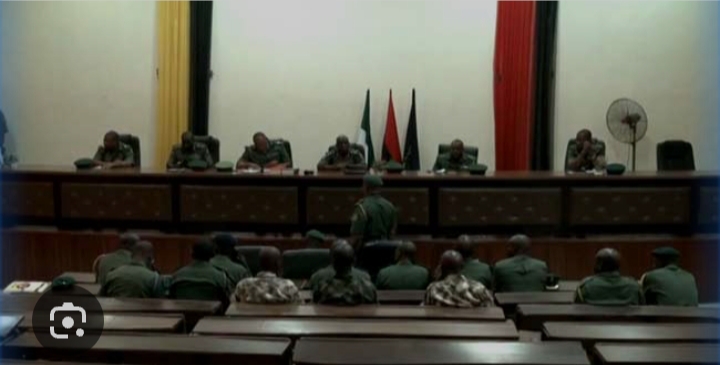
Ma’aji, in a preliminary objection filed before the court martial in charge No: DHQ/GAR/ABJ/49/ADM, between the Armed Forces of Nigeria and Brig Gen M.A. Sadiq, Col Ma’aji, alongside 35 others, urged the court martial to strike out the charges instituted against him, arguing that the military tribunal lacked the jurisdiction to entertain the case.
Ma’aji, in the objection, contended that the charges were fundamentally defective and incompetent in law.
The objection, brought pursuant to Rules 36(1) and 37(1) of the Rules of Procedure Army 1972, urged the tribunal to make an order striking out and/or dismissing the charges against the 2nd Accused.
“Take notice that the 2nd accused hereby objects to the jurisdiction of the General Court Martial to entertain Counts One to Nine of the charges preferred against the 2nd Accused in Charge No: DHQ/GAR/ABJ/49/ADM, namely ARMED FORCES OF NIGERIA V. BRIG. GEN. M. A. SADIQ (N/10321) & 35 ORS and hereby prays the General Court Martial for the following reliefs:
“An Order striking out and/or dismissing the charges against the 2nd Accused in Charge No: DHQ/GAR/ABJ/49/ADM for lack of jurisdiction. An order declining jurisdiction to entertain the charge as constituted.
“And for such further order(s) as the Honourable General Court Martial may deem fit to make in the circumstances.”
The second accused in the charge also argued that the complainant, listed as the Armed Forces of Nigeria, lacked the legal capacity to institute criminal proceedings.
According to Ma’aji, “The complainant (Armed Force of Nigeria) is not a juristic person and thereby lacks the requisite competence to initiate and prosecute the criminal proceedings in Charge No: DHQ/GAR/ABJ/49/ADM.”
Ma’aji further maintained that because the complainant allegedly lacked legal personality, the General Court Martial was equally deprived of jurisdiction to hear the matter.
Citing several Supreme Court and Court of Appeal authorities, including Green v. Green, Fawehinmi v NBA, and Mothercat Nig Ltd v Reg. Trustees of the Full Gospel Assembly Nig, the defence argued that only natural persons or entities expressly recognised by law could sue or be sued.
The written address submitted in support of the objection stated, “The name ‘Armed Forces of Nigeria’ described as ‘complainant’ in Charge No: DHQ/GAR/ABJ/49/ADM is unknown to law and destitute of any legal capacity to exercise Prosecutorial powers in respect of the charges preferred against the 2nd Accused.”
The second accused also challenged the competence of counts one to nine of the charge, which allegedly accused him of inciting other officers to join a plot to overthrow President Tinubu.
Ma’aji insisted that the allegations contained in the particulars of the charges did not fall within the offence of mutiny as contemplated under Section 52(1)(b) of the Armed Forces Act, 2004.
He argued that the particulars of the charge “disclose offences against the Sovereign State otherwise known as the Federal Republic of Nigeria and constitutional order rather than offences relating to military or service discipline or command structure.”
He maintained that the phrase “plot to overthrow the government of the Federal Republic of Nigeria” contained in the charge could not be equated with “lawful authority in the Federation” as envisaged under Section 52(3) of the Armed Forces Act.
“It is submitted that the Federal Republic of Nigeria does not fall within the phrase ‘a lawful authority in the Federation’ as used in Section 52(3) of the Armed Forces Act, Laws of Federation, 2004,” Ma’aji contended.
Relying on constitutional provisions and judicial precedents, he argued that the court-martial, being a tribunal of limited jurisdiction, could not extend its powers beyond what was expressly granted by statute.
Ma’aji also cited the Supreme Court’s warning against judicial expansion of statutory provisions, insisting that any ambiguity in penal legislation must be resolved in favour of the accused persons.
Quoting the Supreme Court decision in Nigerian Navy v. Lambert, the second accused submitted: “It is settled law that penal statutes are to be construed strictly to the benefit of the accused person and that where there is a reasonable construction that avoids the penalty in any particular case, the court must adopt that construction.”
The preliminary objection further contended that for a charge of mutiny or incitement to mutiny to stand, there must be allegations of concerted insubordination, defiance of military authority or refusal of lawful command or organised military rebellion against superior military command.
According to the defence, the particulars supplied by the prosecution failed to disclose those essential ingredients.
On this ground, he urged the General Court Martial to uphold his preliminary objection and dismiss the charges against him for want of jurisdiction.
Meanwhile, a witness in the ongoing trial of six alleged coup plotters before the Federal High Court in Abuja, on Wednesday, told investigators that Ma’aji allegedly threatened to force his way into the Presidential Villa, even if insiders refused to cooperate.