
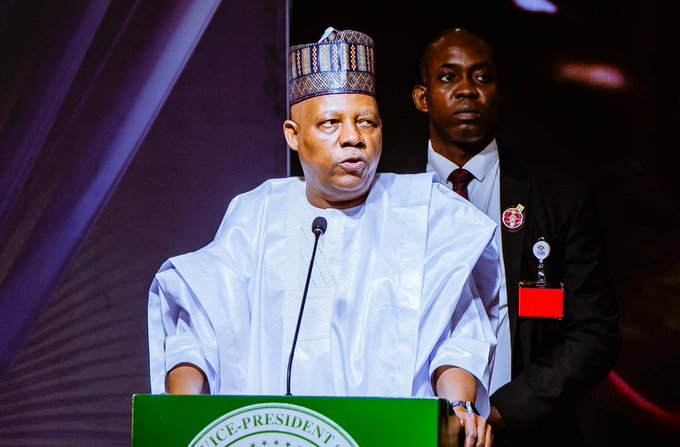
Vice-President Kashim Shettima on Tuesday disclosed that unnamed individuals allegedly attempted to sow distrust between him and President Bola Tinubu shortly after the inauguration of the current administration, claiming that traditional garments he gifted the president during the 2023 campaign were spiritually manipulated to harm him.
Shettima made the revelation in Abuja during the public presentation of the autobiography of former Head of State, Yakubu Gowon, where he reflected on trust, political suspicion, and ethnic relations within Nigeria’s power structure.
According to the vice-president, the incident occurred barely three months after he and Tinubu assumed office in May 2023.
He explained that during the presidential campaign, he procured northern-style garments and caps for Tinubu as part of efforts to help the then-candidate connect more easily with voters across the North.
Shettima said, “When we were campaigning for him to emerge as the candidate of the APC, we were going round the north. So, I got some materials and caps for him to blend with the northern crowd.”
He added that Tinubu liked the outfits so much that aides around him requested more of the garments.
However, Shettima said some individuals later approached the president with allegations that the clothes had been charmed and were intended to kill him so that the vice-president could assume office.
He stated, “Barely three months when we were sworn into office, some of my people from Borno came to him and said, ‘stop wearing those Shettima clothings. He must have charmed them. And you’re going to die. And he will become the president.”
The vice-president said Tinubu dismissed the allegation and later informed him about the encounter after he returned from an official trip to China.
According to Shettima, the president questioned the logic behind the claim, noting that he was merely an aspirant when the clothes were given to him.
Shettima recalled, “But he said their story did not add up because when you gave those garments, I was an aspirant.”
He further disclosed that Tinubu deliberately continued wearing the outfits for about one week to demonstrate that he was not influenced by superstition or political manipulation.
“For one week, to prove to them that he is not fetish, he wore those garments.”
The vice-president described the incident as part of the “gimmicks” and intrigue that often characterise Nigeria’s political environment and power circles.
Besides, the personal account, Shettima used the occasion to draw comparisons between contemporary politics and the era of Gowon’s leadership after the civil war.
He said Nigeria under Gowon witnessed a level of trust and inter-ethnic confidence that appears increasingly difficult to sustain in present-day politics.
Recalling interactions during Gowon’s administration, Shettima said the family of the Sultan of Sokoto regularly sent food items, including “gallons of fura,” to Dodan Barracks in Lagos without suspicion or political anxiety.
He said while speaking about Gowon, “Here was a Christian son of the north, a child of the north-central, a soldier accepted across lines that others try too hard to harden into walls in Nigeria.”
The vice-president argued that Gowon’s leadership symbolised a period when identity and religion did not automatically translate into political hostility.
He added, “His life proved that identity can be carried without hostility.”
Shettima also praised Gowon’s role in regional diplomacy and the formation of the Economic Community of West African States, saying the former military leader understood the importance of cooperation among African countries.
According to him, West Africa still requires stronger collaboration on insecurity, economic development and conflict prevention amid growing instability across the region.
The Vice-President said, “We need cooperation against insecurity. We need diplomacy that prevents conflict from becoming a contagion.”
The remarks have since drawn attention for offering a rare public glimpse into the internal suspicion, political rivalry, and behind-the-scenes manoeuvring that often shape relationships within Nigeria’s highest levels of power.