
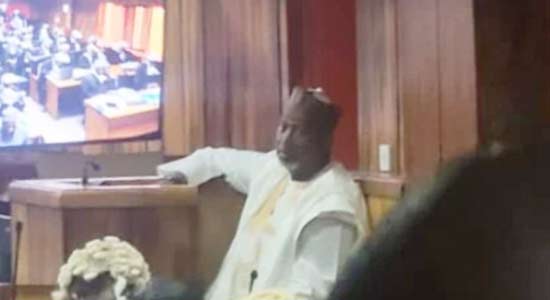
The FCT High Court in Maitama, Abuja, on Thursday, rejected key exhibits presented by the Economic and Financial Crimes Commission (EFCC) to prove its N2.8 billion fraud charges against former Minister of Aviation, Hadi Sirika, and his co-defendants.
The rejected exhibits were the extra-judicial statements of two of Mr Sirika’s co-defendants—his daughter, Fatima Sirika, and her husband, Jalal Hamma.
“The statements of the second and third defendants (Ms Sirika and Jalal Hamma) made at the Economic and Financial Crimes Commission (EFCC) office are inadmissible for non-compliance with the provision of Section 15(4) of the Administration of Criminal Justice Act (ACJA) 2015,” the trial judge, Sylvanus Oriji, ruled on Thursday.
Mr Oriji gave the ruling following the two defendants’ challenge to the voluntariness of the statements.
The statements, said to be confessional, were pivotal to the EFCC’s case.
The EFCC obtained the couple’s statements in 2024 when it invited them during investigations into the N2.8 billion contract fraud.
EFCC alleged that Mr Sirika allegedly spearheaded the fraud while in office as the aviation minister with participation from his daughter and son-in-law.
Mr Sirika served in that role between 2015 and 2023, during the tenure of the late former President Muhammadu Buhari.
In July 2025, EFCC’s lawyer Rotimi Jacobs, a Senior Advocate of Nigeria (SAN), sought to tender as evidence the couple’s extrajudicial statements through a prosecution witness, Adekunle Odofin, who is an investigator with the anti-graft agency.
But the two defendants, through their lawyers, challenged the voluntariness of the statements.
The defence lawyers said the handwritten documents were confessional statements obtained from the two defendants under duress.
This prompted the judge to order a trial-within-trial to verify the claim.
Mr Odofin, the EFCC investigator, appeared as a prosecution witness in the trial-within-trial, insisting that the defendants freely wrote the statements.
He informed the court that Ms Sirika wrote her statement when she same to EFCC’s office along with two lawyers on 26 February 2024 to honour an invitation.
He insisted that the cautionary word was administered to her and that she volunteered to give her statement.
He said her husband, Hamman, who was similarly invited, wrote his own statement when he visited the EFCC’s office with one lawyer on 27 February 2024.
He confirmed that there was no video recording of the encounters on both occasions.
Prosecution lawyer, Oluwaleke Atolagbe, argued that statement writing process in both cases complied with Sections 15(4) and 17(2) of the Administration of Criminal Justice Act (ACJA) 2015. He said video recording is not mandatory when a suspect volunteers a statement, adding that the law makes it optional by using the operative word “may”.
The defence lawyers poked a hole at the arguments, insisting that it was mandatory for the statement writing to be videotaped.
In his ruling on Thursday, the judge said “may”, as used in the provision of ACJA, imposes a duty on officers of law enforcement agencies to comply with the provisions of the law without any room for discretion.