
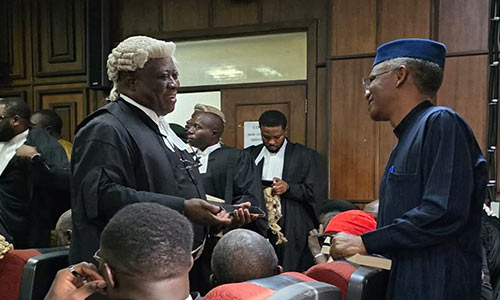
*As Bail Application Stalls Over Missing Court Document
The Department of State Services has arraigned former Kaduna State Governor Nasir El-Rufai before the Federal High Court in Abuja on an amended five-count charge for allegedly accessing the telephone conversation of the National Security Adviser, Nuhu Ribadu, in a case that adds yet another legal front to the former governor’s mounting prosecution across multiple courts and security agencies.
El-Rufai pleaded not guilty when the charges, marked FHC/ABJ/CR/99/2026, were read to him on Thursday before Justice Joyce Abdulmalik. However, proceedings stalled midway through the hearing of the defendant’s bail application when the judge discovered that a further affidavit filed by the defence was not in the court’s file, prompting a stand-down for the document to be properly placed before the court.
The arraignment represents the third separate criminal prosecution El-Rufai is now facing simultaneously, in addition to the ICPC corruption charges at the Federal High Court in Kaduna where he was granted N200 million bail, and the ICPC fraud charges at the Kaduna State High Court where bail was denied by Justice Darius Khobo, a ruling that drew condemnation from Professor Chidi Odinkalu and activist Omoyele Sowore.
The DSS initially filed a three-count charge against El-Rufai in February 2026, accusing him of breaching the Cybercrimes Prohibition Act 2024 and the Nigerian Communications Act 2003.
At Thursday’s proceedings, DSS counsel Oluwole Aladedoye SAN informed the court that the charges had been amended from three to five counts, with the amended charge filed on April 13. He requested the court to substitute the new charge for the earlier one.
El-Rufai’s counsel, Oluwole Iyamu SAN, confirmed he had been served with the amended charge and did not oppose the substitution. Justice Abdulmalik struck out the earlier three-count charge and the amended five-count charge was read to the defendant.
El-Rufai pleaded not guilty to all five counts.
The prosecution stems from an interview El-Rufai gave on Arise Television’s “Prime Time” programme in February, during which he made the extraordinary claim that someone had wiretapped the National Security Adviser’s phone, allowing him to listen to Ribadu instructing security operatives to effect his arrest.
“He made the call because we listened to their calls. The government thinks they are the only ones that listen to calls but we also have our ways. He made the call and gave the order,” El-Rufai stated during the televised interview.
“Someone tapped his phone. The government listens to our calls all the time without a court order. Someone tapped his phone and told us that he gave the order,” the former governor added.
The statement, broadcast on national television, effectively constituted a public admission that El-Rufai had knowledge of, and possibly participated in, the interception of the private communications of one of Nigeria’s most senior security officials, a claim that immediately drew the attention of the DSS and led to the filing of charges.
The case raises significant legal questions about cybersecurity, communications privacy, and whether the government’s own alleged practice of intercepting calls “without a court order,” as El-Rufai described it, provides any defence or mitigating context for the accused.
After El-Rufai entered his not guilty plea, the prosecution requested three consecutive trial dates for the commencement of trial.
Iyamu SAN objected to consecutive trial dates, explaining that his client had been in the custody of the Independent Corrupt Practices and Other Related Offences Commission, making access to him for trial preparation difficult.
“Since the defendant has been in the custody of ICPC, having access to him within three days of trial might be difficult. The three days might not be in our best interest,” Iyamu submitted.
The defence counsel then informed the court of a bail application that had been filed on February 17, along with a further affidavit filed more recently in support of the application.
However, when Justice Abdulmalik checked her docket, the further affidavit was not in the court’s file, creating a procedural obstacle that prevented the bail application from being heard.
The missing document triggered a sharp exchange between the judge and defence counsel.
Justice Abdulmalik told Iyamu that he should have carried out his due diligence of ensuring the process was properly filed rather than “engaging in Nollywood theatrics of camera personnel taking pictures in her courtroom.”