
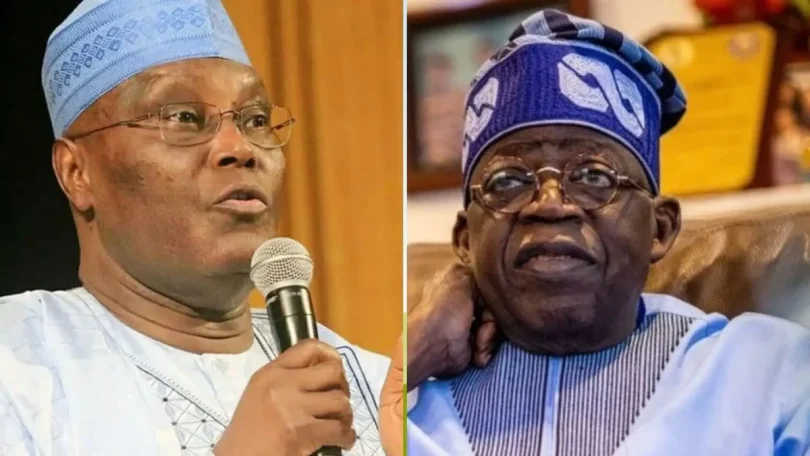
The presidential candidate of the African Democratic Congress (ADC), Atiku Abubakar, has questioned the Federal Government’s continued borrowing despite what he described as a huge financial windfall from high global crude oil prices.
POLITICS NIGERIA reports that the former vice president has asked President Bola Tinubu to explain how the additional oil revenue has been spent.
In a statement issued on Sunday by his Senior Special Assistant on Public Communication, Phrank Shaibu, the former vice president accused the Tinubu administration of poor economic management, lack of transparency and fiscal indiscipline, arguing that the government’s borrowing pattern contradicts its rising oil earnings.
According to Atiku, the Federal Government borrowed about ₦5 trillion from the domestic bond market in the first half of 2026, representing nearly 80 per cent of the total amount borrowed during the same period in 2025.
He argued that such aggressive borrowing would only make sense if government revenue had fallen sharply, insisting that the opposite was the case because crude oil prices had remained well above the benchmark contained in the 2026 budget.
“The exact opposite is the case,” he said.
Atiku noted that while the 2026 Appropriation Act was based on an oil benchmark of $64.84 per barrel, Brent crude averaged about $92 per barrel between March 1 and July 14. He added that Nigerian crude usually sells at a premium above Brent, meaning the country’s actual earnings were even higher.
“This naturally raises two unavoidable questions,” Atiku said.
“First, why is a government enjoying such an extraordinary oil windfall borrowing at almost twice last year’s pace as though the nation were in financial distress? Second, where is the money?”
The former vice president explained that the gap between the budget benchmark and prevailing oil prices amounted to an additional $27.15 for every barrel of crude sold. Based on an average production of 1.5 million barrels per day, he estimated that Nigeria earned about $42.7 million in extra revenue daily.
According to him, over the 135-day period between March 1 and July 14, the country generated an estimated $5.76 billion, equivalent to about ₦7.98 trillion, in additional oil revenue.
“Nigerians deserve a full accounting of this windfall. Where has the money gone? Why is there no transparent disclosure of the proceeds from excess crude sales? Why is government borrowing heavily when oil revenues are significantly above budget projections?” he asked.
Atiku said previous administrations maintained established mechanisms for warehousing and reporting excess crude earnings through the Sovereign Wealth Fund and other fiscal buffers, but argued that Nigerians no longer have access to such information.
“Today, Nigerians have been left completely in the dark. A government that cannot explain what it has done with an estimated ₦7.98 trillion in additional oil receipts has no moral authority to continue plunging the country deeper into debt,” he stated.
The former vice president also argued that despite the oil windfall and the removal of petrol subsidy, many Nigerians have continued to face worsening economic hardship.
He cited recent findings by the United Nations, which he said showed that about 80 per cent of Nigerians could not afford a decent meal every day. He also claimed that infrastructure had continued to deteriorate despite repeated assurances that savings from fuel subsidy removal would be invested in roads, healthcare, education and other critical sectors.
Atiku further criticised the administration, saying, “It is increasingly evident that this administration lacks the competence, discipline, and transparency required to manage the nation’s resources. Rather than allowing Nigerians to benefit from favourable global oil prices, it has chosen the path of endless borrowing, mounting debt, and deepening poverty.”
He promised that an ADC government under his leadership would adopt a different approach to managing public finances.
“Every kobo earned above the budget oil benchmark will be transparently accounted for and managed under a rules-based fiscal framework. Rather than borrowing recklessly in the midst of plenty, we will deploy excess revenues to reduce the nation’s debt burden, strengthen our fiscal buffers, and invest strategically in infrastructure, education, healthcare, agriculture, and other productive sectors that create jobs and stimulate sustainable economic growth,” he said.
Atiku added that his administration would restore transparency in the management of oil revenues by publishing regular reports on excess crude earnings, reducing the cost of governance, eliminating waste, blocking revenue leakages and ensuring that borrowing would only be used to finance productive investments capable of generating measurable economic returns.
“Nigerians deserve answers. They deserve accountability. Above all, they deserve a government that manages national wealth in the public interest, not one that presides over unprecedented opacity while asking future generations to repay debts incurred in the midst of plenty,” he said.
Atiku’s criticism comes as global oil prices remain elevated amid renewed geopolitical tensions in the Middle East. Despite the higher crude prices and the government’s insistence that its economic reforms are stabilising the economy, concerns have continued over the impact of inflation and the rising cost of living.
A recent World Bank report also stated that despite major economic reforms introduced by the Tinubu administration, including the removal of petrol subsidy, foreign exchange reforms and tighter monetary policies, about 79 per cent of Nigerians remain poor or vulnerable to falling into poverty. The report said 61 per cent of Nigerians live below the poverty line, while 33 per cent are classified as ultra-poor and unable to meet their minimum food requirements.
The World Bank acknowledged that the reforms had improved key macroeconomic indicators, including stronger economic growth, higher foreign reserves, narrower fiscal deficits and increased investor confidence. However, it noted that the gains had yet to translate into meaningful improvements in the living standards of most Nigerians, as high inflation continues to erode incomes and social protection programmes remain limited.
President Tinubu has repeatedly defended his economic reforms, maintaining that although they have imposed short-term hardship on Nigerians, they are necessary to rebuild the economy and lay the foundation for long-term growth. He has insisted that the policies are already delivering results through improved macroeconomic stability, stronger public finances and increased investor confidence.