
Politics
By Amb. Tunde Ajisomo
His Excellency Ambassador Peter Ryan and his dear wife, Teresa; former and serving Honourable Ministers, Irish home-based diplomats serving in Nigeria; the Irish clergy at home and in Nigeria; distinguished members of the diplomatic corps; alumni of the Casement Fellowship; esteemed dignitaries and human rights advocates; family and friends joining online; steadfast friends of Ireland; distinguished ladies and gentlement.
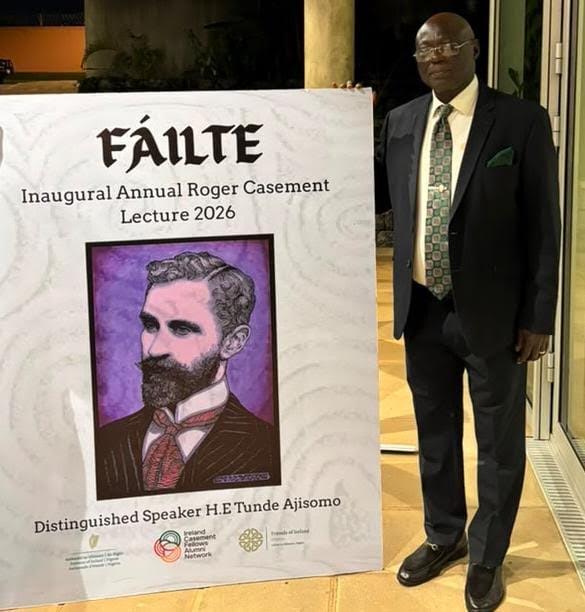
It is a singular honour, and one I do not take lightly, to have been asked to deliver the first Inaugural Annual Lecture in memory of an extraordinary Irishman – patriot, diplomat, poet, cartographer, nationalist, and tireless humanitarian – a man history now remembers as the father of twentieth-century human rights investigation: Sir Roger Casement.
Allow me to begin by offering my profound appreciation to the Government of the Republic of Ireland, and in particular to His Excellency Ambassador Peter Ryan and the whole of Team Ireland in Nigeria, for the honour of this invitation – and, more importantly, for their years of dedicated service to the governments and peoples of both our nations. In recognition of Ireland’s unwavering commitment to deepening its bilateral ties with Nigeria, I offer my warmest congratulations to Ambassador Ryan and his team on the recent commissioning of this historic new Embassy, so fittingly situated within the European Union Compound. I therefore invite you to please join me in applauding the Government of Ireland for this achievement.
This milestone, marking, among other things, the 65th anniversary of Nigeria-Irish diplomatic relations, represents the single largest capital investment by the Irish State anywhere on the African continent. It stands as clear evidence of Ireland’s resolve to make diplomacy itself an engine of economic growth, promotion of cultural and educational exchange, as well as facilitation of regional cooperation. This building is not merely a chancery; it is a statement of intent.
This iconic edifice is a living testament to sixty-five years of a flourishing partnership between our two nations, and a significant piece of living evidence that the Republic of Ireland has firmly anchored its future in Africa’s largest nation. I therefore salute Ambassador Peter Ryan and his colleagues for their vision, commitment, and leadership that conceptualized and brought this landmark project to completion during his tenure, not least his decision to dedicate this very conference hall to the memory of Sir Roger Casement.
Remembering Sir Roger Casement
Today, we gather to honour a remarkable son of Ireland, born on the 1st of September 1864 in Kingstown – now Dún Laoghaire – County Dublin. Casement stands among the foremost martyrs of Ireland’s struggle against British colonial rule. He gave his life for a cause greater than himself: arrested, convicted, and executed for high treason at Pentonville Prison, London, on the 3rd of August 1916. Only in 1965 were his remains finally returned home to Ireland, where a State funeral restored him to the nation he served and died for.
Ten years ago, in recognition of Casement’s role in Ireland’s fight for independence and his selfless humanitarian labour across Africa and the Amazon, the Irish Government marked the centenary of his landing at Banna Strand, County Kerry, aboard a German submarine – an occasion observed on the 21st of April 2016. There, former President Michael D. Higgins laid a wreath on behalf of the Irish people at the ancient ringfort near Ardfert, now known to the world as Casement Fort, honouring what President Higgins described as Casement’s idealism, his passionate empathy for the hopeless, and the oppressed.
That same spirit of remembrance reached Abuja. On the 3rd of August 2016, the Embassy of Ireland mounted a pop-up exhibition at the Thought Pyramid Art Centre in Wuse II, marking the centenary of Casement’s death under the title “A Century of Lessons.” The exhibition showcased Casement’s pioneering diplomatic work in Calabar, then Nigeria’s Delta Protectorate, as a young British Consul in 1894, when he surveyed the Niger Delta area and produced early maps that were lithographed at the Intelligence Division of the War Office in the UK and Peru. From Nigeria, he served as Consul in Portuguese East Africa (Mozambique, 1895-98), Angola (1898-1900), Congo, Free State (1901-1904) and Brazil and Peru (1906-11). During his service years in Africa and in the Amazon, he exposed the exploitation of indigenous peoples by international companies.
The Casement Fellowship Human Rights Programme
As part of the centenary commemorations in 2016, the Irish Government established the Casement Fellowship Programme, honouring the legacy of a prominent Irish humanitarian activist who championed the cause of the oppressed. It is administered under the wider Irish Fellowship Programme; the scholarship welcomed its first cohort of Nigerian professionals in the 2017/2018 academic year to pursue fully funded master’s degrees in law, human rights, and governance in Ireland. The programme is designed to nurture future leaders, strengthen national capacity toward the attainment of the UN Sustainable Development Goals, and forge lasting bonds between our two peoples.
It warms my heart to see so many distinguished alumni of the Casement Fellowship today, both here in this hall and those joining us online, to honour the memory of this courageous Irish human rights activist Let us give the Irish Government a further round of applause – for this noble initiative aimed at deepening Nigeria-Irish relations and for extending it across West Africa, including to Ghana. In this regard, I commend the Ambassador for accepting my suggestion to involve the Political Affairs Department of the ECOWAS Commission in the evaluation and selection of Casement Fellowship candidates, with a view to spreading the benefits of this lofty programme.
Today, the 9th of July 2026, the Embassy of Ireland in Abuja, under the able leadership of Ambassador Peter Ryan, has taken a further, decisive step: dedicating this elegant conference hall as the Roger Casement Hall and inaugurating what will become an annual tradition of lectures in his honour. Once again, I thank the Ambassador and his team for keeping alive, here in Abuja, in Nigeria, and across West Africa, the dream and the vision of a man who died over a century ago.
The Lessons of a Life
Permit me to pose a question to us this eveningWhatat lessons can we draw from Sir Roger Casement’s impactful life? How do we carry his legacy forward in strengthening the bonds between Nigeria and Ireland? Casement’s extraordinary, illustrious, and courageous life offers profound instruction on human rights, global solidarity, and the true cost of conviction.
First, human rights know no borders. Casement proved that genuine activism must be universal, never selective. We are reminded that suffering does not become less urgent simply because it occurs elsewhere. Long before he took up the cause of Irish independence, Casement earned international acclaim for exposing the brutal exploitation of native labour by colonial traders in the Congo and in the Putumayo basin of Peru. His 1904 report on the Congo forced a wholesale reorganisation of Belgian colonial rule and emboldened a generation of activists to speak out against racism and colonialism.
Second, look beyond the official narrative. Casement taught the world to seek out the truth on the ground rather than accept the version offered by the powers that be. Institutions will always manufacture a story that flatters them; the antidote is maintaining direct contact with the people affected and a commitment to independent witness.
Third, power will weaponise personal identity. Casement’s persecution and prosecution represent a sobering warning about how institutions destroy a reformer’s credibility by attacking their private life. During his trial, the British government secretly circulated his private notes – the so-called “Black Diaries” – in a calculated effort to discredit him. Activists who challenge power must be prepared for coordinated character assassination designed to distract from the truths they have exposed.
Fourth, oppression is interconnected. Casement’s journey shows how fighting injustice abroad can open one’s eyes to injustice at home. Colonial, racial, and economic subjugation share the same underlying architecture. His exposure to the devastation wrought by European imperialism in Africa and South America became his political awakening, drawing a direct line for him between the suffering of colonised peoples abroad and Britain’s subjugation of his own Ireland.
Fifth, privilege should be wielded as a shield. Casement showed how personal standing can be used to amplify the voices of the voiceless. Those who hold social capital or institutional privilege bear a responsibility to use it in defence of the marginalised. As a highly respected British Consul, Casement leveraged his considerable platform to compel his own government and the international community to confront corporate atrocities that they would rather have ignored.
Sixth, integrity must outweigh conformity. Casement sacrificed status, wealth, and personal safety for the principles dear to his heart. He walked away from a comfortable retirement – and from his British knighthood – to join the Irish Volunteers. For his role in seeking German arms in support of the 1916 Easter Rising, he was captured, tried for high treason, and hanged in jail. It was, in the end, the price for his convictions.
Celebrating 65 Years of Ireland-Nigeria Relations
This occasion is also one for celebrating sixty-five years of formal diplomatic relations between our two countries, a milestone rooted in 1961, when Ireland opened its first embassy anywhere on the African continent, in Lagos, shortly after then-Taoiseach Seán Lemass attended Nigeria’s independence celebrations in 1960.
Our bilateral relationship, based on mutual respect, is very deep, and across generations – from the early footprints of Irish missionaries in Nigerian education and healthcare, to a shared patron saint, to the thriving Nigerian diaspora now woven into the fabric of contemporary Ireland. As we celebrate the life and times of Sir Roger Casement, it is equally important to remember and celebrate the lives and sacrifices of the many Irish Catholic priests who, under the auspices of the Society for the Mission for Africa (SMA), devoted themselves to the service of Africa and Nigeria.
It is important to highlight that in the mid-1900s, about 500 of the estimated 800 foreign priests in Nigeria were Irish. Then, the Irish religious ran about 2,419 primary schools catering for 561,318 Nigerian pupils and 47 hospitals serving 714,441. Today, these numbers have drastically reduced due to ageing vocations, and Nigeria now sends priests to Ireland.
We remember the Irish priests, teachers, healers, mentors, and friends. Their legacy is etched in the countless lives they touched, the communities they served and empowered, and the bridges they built between Ireland and Nigeria. May their sacrifices continue to inspire us to serve with humility, to lead with compassion, and to build a future rooted in solidarity, hope, and sustainable peace.
I must add that recent years have deepened this bond between our two countries. In March 2026, Ireland’s Minister Jack Chambers led a high-level delegation to Nigeria to open this flagship chancery. Also, our cooperation in the educational, economic and cultural sectors continues to flourish as exemplified by the recent special literary celebration and the launch of “Deepening Green,” a landmark poetry anthology, published by the Irish Embassy, pairing contemporary Irish and Nigerian voices in the tradition of Seamus Heaney and Niyi Osundare. I was privileged to attend that joyous occasion with my wife, and it beautifully captured the depth of our cultural kinship.
Given this long and cordial history, our two nations must now turbocharge our relationship for the 21st century and beyond, moving beyond historical sentiment toward a robust, institutional partnership driven by economic, technological, educational, and cultural synergy. The Irish Embassy has already done much to advance this bilateral relationship, and both countries must now do more: to deepen cooperation in agricultural technology, fintech, and digital transformation, involving our diaspora as a strategic national asset. The Nigerian diaspora in Ireland is, without question, exceptionally accomplished – excelling in politics, healthcare, technology, and elite sport. They should be embraced as economic and cultural ambassadors in their own right, furthering the ties between our two nations.
As Ireland officially took up the role of the Presidency of the European Union on July 1 2026, with an opening ceremony held at Dublin Castle, we congratulate the government of Ireland and look forward to a stronger Nigeria-Ireland-EU relationship, under the Irish Presidency and beyond
Conclusion
In closing, let me pay a brief farewell tribute to Ambassador Peter Ryan and his dear wife Teresa, as they conclude a remarkable four-year duty tour in Nigeria. We celebrate the extraordinary impact of your leadership, evidenced by remarkable achievements in various sectors, including education and literacy, culture and literary exchanges, sports, diplomacy, and economic and security alliances. Since taking up your post in January 2023, Ambassador Ryan and his wife have been far more than Irish representatives – you have been true friends, bridge-builders, and cherished members of our community. We remember with delight and nostalgic feelings Ambassador Ryan’s readings of James Joyce’s book “Ulysses” in English, Hausa, and Yoruba. Please can we give another round of applause to the Ambassador!
These and other footprints of your legacy will not be forgotten. Thank you for your warmth, for your rare gift of storytelling, and for your ability to make everyone around you feel valued and respected. As the Irish would say – Slán go fóill – goodbye for now – we wish you, Teresa, and your entire family boundless success, fulfillment, and joy in your future endeavour. As you will be leaving Nigeria soon, let me, on behalf of myself and my family, offer you a traditional Irish prayer: “May the road rise to meet you, May the wind be always at your back, May the sun shine warm upon your face, The rains fall soft upon your fields, And until we meet again, May God hold you in the palm of his hand.”
Finally, to your distinguished successor, Ambassador Ms Lesley Ní Bhriain, we also extend our warmest welcome. May her tenure in Nigeria be marked by historic achievements, warm hospitality, and enduring friendship.
I thank you all for your kind attention. God bless the Republic of Ireland and the Federal Republic of Nigeria.
F.O
Tags: Inaugural annual lecture