
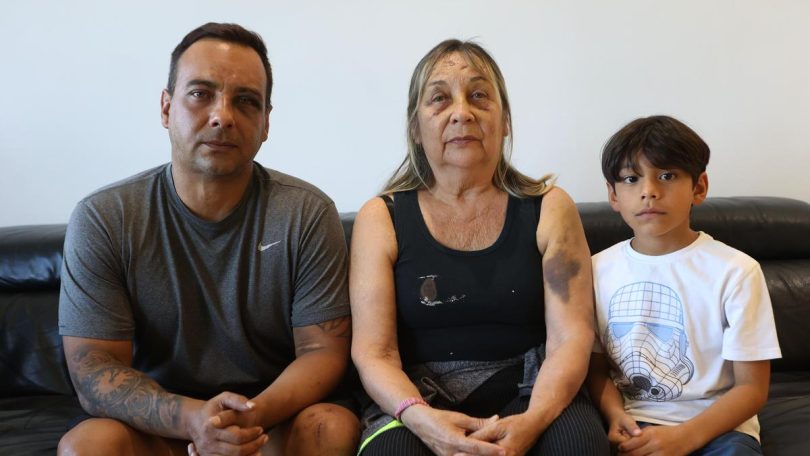
Venezuelan merchant Grian Serrano has survived two of the country’s worst natural disasters: the devastating 1999 mudslides that ravaged the coastal state of La Guaira and, 26 years later, two powerful earthquakes that struck the same region.
Bruised around his left eye and across much of his body, 46-year-old Mr. Serrano is recovering from the ordeal he endured with his son and mother.
The three were buried beneath rubble and twisted steel when their eight-story apartment building collapsed in the city of Caraballeda in La Guaira, the state hardest hit by the magnitude 7.2 and 7.5 earthquakes.
Venezuela’s twin earthquakes: Unprecedented struggles for survival amid crisis
These images provided by Vantor show the before and after of the earthquakes that struck on June 24, 2026, in Playa Grande, Venezuela. On the right are buildings as they appeared on June 15, 2026, and on the left are collapsed buildings from the day after the earthquakes, on Thursday, June 25, 2026. (Satellite image ©2026 Vantor via AP). Among the living, a humanitarian crisis is unfolding. United Nations agencies estimated on June 30, 2026, that the earthquake amassed 1.2 million tons of debris of destroyed buildings and belongings.

Damaged buildings stand in Catia La Mar, Venezuela, a day after an earthquake and several aftershocks struck the city on Thursday (June 25, 2026). With the window for finding survivors shrinking quickly, Venezuelans combed through the ruins of buildings toppled by last week’s powerful back-to-back earthquakes, and attention turned to the country’s humanitarian crisis, which could persist for years.

Patients lie outside a hospital evacuated after it was damaged in an earthquake in Catia La Mar, Venezuela on June 25, 2026. Meanwhile, the number of official rescues has dropped dramatically in the last three days, the government said, from 5,380 people saved in the first two days after the quakes to just four people found alive June 29, 2026, by authorities.

Rescue workers gesture for silence as they search for survivors in a building that collapsed after earthquakes struck Caracas, Venezuela, a day earlier on June 25, 2026. The prime window for finding earthquake survivors is typically 48 to 72 hours, but it is possible to survive longer depending on factors such as temperature and access to water or food.

People camp in the street the night after the earthquake struck Caracas, Venezuela on June 25, 2026. Without access to toilets, showers or soap, displaced Venezuelans have also become increasingly vulnerable to the outbreak of preventable diseases like measles, given the population’s low vaccination rates, World Health Organisation spokesperson Christian Lindmeier said.

U.S Marine Corps military aircraft on the tarmac as U.S. teams are deployed to support relief operations following earthquakes in Venezuela. Meanwhile, more than 100 people just deported from the United States were being held in a hotel when earthquakes struck Venezuela, setting off a scramble to find survivors and bodies buried in the rubble, according to survivors. The U.S. ran 12 deportation flights to Venezuela in May, operating three days a week, according to ICE Flight Monitor. Deportation flights to Venezuela resumed in February 2025 after a 13-month pause.

A satellite image shows an overview of El Junquito, Venezuela, June 26, 2026, in the aftermath of earthquakes. The government puts the death toll at over 1,900. Experts say that is a significant undercount as more bodies are hauled from the rubble every day and morgues struggle to handle the influx.

Indian Air Force C-17 Globemaster III aircraft arrives at Maiquetía International Airport, Caracas, carrying 66 tonnes of humanitarian aid- including an Indian Army Field Hospital, over 35 tonnes of relief supplies, medicines and medical equipment, and two BHISHM Cubes, for Venezuela as part of post-earthquake relief efforts on June 28, 2026.

U.S. and French search-and-rescue personnel work to reach earthquake survivors trapped in the rubble in La Guaira, Venezuela on June 28, 2026. Many of those displaced in the hardest-hit state of La Guaira, just outside the capital of Caracas along the coast, are suffering from widespread food shortages, WHO spokesperson Christian Lindmeier said.

Aerial view of collapsed buildings in Caraballeda, La Guaira state, Venezuela, on June 30, 2026, following earthquakes. An increased presence of nongovernmental organisations was noticeable on June 30 in La Guaira and adjacent communities, with tents from the Red Cross, the World Food Programme and other organisations set up on sidewalks, waterfront esplanades and athletic facilities.

Rescue workers react as they conduct search and rescue efforts to reach potential survivors on on June 30, 2026, after earthquakes struck La Guaira, Venezuela. According to the government, last week’s earthquakes damaged or otherwise compromised 38 hospitals nationwide. WHO said it so far has evaluated 21 of those facilities, three of which are no longer operating. Another six have sustained damage and the rest are now buckling under the influx of injuries.

Rescuers work at the site of a collapsed building, in the aftermath of earthquakes, in La Guaira, Venezuela on June 30, 2026. With the government tight-lipped about victims and survivors and offering no official count of missing people, ordinary Venezuelans are struggling to find relatives.

Yohancy Gil, 24 and her husband Sergio Guanipa, 30, stand on rubble as they wait for news from rescue teams looking for their children under the rubble at the site of a collapsed building in the aftermath of earthquakes, in La Guaira, Venezuela on June 30, 2026. Many have turned to WhatsApp groups and nongovernmental digital databases to report their loved ones as missing. One such registry listed at least 43,220 people as missing.

View of a damaged hotel at a beach in Caraballeda, La Guaira state, Venezuela, on June 30, 2026, following the June 24 twin earthquakes. In his daily televised casualty update, Jorge Rodríguez, brother of interim President Delcy Rodríguez, said that the official toll stood at 1,943 people killed and 10,571 injured as of June 30, 2026, urging the public to share only government information.

A U.S. Marines helicopter overflies a quake-hit area in Caraballeda, La Guaira state, Venezuela, on June 30, 2026, following the June 24 twin earthquakes. NASA estimates that nearly 59,000 buildings have been damaged or destroyed by the earthquakes, which would put the number of people affected by the quakes in the hundreds of thousands. The U.N. children’s agency, UNICEF, on June 30, 2026, said 6,80,000 children are in need of humanitarian assistance nationwide.
1/3
“It is a miracle from God,” Mr. Serrano said as he recalled how, in total darkness, he clawed through debris with his bare hands before rescuing his eight-year-old son and 69-year-old mother with the help of two passersby.
The two earthquakes have killed more than 1,700 people and injured more than 5,000, according to the government. Hundreds of buildings collapsed or were damaged, primarily in La Guaira. Significant damage was also reported in the capital, Caracas, and in the states of Carabobo, Miranda, Aragua and Yaracuy.
La Guaira — known as Vargas until 2019 — is Venezuela’s second-smallest state but one of its most strategically important. About 30 km north of Caracas, it is home to the country’s main international airport and second-largest seaport.

Its roughly 4,40,000 residents are largely low-income and depend on tourism, commerce and jobs tied to the airport and seaport.
Speaking from his brother’s home in Caracas, Mr. Serrano recalled the terror he felt last week, his thoughts inevitably returning to December 15, 1999, when he was jolted awake by the screams of their household employee, who had seen a nearby river overflow after days of heavy rain.
From his window, he watched the swollen river sweep away trees, massive boulders and vehicles with people trapped inside, banging on the windows and pleading for help.

Driven by instinct, Mr. Serrano fled his fourth-floor apartment with his mother, sister and nanny, climbing to the roof. From there, they watched floodwaters engulf the building’s lower floors as massive trees slammed into its columns, fearing it would collapse like others nearby.
Their fears eased at dawn as the rain stopped and the floodwaters began to recede. After waiting in vain for rescue, the family made their way through mud, rocks, debris and fallen trees to his grandparents’ home in a nearby neighbourhood.
The 1999 floods and landslides known as the “Vargas Tragedy” killed 782 people, another 2,000 were reported missing and about 2,50,000 residents were affected, according to Ángel Rangel, who led rescue operations as director of Venezuela’s Civil Protection agency.

Still shaken by the devastation left by the earthquakes, Mr. Serrano believes La Guaira — bordered by the Caribbean Sea and the Ávila mountain range — is under a curse.
“It isn’t normal for such horrible things to happen in the same place,” he said.
Mr. Rangel, a disaster specialist, sees it differently. The engineer said the buildings that collapsed in La Guaira were built on terrain formed over centuries by sediment carried down from the surrounding mountains.

“That type of terrain is particularly risky for construction,” Mr. Rangel said, adding that building in such areas requires “strict adherence to seismic-resistant engineering standards” adopted after the powerful 1967 earthquake that struck Caracas.
Many of the buildings that collapsed in La Guaira were built in the 1970s, and it remains unclear whether they met those standards.
After losing his home and all his belongings, Mr. Serrano said he does not know what comes next. But one thing is certain: He will never live in La Guaira again.

“That’s twice now,” he said. “Sometimes I think if there’s a third time, it’s going to win the battle.”
Published – July 01, 2026 04:46 pm IST