
DUBAI – Iran’s slain Supreme Leader Ayatollah Ali Khamenei was buried in the country’s holiest shrine, state media said early on July 10, after huge crowds gathered for his funeral with his son and successor Mojtaba Khamenei still hidden from public view.
The burial in Mashhad in north-east Iran follows a week of mass funeral processions, rallies and mourning ceremonies that has coincided with a renewed burst of conflict with the United States following weeks of truce in the four-month-old war.
It took place on the second day of attacks between Iran and the US, with Iranian officials reporting that US strikes killed 17 people and state media saying one targeted a railway line between Tehran and Mashhad, where Khamenei’s burial was held, forcing people to be transferred to buses.
Khamenei was killed in the first strikes of the war launched by the United States and Israel on Feb 28. The US and Iran agreed to a truce last month.
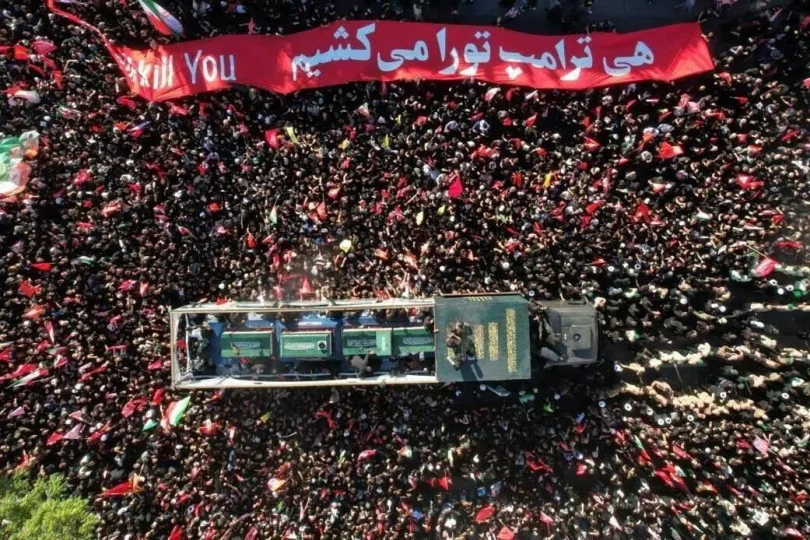
Khamenei’s body was carried slowly by truck on July 9 through the crammed Mashhad streets towards the gilt dome and minarets of the Shrine of Imam Reza as white-turbaned clerics walked on either side. Black-clad mourners pressed close behind, waving Iranian flags, photographs of the late Khamenei and red placards with revolutionary slogans.
Parliament speaker and chief negotiator in talks with the US, Mohammad Bagher Ghalibaf, powerful chief justice Gholamhossein Mohseni Ejei, and Khamenei’s eldest son Mostafa Khamenei were all present at the shrine, with some senior figures weeping over Khamenei’s coffin, state TV images showed.
The burial is the culmination of a week of funeral events in both Iran and Iraq that the Islamic Republic’s clerical leaders encouraged huge crowds to attend in an effort to display the might and ideological fervour of their theocratic state.
Despite having survived a months-long blitz by the United States and Israel, Iran faces huge internal challenges, and the legacy of Khamenei’s 37-year rule is bitterly disputed.
‘Kill Trump’ placards appear at burial ceremony
The whereabouts of Mojtaba Khamenei, proclaimed supreme leader by a clerical assembly in early March, a week after his father’s death, has remained a mystery to Iranians. He has not appeared in public since the war began. While he has made written statements, no image, video or voice recording of him has been issued.
He suffered debilitating injuries in the strike that killed his father, his face disfigured and limbs badly wounded.
Senior sources in Tehran have said he is recovering but that he has not yet been well enough to manage public appearances.
State security services are also trying to limit his exposure in case of more US attacks.
In a sign of the security tensions, at least one fighter jet escorted the plane carrying Khamenei’s coffin to its final burial in Mashhad, footage from the supreme leader’s website showed.
As crowds jostled in Mashhad awaiting Khamenei’s funeral cortege, the crowd chanted slogans demanding revenge on US President Donald Trump for his killing.
“I swear by the blood of the supreme leader, Trump, we will kill you!” they shouted, with women holding up placards reading “Kill Trump”.
Chants against the United States
The shrine’s courtyard was a mass of mourners as dusk fell, their defiant chants of “Death to America” ringing out above the lyrical funeral laments and string music broadcast by loudspeakers.
A helicopter lifted Khamenei’s coffin from the truck over the impenetrable crowd for the final short stretch to a blue-tiled arched recess at the shrine.
Khamenei’s oldest son, Mostafa, said the funeral prayer, and a throng of male mourners carried the coffin, painted in the red, white and green of Iran’s flag, inside the shrine.
Many of those gathered inside held candles, stretched their arms toward the coffin and wept, video showed.
The official IRNA news agency reported early on July 10 that the burials of Khamenei and four family members killed alongside him were completed.
Imam Reza was one of Shi’ite Islam’s holiest figures and the shrine complex in Mashhad, Khamenei’s hometown, is a centre for pilgrimage.
Khamenei’s remains were previously paraded through Tehran, the Shi’ite Muslim clerical centre of Qom and the Iraqi shrine cities of Najaf and Karbala.
At each event, huge crowds have thronged the streets to the mournful accompaniment of sung Shi’ite laments and chanted revolutionary slogans.
Martyrdom holds a central place in Shi’ite theology, and Khamenei’s death at the hands of foreign enemies has played into a religious and political tradition that runs deep through the Islamic Republic.
Khamenei’s long rule and disputed legacy
The funeral comes at a critical moment for Iran, closing nearly four decades of Khamenei’s rule and months after the latest round of mass nationwide protests against the Islamic Republic.
Security forces put down that unrest, sparked by anger over the sanctions-throttled economy, by killing thousands of demonstrators in a wave of repression that echoed other bouts of violence over recent years.
Analysts see Iran as having emerged from the war with the US strategically strengthened, with its grip over the vital Strait of Hormuz intact. But it has suffered widespread damage that has added to internal economic woes.
The late Khamenei was appointed supreme leader in 1989, a decade after the Islamic revolution, and over the decades he consolidated political, economic and military power in his office.
That effort, which increasingly marginalised the elected president and parliament, was conducted in concert with the Islamic Revolutionary Guard Corps that grew in influence throughout Khamenei’s rule.
Mojtaba Khamenei was appointed with the backing of the Guards, who are now seen as the dominant force in Iranian political and strategic thinking. REUTERS, AFP