
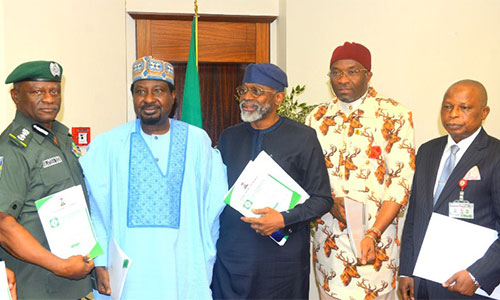
The Federal Government has moved significantly closer to establishing state police in Nigeria, with the Chief of Staff to the President, Hon. Femi Gbajabiamila, disclosing on Thursday that the constitutional amendment required to create the new policing structure could be introduced soon, following months of consultations among the Executive, the National Assembly, and security agencies that have now reached an advanced stage.
Gbajabiamila made the disclosure while briefing State House correspondents after a high-level consultative meeting on state police convened by the Presidency at the State House, Abuja. The meeting was attended by the Deputy President of the Senate, Senator Barau Jibrin; the Deputy Speaker of the House of Representatives, Benjamin Kalu; the Attorney General of the Federation and Minister of Justice, Prince Lateef Fagbemi, SAN; and the Inspector-General of Police, Kayode Egbetokun, among other senior government and security officials.
The Chief of Staff said deliberations on the proposed state police framework began three to four months ago on the directive of President Bola Ahmed Tinubu, and that the process has since gained considerable momentum.
Gbajabiamila acknowledged the complexity of the reform, noting that establishing state police involves critical constitutional and legal considerations that cannot be rushed.
“We started deliberations in the last three or four months on how to go about the establishment of state police as directed by Mr President. Establishing state police is not something that you do with the snap of the fingers. There is a lot involved in terms of constitution and legalities, and thank God we have now gained a lot of traction,” Gbajabiamila stated.
He expressed optimism that the amendment would be presented in the near term: “Hopefully, the amendment will come shortly, and the details of the amendment will come after that.”
Gbajabiamila explained that discussions have now advanced to the point where the specific constitutional amendments needed to create the legal foundation for state police are being finalised. The enabling legislation, which would provide the detailed operational framework for the new policing structure, would be enacted after the constitutional amendment is passed.
“Right now, what we are looking at is the constitutional amendment itself, and then the enabling law would follow thereafter. That is what we have been deliberating on in the last couple of hours,” the Chief of Staff stated.
Under Nigeria’s current constitutional framework, policing is on the Exclusive Legislative List, meaning only the Federal Government has the power to establish and maintain police forces. The creation of state police therefore requires a constitutional amendment, which must be passed by two-thirds of both chambers of the National Assembly and ratified by at least two-thirds of the 36 state Houses of Assembly.
Gbajabiamila highlighted what he described as broad national consensus on the need for state police, stating that the conversation has moved beyond whether Nigeria should adopt decentralised policing to how the system should be structured.
“The debate is no longer about whether state police should be established but about creating the appropriate legal and institutional framework for its operation,” the Chief of Staff stated.
He identified several key issues that the consultations have been examining, including oversight mechanisms to prevent abuse, accountability structures to ensure transparency, funding arrangements to guarantee sustainability, and operational frameworks to ensure effectiveness.
These concerns have historically been at the centre of opposition to state police. Critics have warned that state governors could weaponise state police forces against political opponents, that many states lack the financial resources to fund a professional police force, and that the absence of strong accountability mechanisms could lead to human rights abuses. The Presidency’s acknowledgment that these concerns are being actively addressed in the framework design suggests an effort to build the broadest possible coalition of support for the amendment.
Gbajabiamila disclosed that President Tinubu, who has consistently advocated for state police as a fundamental component of Nigeria’s security reform agenda, would receive a comprehensive report on the outcome of the consultative meeting.
The President’s advocacy for state police predates his presidency. As Governor of Lagos State, Tinubu was at the forefront of efforts to establish state-level policing, including the creation of neighbourhood safety corps and other sub-national security initiatives. His support for decentralised policing was also a feature of his 2023 presidential campaign platform.
Since assuming office, Tinubu has repeatedly maintained that state police represents a necessary response to Nigeria’s evolving security challenges, arguing that a decentralised policing structure would strengthen grassroots security, improve intelligence gathering at the local level, and enhance the capacity of state governments to protect lives and property within their jurisdictions.
The push for state police comes against the backdrop of one of the most challenging security periods in Nigeria’s recent history. The mass abduction of pupils and teachers from schools in Oyo and Borno states, which has prompted nationwide protests, Senate condemnation, and a federal government delegation to the affected communities, has renewed calls for fundamental reforms to Nigeria’s security architecture.
The Nigeria Police Force, with approximately 370,000 officers serving a population of over 220 million, has been widely criticised as overstretched, underfunded, and unable to provide adequate security across the country’s vast territory. Advocates of state police argue that decentralised policing would address these challenges by allowing state governments to recruit, train, and deploy police officers who are familiar with local terrain, languages, and security dynamics.
The call for state police has also been reinforced by the House of Representatives, where lawmakers representing constituencies affected by the Oyo abductions demanded the urgent decentralisation of policing, and by the Lagos State House of Assembly, whose Speaker Mudashiru Obasa reiterated the Assembly’s long-standing support for state policing during teacher protests over the school abductions.
The pathway from the current consultative stage to the actual establishment of state police involves several critical steps, each carrying its own political and procedural challenges.
SEE Full Details ➜