
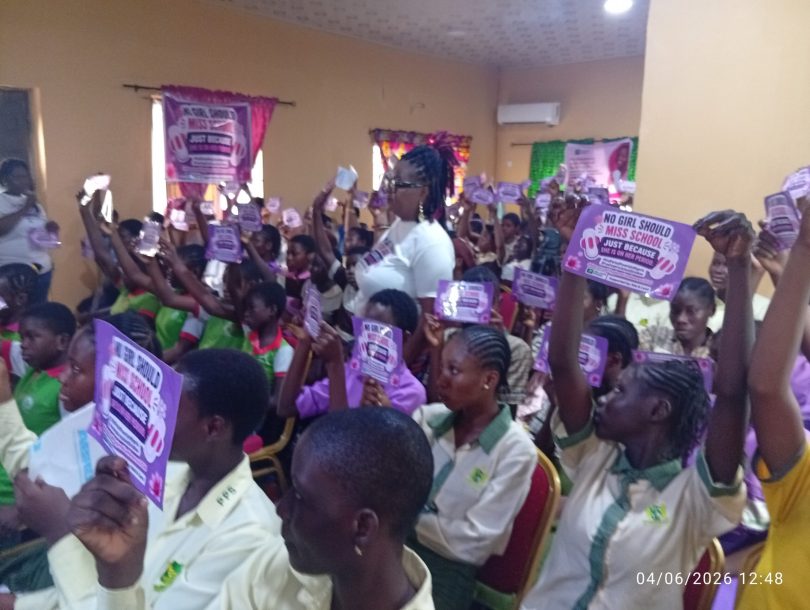
The Centre for Children’s Health Education, Orientation and Protection (CEE-HOPE) on Thursday called on federal and state governments to provide free sanitary pads to schoolgirls and invest in school water and sanitation facilities to end period poverty in Nigeria.
Speaking at CEE-HOPE’s 2026 menstrual hygiene management conference attended by many students from public and private schools in Lagos, teachers, child protection experts and women advocates, founder and executive director Betty Abah said menstrual hygiene must be treated as an education, gender equality and human rights issue, not just a health concern.
“Period poverty is not merely about the inability to buy sanitary pads. It is about period dignity, period equity and menstrual justice,” Abah told participants.
“It is about whether a girl can remain confident in the classroom and pursue her dreams without interruption because of a natural biological process,” she added.
Abah cited data showing about 37 million women and girls in Nigeria lack access to or cannot afford menstrual products. She said studies indicate 67% of women and girls have used unsafe alternatives such as cloth or tissue, and that up to 1 in 10 girls miss school during menstruation, especially in low-income and rural communities.
The CEE-HOPE founder said the NGO has documented cases in Makoko (Lagos); Kurudu (Abuja); and Otukpo (Benue), where girls’ education, confidence and health were affected due to lack of menstrual products.
“At CEE-HOPE, we have encountered girls whose education, confidence and health are affected simply because they cannot afford menstrual products,” Abah said. “Their experiences remind us that period poverty is not an abstract concept; it is a daily reality for many Nigerian girls.”
She welcomed Nigeria’s National Policy on Menstrual Health and Hygiene Management but said “a policy must be more than a document.” Abah urged governments at all levels to:
1. Provide free sanitary pads to schoolgirls, especially from low-income households
2. Remove or reduce taxes and tariffs on menstrual products
3. Invest in functional water, sanitation and hygiene facilities in schools
4. Support menstrual health education and awareness programs
5. Establish accountability mechanisms for policy implementation
Abah pointed to Kenya, Scotland and New Zealand as examples where government investment in menstrual health improved school attendance and educational outcomes for girls. “Because no girl should have to choose between her education and her period,” she said.
The CEE-HOPE founder provided free sanitary pads and bags to all the students who attended the conference.
Other speakers included Amurawaiye Adedoyin, a registered nurse who addressed myths and misconceptions about menstruation; Aderonke Oyelakin, coordinator of the Child Protection Network in Lagos; Rhoda Olorunfemi, founder of Rhoda Serene Care Foundation; Ololade Ajayi, executive director of DOHS Cares Foundation; and Willie Workman, founder of Kreative Arts Foundation for Community Engagement.
SEE Full Details ➜