
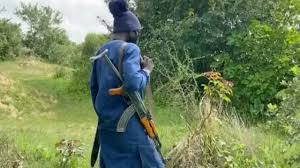
Security
Apart from the loss of thousands of lives of Nigerians as a result of rising insecurity in the country, there are huge economic losses involved too. So there is need for comprehensive efforts to restore peace, encourage investment and revive economic activities that will alleviate the widespread poverty and food insecurity exacerbated by the current state of insecurity in the country.
By Goddy IKeh
MANY Nigerians are daily reacting to the rising insecurity in the country with frequent reports of kidnapping and killing of Nigerians by the bandits across the country.
There is hardly a week without two or three new cases of invasion of schools and villages by bandits and taking of students, teachers and several citizens hostage. There is also a recent report of a retired Army Major General, who was kidnapped with his wife in Katsina state by the bandits, while more than 30 students, pupils and teachers kidnapped in Oyo State by the bandits have already spent over two weeks in captivity, while one of the teachers had been beheaded.
Nigerians are daily taking to the social media to express their anger over the worsening security crisis in the country and the failure of the federal government to successfully check the menace, rather the federal government and the political parties are busy engaging in political activities, including organizing various conventions and selection of the aspirants for the 2027 presidential and general elections.
Speaking recently on the security crisis in the country, former Nigerian President, Olusegun Obasanjo, criticized President Bola Tinubu’s administration for the worsening insecurity, mass killings and kidnappings across the country, declaring that any government that fails to safeguard the lives and property of its citizens has lost its legitimacy and right to exist.
Obasanjo said that the administration lacked the will and capacity to tackle insecurity despite possessing advanced technological tools (like drones) to track and neutralize the criminals.
He questioned why the administration relies on apologies and negotiations rather than decisive actions to eliminate the terrorists and bandits. Obasanjo expressed frustration that the current security collapse has left everyday citizens vulnerable, asserting that if the Nigerian government remains incapable of protecting its people, Nigerians have a legitimate right to seek international assistance.
According to local media reports, Obasanjo condemned the attempts in some quarters to blame the violence on religious or tribal considerations, emphasizing that “Nigerians are being killed” regardless of their faith or region and that every life matters.
In its reaction to the security crisis, the Socio-Economic Rights and Accountability Project, SERAP, introduced a different dimension to it by urging the United Nations Secretary-General António Guterres “to urgently invoke Article 99 of the UN Charter and bring Nigeria’s escalating insecurity, which is marked by mass abductions, killings, attacks on civilians, mass displacement, and other grave human rights violations, to the attention of the UN Security Council.”
In a statement in Lagos, SERAP said: “Nigeria’s escalating insecurity and grave human rights violations are reflected in repeated abductions, killings, attacks on civilians, and mass displacement in Oyo, Benue, Borno, Plateau, Kaduna, Zamfara, and several other parts of the country.”
In the open letter dated 30 May 2026 and signed by SERAP deputy director Kolawole Oluwadare, the organisation said:
“The scale, persistence, and regional implications of the insecurity and grave human rights crisis in Nigeria pose a threat to international peace and security and risk aggravating existing threats in the region.”
“Article 99 of the UN Charter is designed precisely for situations in which emerging or ongoing crises require urgent preventive diplomacy, sustained international scrutiny, and coordinated international action,” SERAP said.
“Several years of violence and conflicts in several states have created appalling human suffering, physical destruction and collective trauma across Nigeria. Our appeal is grounded in the preventive mandate of the UN Charter and the urgent need to address a rapidly deteriorating situation in the country,” it added.
SERAP therefore urges António Guterres to exercise his authority under Article 99 and bring the situation in Nigeria to the attention of the Security Council without delay, encourage regular and public Security Council briefings on insecurity, abductions, and humanitarian consequences in Nigeria.
It requested for systematic reporting by relevant UN bodies on attacks, displacement, and humanitarian impacts, while calling on Nigerian authorities to take urgent measures to prevent attacks, protect civilians, and secure the release of abducted persons.
SERAP also called for prompt, independent and effective investigations into all incidents and ensure accountability for perpetrators and enablers, while publicly calling on the Nigerian authorities to uphold their human rights obligations and strengthen civilian protection measures.
It also called for support to measures to end impunity and ensure remedies and reparations for victims and affected communities, while encouraging the international community to use all available influence to prevent further escalation and protect people’s lives.
Meanwhile, the minister of defence, Gen. Christopher Musa has said that every Nigerian must rise to fight insecurity in the country, describing insecurity as Nigeria’s challenge which must be addressed by all.
Speaking in an exclusive interview with Arise TV, he stressed the need for stronger collaboration between the federal government, states, and local governments in tackling insecurity, particularly along the nation’s borders.
He noted that while the federal government has continued to provide states with more funds than ever before, the effectiveness of security measures depends largely on grassroots action. Musa explained that crime is fundamentally a local issue, and as such, local governments must play a more active role in addressing it.
Highlighting the importance of partnerships with multinational joint task forces to strengthen border control and prevent cross-border crimes, Musa reiterated that without functional local governments, national security efforts will remain incomplete.
“Border security is one issue we have to look at, and for us, we need the states to partner with the federal government. The federal government is doing its best, states are getting their funds as required, more than they ever had.
“We need to have our local governments work because there are steps that we need to take to address these issues. Our local governments must be up and doing because crime is local. If local governments are working, they’ll be able to tackle these things within their own area before it gets to the state, before it gets to the federal. So I think it’s a whole society approach to security.
Describing insecurity as a Nigerian challenge, he said all Nigerians must put hands together to fight it.
He argued, “Our Armed Forces and security agencies have intensified operations against terrorists, bandits, kidnappers, oil thieves, and criminal networks.
“While challenges remain, many communities and highways are becoming safer and more economically active.
“I want to assure you that this government will not relent until every Nigerian can live, work, travel, and dream in safety.”
Writing on the effects of security challenges on the Nigerian economy, Ibukunolu James of BudgIT noted that Nigeria grapples with several security challenges that directly impact its economy, ranging from insurgency to conflicts between farmers and herders to organized crime looting and abduction for ransom.
According to him, these security threats not only undermine national stability and the rule of law, but also have adverse effects on the economy, affecting price, output, employment, trade balance, poverty, inequality, defense expenditure, government budget patterns, socio-political environment, and several others.
The impact of banditry on the economy is multifaceted and deeply concerning. Addressing the security situation is imperative, not only for the population’s safety but also for the economic stability and development of the country.
Although the Nigerian government’s approach to combating terrorism has varied, given the complexity of the security situation in Nigeria, communities’ resilience against terrorism and enhanced cooperation between law enforcement agencies should be built into projects and programs designed to combat insecurity along with economic, political, and social tensions.
To tackle insecurity comprehensively, it is essential to establish an efficient network of intelligence gathering and analysis in Nigeria. An intelligence hub should be set up in this network to coordinate efforts between the various government agencies, support interagency collaboration, engage information-gathering communities, use technology for surveillance and data analysis, invest in human intelligence agents, strengthen international cooperation, and develop risk assessment frameworks to ensure accountability and oversight.
The absence of government and security infrastructure in numerous parts of Nigeria constitutes a pressing issue. As a result, residents are at the mercy of any criminal element that rises above them. Prioritizing the establishment of robust security measures in rural areas is crucial to safeguarding communities against potential risks.
Keeping in mind that most security threats are within the hinterlands, the government should establish, empower, and fund community policing initiatives and engender partnerships between law enforcement agencies and citizens to engage local communities in security efforts. Community members can provide useful information, help prevent crime, and identify and arrest offenders who operate within their territories.
Comprehensive efforts are needed to restore peace, encourage investment, and revive economic activities that will alleviate the widespread poverty and food insecurity exacerbated by the current state of insecurity.
It is therefore recommended that the government must reduce the level of unemployment in Nigeria, as political instability is encouraged by the high level of unemployment. Many graduates possess the necessary skills and education to contribute to economic growth but are unemployed.
Strengthening prosecution and legal actions to ensure perpetrators of offenses such as terrorism, insurgency, banditry, or kidnapping are swiftly apprehended, prosecuted, and held to account under the law. There is a need to look into the consequence management of banditry and terrorism in Nigeria. To speed up trials and secure convictions, this calls for strengthening the capacities of law enforcement agencies, improving their investigative techniques, and working more closely with judicial authorities.
Also important is addressing the root causes of insecurity. Economic inclusion, job creation, and education are critical to reducing the pool of vulnerable individuals who may be drawn into criminal or extremist activities. Development must reach underserved regions, closing the gaps that often breed unrest.
Diplomatically, Nigeria must actively engage with international partners to correct exaggerated perceptions while acknowledging real challenges. Transparency and visible progress can help rebuild trust and gradually shift global narratives.
For investors, consistency is key. Policy stability, regulatory clarity, and visible improvements in security will do more to restore confidence than talks alone. Nigeria’s market fundamentals (its population, entrepreneurial energy, and resource base) remain strong. But these advantages cannot compensate indefinitely for insecurity.
Concluding, he stated that the choice before the nation is clear and that a nation that cannot guarantee safety will struggle to attract investment, no matter how attractive its economic policies may be. “Equally, a nation that restores order and builds trust can unlock immense opportunities,” he added.
A.I
June 2, 2026
Tags: Kolawole Oluwadare Olusegun Obasanjo SERAP