
Business
By Anthony Isibor
THE Nigerian Communications Commission, NCC, has commenced a review of Mobile Termination Rates, MTR, citing significant changes in the telecommunications industry and broader economic environment since the last determination was conducted in 2018.
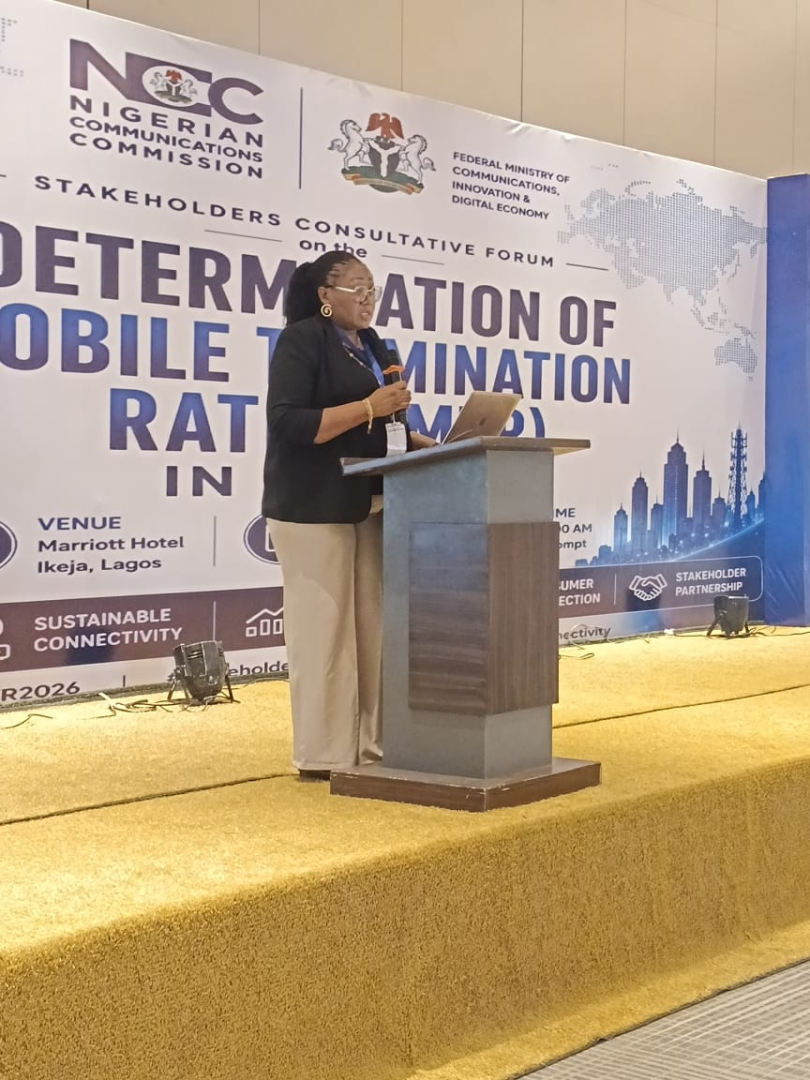
Speaking at a stakeholders’ consultative forum on the determination of Mobile Termination Rates in Nigeria, Nkechi Araka, Assistant Director, Policy Competition and Economic Analysis stated that the exercise was designed to assess whether the current regulatory framework still reflects realities in the country’s rapidly evolving communications market.
According to her, developments in the sector over the past eight years have transformed the operating environment for telecommunications companies.
She identified the rollout of 5G services, the growing influence of over-the-top, OTT, service providers, the emergence of Mobile Virtual Network Operators, MVNOs, changing consumer expectations and worsening macroeconomic conditions as key factors driving the review.
Araka noted that fluctuations in exchange rates and rising inflation have significantly altered operators’ cost structures since the last MTR determination.
“The communications market has changed significantly since we did the last determination in 2018. Consumer demand has also evolved, with subscribers expecting affordable, high-quality and always-available connectivity,” she said.
She explained that Mobile Termination Rates remain a critical component of the telecommunications ecosystem because they influence how networks interconnect, the charges operators pay one another, and ultimately the prices consumers pay for services.
According to Araka, MTR also affects competition, investment decisions and the overall quality of service delivery in the sector.
“A cost-based mobile termination rate supports a level playing field by ensuring that no operator gains an unfair advantage through interconnection arrangements. It also promotes investment by ensuring that operators can recover efficient costs associated with providing termination services,” she said.
The NCC official described the delay in reviewing the rates as unusual, noting that previous reviews were typically conducted every three to four years.
She said the prolonged gap between the 2018 determination and the current review made it increasingly difficult for existing rates to accurately reflect the actual costs of providing telecommunications services.
“The commission believes now is the appropriate time to undertake this review because the current framework may no longer accurately reflect underlying costs and market realities,” she added.
Araka said the review is anchored on provisions of the Nigerian Communications Act 2003, particularly Sections 96, 97 and 108, which empower the Commission to regulate interconnection arrangements and ensure charges remain fair, reasonable, cost-oriented and non-discriminatory.
She outlined five key objectives of the study, including assessing the impact of the current interconnection regime, developing an updated regulatory framework for wholesale and retail pricing, determining cost-reflective mobile termination rates, reviewing the existing asymmetry regime and establishing an appropriate international termination rate for inbound international traffic.
The study will also examine voice and SMS termination rates, USSD services, interconnection arrangements involving Mobile Virtual Network Operators and retail pricing controls.
Providing a historical overview of interconnection regulation in Nigeria, Araka said the NCC introduced its first interconnection determination in 2003, followed by reviews in 2006 and 2009 when an asymmetric regime was introduced.
She noted that the 2018 determination established a uniform mobile termination rate of N3.90 per minute, while subsequent adjustments created separate rates for new entrants. Although international termination rates were reviewed in 2022, she said the mobile termination rate itself remained unchanged.
Araka explained that the expected outcome of the exercise is a transparent, evidence-based and cost-reflective framework developed through extensive stakeholder engagement.
For consumers, she stated that the review should support affordable and sustainable service delivery, while for operators, it is expected to provide regulatory certainty and a framework that better reflects prevailing market conditions.
She added that the review would also promote fair competition, encourage market entry by new players and provide predictable signals for continued investment in telecommunications infrastructure and innovation.
According to her, the process will involve stakeholder consultations, data collection from operators, publication of interim findings for industry feedback and the eventual development of a proposed new regulatory framework for mobile termination rates in Nigeria.
A.I
June 16, 2026
Tags: NCC Nigerian Communications Commission Nkechi Araka