
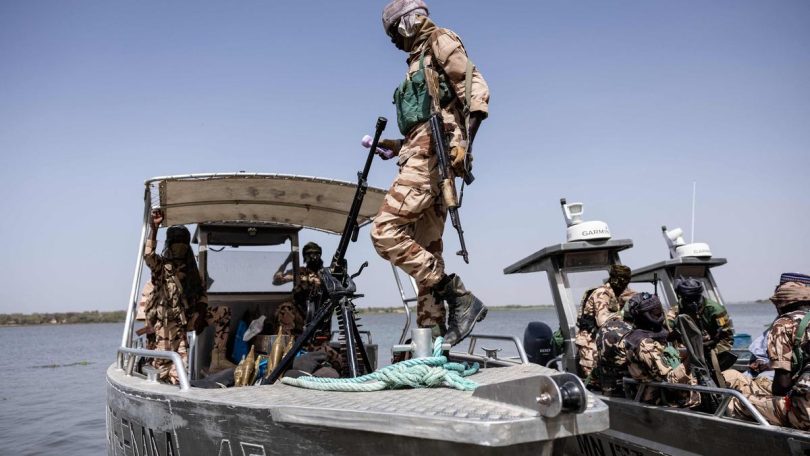
A joint operation by Nigerian forces and U.S. African Command that killed 175 Islamic militants has drawn attention to the complex security situation in Lake Chad basin. The operation has renewed the focus on Islamic State West Africa Province (ISWAP), which has steadily eclipsed Boko Haram to become the most powerful jihadist organisation operating in the basin.
In recent months, Washington has expanded military and intelligence support to Nigeria as part of broader efforts to counter Islamic State affiliates operating across West Africa.
The strikes carried out on May 16 and 18 killed Abu-Bilal al-Minuki, a senior ISIS-linked commander associated with ISWAP — the Islamic State’s affiliate in West Africa. They also destroyed checkpoints and weapons used by the group, dealing a temporary setback to its operations. Abu al-Minuki was killed along with his lieutenants on his compound in a helicopter-borne assault.
He was a key figure in providing guidance for facilitating ISIL- linked operations across the Lake Chad basin. He was part of the Boko Haram group until the splinter and joined ISWAP which pledged alliance to ISIS. Abu al-Minuki was described by U.S. President Donald Trump as the “second in command of ISIS globally” and “the most active terrorist in the world”.
ISWAP traces its origin to Boko Haram, popularly translated as Western education is forbidden, a militant Islamic movement that emerged in the early 2000s in northeastern Nigeria under the leadership of Mohammad Yusuf. The movement’s primary objective was to establish an Islamist regime and oppose western education and democracy.
Following the death of Mohammed Yusuf in the wake of clashes between Boko Haram and Nigerian forces in 2009, Abubakar Shekau assumed leadership. Under his leadership, the network’s operational capabilities expanded, frequently attacking security and police forces. It subsequently evolved into a violent insurgent movement.
It was the 2014 Chibok incident where 276 school girls were abducted that brought global attention to the insurgency. The U.S. State Department designated Boko Haram as a foreign terrorist organisation.
Deep fissures develop
Differences over ideological and strategic matters intensified divisions within the network, despite its growing influence.
Increasing disagreements over Shekau’s leadership led to many commanders breaking away to form Ansaru, a new jihadist faction closely linked to the al-Qaeda. The organisation under Shekau’s leadership not only sanctioned attacks against the Nigerian state and Christians but also against state-aligned Muslims.
Shekau was accused of ignoring the organisation’s consultative structure and making decisions independently, drawing criticism from senior commanders.
Divisions deepened within the group as Boko Haram pledged loyalty to the Islamic state in 2015.
The ISIS was concerned about the faction’s conduct under Shekau, particularly his violence against Muslims and use of women and children in suicide bombing. According to the UNICEF, between 2014 and 2016, nearly 20% of Boko Haram’s suicide bombers were children, three quarters of whom were girls.
Amid growing disagreements, ISIS appointed Abu Musab-Al-Barnawi as the head of its West African affiliate, sidelining Shekau. This decision led to a split within Boko Haram.
This split was a major turning point, as it introduced another armed group — ISWAP — which aligned with ISIS in the Lake Chad region, while Shekau’s faction remained Boko Haram.
ISWAP and Boko Haram differed in their operational conduct, despite sharing jihadist roots and the objective of establishing governments based on Islamic law. ISWAP presented itself as more focused on military and state forces and restrained towards Muslim civilians than Boko Haram under Shekau.
Stronger structure
Unlike Boko Haram under Shekau, ISWAP developed a more structured command system and a stronger territorial presence. It relies on the consultative structure (shura) supported by regional commanders rather than centring authority on a single leader. By taxing residents and economic activities including fishing and farming zones, the group developed a structured revenue system around the Lake Chad basin rather than depending on looting and kidnappings like Boko Haram. The group has exploited the region’s fragile socio-economic conditions and weak governance, to recruit members from local communities.
ISWAP’s organisational structure, established revenue system and influence over communities marginalised by the states helped it emerge as a dominant jihadist force. Ideological legitimacy and strategic guidance by ISIS has also benefited the network’s operation.
ISWAP does not operate in Nigeria alone, but has a significant presence in neighbouring states, resulting in a regional security challenge. Porous borders, weak governance and gaps in intelligence sharing among affected states have contributed to its growing influence in the basin. Military operations face challenges due to porous borders around the Lake Chad basin which facilitates the movement of fighters and weapons across national borders.
In response Nigeria, Niger, Chad, Cameroon and Benin have formed the Multinational Joint Task Force to coordinate counter-terrorism efforts.
Rivalry within the jihadist movement has also shaped the conflict.
Frequent clashes between ISWAP and Shekau’s Boko Haram faction reflected a broader struggle for territory, recruits and influence across the basin.
Weakening of Boko Haram, following the death of Shekau in 2021 during these clashes, consolidated ISWAP’s position as the dominant jihadist force in the region. ISWAP commanders perceive the basin as a region shaped by weak borders, limited state presence and long-standing socio-economic challenges. They leveraged the porous borders between Nigeria, Niger, Chad and Cameroon as well as gaps in regional security cooperation to operate across national boundaries.
To overcome its conventional military disadvantages, ISWAP fights asymmetrically through ambushes, improvised explosive devices and influence over communities marginalised by the state. Still, ISWAP’s expansion has transformed what began as a localised insurgency in Nigeria into one of Africa’s most resilient transnational security challenges.
Published – June 05, 2026 05:10 am IST