
KYIV – Ukraine and its allies are increasingly confident that Russia’s invasion is running out of steam as Kyiv stabilises the frontline and stalls a spring offensive by Moscow.
Ukraine’s growing effectiveness at deploying drones to inflict heavy Russian troop losses is being matched by strikes behind the frontlines and deep inside Russia that are stoking increasing domestic criticism of President Vladimir Putin.
Alongside an economic slowdown and restrictions on the internet, that’s leading to a deepening war fatigue among ordinary Russians.
The nervous mood is shared by many in Russia’s elite, with some senior Kremlin officials believing the conflict has reached a dead end with no clear way to resolve it, people familiar with situation said.
Mr Putin wants to conclude the war by the end of 2026, but only on what he sees as victorious terms, including full control over the eastern Ukrainian Donbas region that his forces have failed to capture for more than a decade, according to one of the people, while also seeking a broader security agreement with Europe that would effectively acknowledge Moscow’s territorial gains.
Kremlin spokesman Dmitry Peskov denied that Mr Putin had set any such deadline.
“Ukraine is putting up a strong defence,” NATO Secretary-General Mark Rutte said after a meeting of the military alliance’s foreign ministers in Helsingborg, Sweden, on May 22.
“If you look at the frontline at the moment, it is stabilising.”
Ukraine is even regaining territory “in net terms,” he said.
This change of dynamics is also impacting investors, who are increasingly upbeat about Ukraine’s ability to pay back the massive foreign debt it took on before the war and restructured during the conflict.
The country’s dollar bonds maturing in 2029 jumped to a record high of 84 cents on the dollar on May 22, up from as low as 70 cents in March.
Kyiv on May 21 announced a major security buildup in the north of the country after President Volodymyr Zelensky warned about the risk of a potential Russian offensive from Bryansk region and Belarus, mirroring a failed attempt to seize Kyiv in the first weeks of the full-scale invasion.
Even as Ukraine is bracing for an additional Russian push this summer, warning that the Kremlin could resort to another unpopular conscription campaign to bolster the offensive, its forces have mostly held the line since fighting picked up after a winter lull.
They stabilised much of the front by mid-May, according to data from DeepState, a conflict mapping service that cooperates with Ukraine’s Defence Ministry.
Kyiv has also significantly improved its casualty ratio to roughly one Ukrainian soldier for every five Russian troops, Finnish President Alexander Stubb said in April.
US Secretary of State Marco Rubio repeated that assessment in a Prime Times interview May 13, saying Ukraine now had Europe’s “most powerful armed forces.”
Drones deployed in growing numbers by Ukraine have become a game changer in the war, helping to offset a manpower disadvantage that’s dogged Kyiv since Russia’s full-scale invasion began more than four years ago.
Still, Kyiv has also failed to achieve its strategic goals, neither reclaiming most of the territory Russia is occupying nor moving closer to an acceptable peace deal in US-led negotiations that are currently stalled.
Defence Minister Mykhailo Fedorov told reporters earlier this week Ukraine has significantly “slowed the enemy’s advance and is gradually regaining the initiative.”
About 35,203 Russian soldiers were killed or severely wounded in April and the goal is “to inflict at least 200 enemy losses for every square kilometre of advance,” he said.
The figures couldn’t be independently verified.
The minister has previously said that 50,000 Russian casualties a month would make the war unsustainable for Moscow.
“Together with the President and the diplomatic team, we explain to our partners that Ukraine is doing its homework,” Mr Fedorov told Bloomberg News.
“What matters now is for our partners to do their part and help scale up what is already proving effective today.”
Over the weekend, Kyiv launched one of its heaviest attacks on Moscow and the surrounding region since the start of the war, with many Russians now directly blaming Mr Putin for bringing the conflict to their doorsteps.
Russia has conducted massive recent drone and missile strikes in an attempt to break Ukrainian morale.
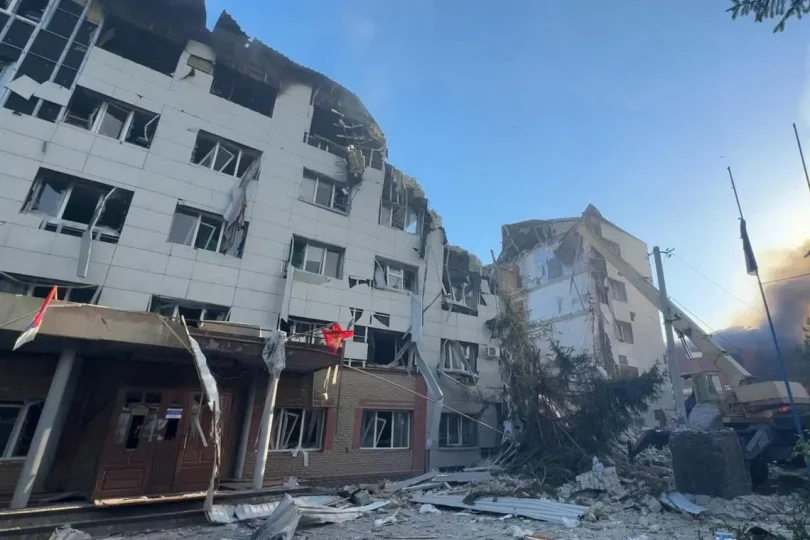
The United Nations reported that the death toll among civilians rose in April to the highest since July 2025.
Several European diplomats – speaking on condition of anonymity – said they regarded the mood in Russia as gloomy with the battlefield at a stalemate and Kyiv’s drone strikes taking the war to Moscow.
Even so, Ukraine’s newfound confidence on the battlefield also faces mounting domestic challenges.
The war-weary population is increasingly unwilling to join the army and broader conscription is also deeply unpopular.
To address that, Mr Fedorov is preparing reforms that will increase pay for soldiers – particularly much-needed infantry – and attract fresh recruits, as well as improve the efficiency of troop deployment and expand drone use.
Though increasingly adept at intercepting drones, Ukraine’s air defences continue to struggle against ballistic missiles that decimated its energy infrastructure during the brutally cold winter.
Kyiv has repeatedly complained about growing difficulties in securing ammunition for US-made Patriot missile systems that have proved to be the only really effective weapon against ballistic missiles.
“Russia is facing setbacks on the battlefield,” said Mr Nigel Gould-Davies, senior fellow for Russia and Eurasia at the International Institute for Strategic Studies in London.
“In order to sustain its war efforts in Ukraine, the Kremlin will almost certainly have to impose a second partial mobilisation” within the next 12 months, he said. BLOOMBERG