
Defence
By Lengnan Tobias, News Agency of Nigeria (NAN)
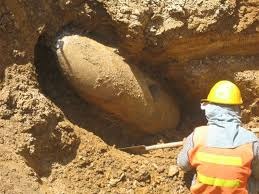
FIFTY-six years after the Nigerian Civil War, more than 1,600 live bombs recovered from old battlefields remain in storage, posing a constant threat to communities in the southeast and beyond.
Also known as the Biafran War, the Nigerian Civil War was a devastating conflict fought between the Federal Government of Nigeria and the secessionist state of Biafra, which proclaimed its independence in 1967.
Prof. Bala Yakubu, a bomb disposal expert, warns of the inherent dangers of unexploded bombs while speaking to the News Agency of Nigeria (NAN).
“We have 1,600 active bombs from the Biafra war in the country. Any one of them can explode, and if it does, others nearby can detonate in what we call ‘sympathy flight’.”
According to him, explosive remnants of war last longer than humans.
“That is why they are a direct threat to people in these areas.”
Yakubu urged the Federal Government to immediately evacuate or destroy the ordnance currently stored at the Mine Action Centre in Owerri, Imo.
The weapons were recovered from former battlefields in the South-East, South-South, and parts of North-Central Nigeria since 2015.
His company, Deminers Concept, was engaged by the late President Umaru Musa Yar’Adua’s administration to clear farmlands in the former battlefields 30 years after the war ended.
He said within that period, 150 people were killed and over 750 others injured.
The team removed explosives across Anambra, Enugu, Abia, Akwa Ibom, Cross River, Rivers, Delta, and parts of Benue.
“After clearing them, we did not destroy them because there was no commitment from the previous government.”
“We wrote to successive administrations after Yar’Adua, but got no response.”
The danger became clear in 2022 when one of the stored mortar bombs exploded, causing civilian casualties.
Yakubu said the incident showed the urgent need for action to end the risk to residents.
Since 2009, Deminers Concept has cleared 17,632 remnants of locally fabricated weapons, including “Ogbunigwe” and “Ojukwu buckets,” from old battlefields.
The team also destroyed 685 landmines, 682 anti-personnel and 143 anti-vehicles during operations from 2009 to 2012.
“These landmines are rusty and old, but they are still lethal.
“Under the convention Nigeria signed, they must be cleared.”
He said less than 15 per cent of contaminated sites in Imo remain to be cleared.
“If the government provides funding, we will mobilise and finish the remaining work.
“What is left includes removing destroyed armored vehicles and Biafran ‘Red Devil’ tanks, which are meant to be donated to the Army Museum.”
More so, he said vegetation is the biggest obstacle.
Unlike the semi-Sahel terrain in Benue where work started, the South-East and South-South have heavy year-round rainfall and rapid overgrowth that makes detection difficult.
“Our equipment locates where a bomb is, but not how deep it lies.
“We have to cut through thick grass to see the bomb physically before we can remove it.
“We have stopped demining for about five years now; so, we also need to upgrade our equipment.”
Funding remains a major hurdle. The former war zone spans over 270,000 square kilometers, with about 69,000 square kilometers in Anambra, Imo, and Abia alone confirmed contaminated. At $20 per square meter, the cost would run into billions.
“Getting transport to these hinterlands is tough. Sometimes we park cars five or six kilometers away and trek to remove bombs.
“The communities are accommodating and some governors are helping, but federal support has not come,” he said.
But Nigeria is not alone; a recent report by Wikipedia stated that 78 countries are contaminated by land mines, which kill or maim 15,000–20,000 people every year.
“Approximately 80 per cent of casualties are civilian, with children being the most affected age group.
“On average, 50 per cent of blast victims die within hours.”
In recent years, mines have been increasingly used as weapons of terror, particularly against local populations in conflicts like the Syrian Civil War.
In addition to the obvious danger of explosion, the report said buried unexploded ordnance (UXO) can cause environmental contamination.
“In some heavily used military training areas, munitions-related chemicals such as explosives and perchlorate (a component of pyrotechnics and rocket fuel) may enter soil and groundwater, thereby contaminating the water supply and preventing agrarian uses such as farming.”
It added that data on deaths from post-war bombs (unexploded ordnance or UXO) varies significantly by region and time period, with thousands still dying long after conflicts end.
In France and Belgium (WWI/WWII), reports indicated that unexploded shells continue to cause casualties.
Also in France, 630 deminers have died, and 260 civilians have been killed by UXO since the end of WWII. Between 1996 and 2016, 39 people were killed and over 60 injured by WWI explosives in France.
The Local France, in its Global Impact (2015–2024), indicated that a decade-long study found that unexploded ordnance accounted for tow per cent of recorded deaths from explosive weapons (2,113 killed), while landmines accounted for 1.2 per cent (1,385 killed).
It said a 2026 report on recent conflict trends indicated that long after a war formally ends, injuries from explosives and landmines account for nearly four in 10 casualties.
“These deaths primarily occur among civilians, including farmers and construction workers, as well as specialized bomb disposal units, as reported.”
Also, National Interest reported in 2025 that Vietnam recorded over 100,000 casualties from unexploded ordnance in the 50 years since the war ended.
In Syria, the problem is more immediate.
On March 18, the 15th anniversary of the start of nationwide protests against Bashar al-Assad’s regime was marked; however, more than 15 million Syrians still face daily threats from landmines and unexploded ordnance.
At least 1,900 casualties and 700 deaths have been reported since December 2024, according to Andrew Moore, Regional Director for the Middle East and North Africa at The HALO Trust.
“We face a huge challenge with landmine clearance, IEDs, and unexploded ordnance.
“The scale is enormous. People are being killed and injured every day,” Moore told the UK’s International Development Committee.
He cited minefields along former frontlines in the northwest and widespread contamination in towns and cities from grenades, artillery rounds, mortars, and bombs that failed to detonate.
In the North-West alone, more than 400 square kilometers require surveying, a task now aided by drones and AI.
For Yakubu, Nigeria’s sure way to safety is to clear the remaining bombs before they claim more lives.
Observers say the clock is ticking on whether the current government will view this as a wake-up call to resolve the 56-year-old dilemma.(NANFeatures)
F.O
Tags: bomb Civil War