
Politics
By Ike Abonyi
“RIBADU is the mastermind behind my inquiries and the criticism directed at my commissioners. He aims to be president in 2031 and is intent on removing anyone he perceives as a hurdle to his ambitions” — Nasir El-Rufai (Arise TV, February 2025)
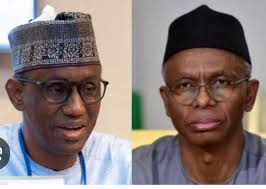
Could the unusual appointment of a Homeland Security Adviser be linked to the upcoming 2027 general election? Is the apprehension surrounding what Nuhu Ribadu and Nasir El-Rufai might accomplish in electoral politics behind the introduction of this local security position? Why are Ribadu and El Rufai consistently significant players, whether positively or negatively, in every electoral cycle in Nigeria? Have they found in Tinubu a formidable obstacle? Insights into these inquiries may be unearthed through our political discussions this week, as we examine the roles of these two influential individuals in our political landscape.
In football, “over-dribbling” refers to the practice of holding onto the ball for too long, repeatedly manoeuvring past a defender without making a timely pass. While this may captivate the audience, it often disrupts the team’s rhythm, limits available options, and can lead to a tackle or loss of possession. In political terms, over-dribbling equates to excessive strategising, constant manoeuvring, and indulging in endless political machinations rather than pursuing decisive actions or forming stable alliances. When discussing over-dribbling in politics in Nigeria, we can’t overlook Mallam Nasir El-Rufai and Nuhu Ribadu—two prominent figures whose intellectual ingenuity is widely recognised.
My first encounter with El-Rufai occurred in 2006 as we approached the presidential election when the late Umaru Yar’Adua was set to run in 2007, and El-Rufai was heading the media strategy for that campaign. His tireless efforts to secure Yar’Adua’s election led to his departure from the government, as the modest and reserved Yar’Adua found it difficult to accept El-Rufai’s evident overwhelming brilliance, which was apparent to all under Olusegun Obasanjo.
As for Ribadu, my initial contact occurred during the Human Rights Violation and Investigation Commission, also known as the Oputa Panel, which was established in 1999 by the Obasanjo administration to address various unresolved injustices of the time. I was a reporter covering the panel’s hearings, and Ribadu was acting as a legal representative for the Nigerian Police. He attracted significant attention not purely as a police officer but as a vocal advocate for Northern interests, often overshadowing his role as legal counsel.
Justice Chukwudifu Oputa, the panel’s chairman, alongside Rev. Fr. Matthew Kukah (now the Bishop of Sokoto), repeatedly instructed Ribadu to maintain some neutrality given his position. His fervent defence of Northern issues was overt and provocative. In time, both Ribadu and El-Rufai became integral figures in the Obasanjo administration, forming part of a close-knit “Economic Team” aimed at modernising Nigeria’s governmental framework. Their alliance hinged on a shared reputation for integrity and steadfastness.
During this era, their focus was aimed outward, targeting the old political establishment they sought to replace. The connection between El-Rufai and Ribadu exemplifies the dynamic nature of Nigerian power politics. Both men became recognised as “technocratic superstars” during the Obasanjo administration—one as the reform-minded leader of the Federal Capital Territory and the other as the determined face of the Economic and Financial Crimes Commission (EFCC). Their individual pathways and collaborations offer valuable lessons regarding the intricate nature of political manoeuvring within the corridors of power.
What followed is well-documented, but it’s important to note that the duo was so influential in the Obasanjo government that they played a significant role in deciding who would be Yar’Adua’s vice president in 2007. When Yar’Adua ultimately distanced himself from them and his successor, Goodluck Jonathan, showed little enthusiasm for their continued involvement, they entered a period of political obscurity. Ribadu aligned himself with Bola Tinubu, who welcomed him and offered him the presidential ticket for his party, the Action Congress of Nigeria (ACN), in 2011, while El-Rufai partnered with the esteemed former Head of State, Gen. Muhammadu Buhari, to provide the much-needed intellectual foundation for his political platform.
Recognising El-Rufai’s potential, an energised Buhari appointed him as the National Secretary of the Congress for Progressive Change (CPC), leading El-Rufai to strive to surpass Buhari’s previous regular 12 million electoral achievements. This collaboration culminated in the Tinubu/Buhari alliance that successfully unseated the sitting President, Goodluck Jonathan, paving the way for Buhari’s victory in 2015.
Ambition eventually created a rift between El-Rufai and Ribadu, as anticipated; one ascended to the governorship of Kaduna State while the other faced defeat in his pursuit of the Adamawa governorship. As the 2023 elections approached, El-Rufai was strategising for a vice-presidential position with any Southern candidate except Tinubu, whom he publicly dismissed, while Ribadu maintained his loyalty to Tinubu despite widespread scepticism regarding his prospects. Yet, the outgoing President Buhari’s ambivalence kept both men in uncertainty.
Out of frustration, El-Rufai was compelled to set aside his initial objections and align with Tinubu, whose candidacy had recently gained traction due to Buhari’s indecision. By effectively collaborating with Ribadu, they were able to deliver Tinubu an impressive 8 million votes, a result that emerged late at night amid considerable surprise.
In the aftermath, Ribadu was rewarded for his loyalty, while El-Rufai faced consequences for his earlier disloyalty. While acknowledging El-Rufai’s contribution to his victory in 2023, Tinubu was also mindful of El-Rufai’s previous reservations about him, interpreting them as sincere.
This sequence of events further widened the gap between these two politically shrewd figures. El-Rufai faced disgrace during ministerial confirmation processes, while Ribadu received the appointment as National Security Adviser.
Given their pivotal roles in previous elections, both men possess invaluable insights into electoral strategies that are not readily apparent. Excluding either figure from future electoral considerations could prove detrimental.
El-Rufai’s attempt to demonstrate his influence by claiming access to the intelligence chief’s contacts has since led to his detainment, but this has not quelled the tensions he has kindled.
Tinubu, aware of the need to consolidate power—encompassing state governors, key opposition figures, the National Assembly, and the judiciary—approaches the prospect of the 2027 election with trepidation. His growing discord with Northern factions has rendered every Northern figure, particularly among the Hausa Fulani, suspect.
It is no longer feasible to depend solely on Ribadu, especially with the volatile El-Rufai now positioned outside the inner circle and visibly upset. The logical shift now lies in seeking a dependable alternative among local figures. Even if Ribadu opts for loyalty, his capability in election matters remains questionable and must be bolstered.
The current challenges faced by El-Rufai and Ribadu serve as a cautionary tale on the risks of over-dribbling, which leaves them vulnerable to counterattacks, as we now witness.
The longer a politician remains entrenched in the “ball” of political intrigue, the more exposed they become. Every unnecessary manoeuvre provides opportunities for adversaries to counter and strategise against them.
In high-risk political landscapes, over-dribbling often results in public conflicts or significant legal challenges. When a politician tries to control too many aspects of power simultaneously, they furnish their opponents with the tools needed to dismantle their position—often leveraging state mechanisms or investigative bodies to do so.”.
A political independent who chooses not to collaborate may end up distancing themselves from their supporters and political protégés, a situation currently affecting El Rufai and Ribadu’s political followers as the 2027 elections approach. At first, the public admires a political maverick like El Rufai—someone capable of outmanoeuvring the establishment and overcoming bureaucratic hurdles. However, when their elaborate strategies fail to produce tangible results or encounter a formidable opponent like Tinubu, the initial cheers may shift to discontent.
The consequences of the impulsive actions taken by these two prominent political figures highlight that in politics, the most successful politicians are not necessarily those displaying intricate manoeuvring, but rather those who know when to make straightforward, impactful decisions. Just as in football, the scoreboard doesn’t measure the number of successful dribbles, but rather how many goals are scored.
By now, these two have realised that the cost of political manoeuvring has led to the loss of a significant friendship for the sake of political survival. While Ribadu effectively utilises the state’s official resources, El-Rufai is pushing the boundaries of political resistance, turning their private disagreements into a public discourse on the use of state authority.
The ongoing story of El-Rufai and Ribadu serves as a poignant reminder that in high-stakes politics, today’s ally can become tomorrow’s warning, and a reformist’s greatest opponent can often be the system they once helped establish. God help us as we navigate all the intrigues in our political landscape.
A.I
May 21, 2026
Tags: Ike Abonyi Nasir el-Rufai Nuhu Ribadu