
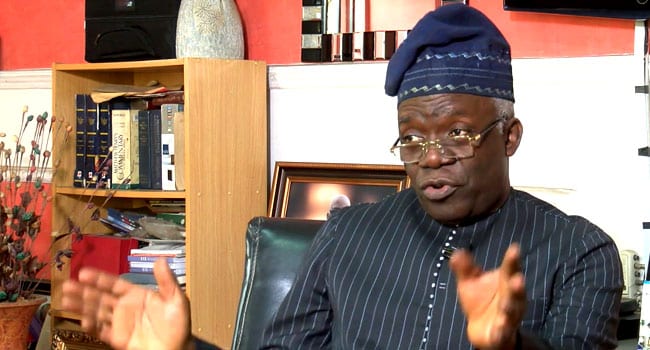
A Senior Advocate of Nigeria (SAN), Femi Falana, has called on the Attorney-General of the Federation (AGF) and Minister of Justice, Lateef Fagbemi, to terminate what he described as an ‘illegal charge’ against 36 alleged coup plotters currently facing trial before a General Court Martial.
Falana made the call in a press statement made available to journalists, urging the Federal Government to instead arraign the accused military officers before the Federal High Court.
“I am compelled to call on the Attorney-General of the Federation and Minister of Justice to exercise his powers under Section 174 of the Constitution by terminating the illegal charge before the General Court Martial. Thereafter, the Attorney-General should proceed to charge the 36 accused military officers before the Federal High Court,” he said.
PrimeTimes Nigeria reports that the senior lawyer argued that the planned prosecution of the suspects by a military court contravenes Section 251 of the Constitution, which vests jurisdiction over treason and related offences in the Federal High Court.
According to him, trying some suspects in a civilian court and others before a military tribunal for the same offence violates the principle of equality before the law.
“Since the Constitution has provided for equality of citizens before the law, the planned trial of six suspects in the Federal High Court and 36 other suspects in the General Court Martial for the same offence cannot be justified under any law in Nigeria,” Falana stated.
Falana further maintained that a General Court Martial lacks the legal authority to try offences such as terrorism, treason, and treasonable felony under Nigeria’s current constitutional framework.
He stressed that such offences fall strictly within the jurisdiction of the Federal High Court, making the ongoing proceedings inappropriate.
Drawing from Nigeria’s history, Falana recalled that even during military regimes, coup plotters were not tried by court martials.
He noted that military officers accused of treason in 1976, 1990, and 1995 were prosecuted by special military tribunals established under specific decrees, rather than conventional military courts.
“Since all treason and other anti-democratic decrees were abolished in 1999 to pave the way for the restoration of democratic rule in Nigeria, any person involved in treason or treasonable felony can only be tried by the Federal High Court,” he added.