
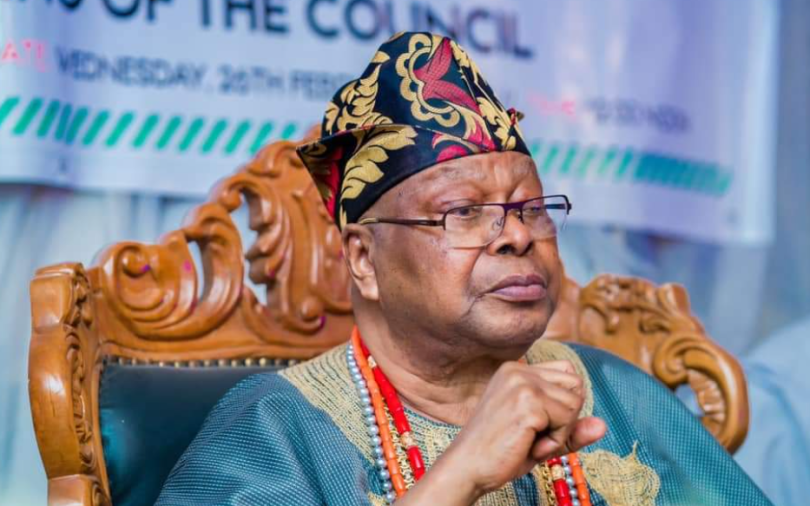
The struggle to produce the next Awujale of Ijebuland has developed into one of the most consequential traditional succession disputes in contemporary Yorubaland, have drawn together questions of culture, customary law, politics, and the future of one of Nigeria’s most influential traditional institutions.
Months after the passing of the late Awujale, Oba (Dr.) Sikiru Kayode Adetona, the process of selecting his successor has become continuously contentious, with competing interpretations of the law, disagreements among kingmakers, and growing public interest across Ijebuland and beyond.
Central to this controversy is the Awujale Afobaje Council, the statutory body responsible for selecting a new monarch under the Chiefs Declaration of Western Nigeria (1957) and the Ogun State Obas and Chiefs Law, 2021.
The latest crisis erupted after the Olisa of Ijebu-Ode, Chief Rasheed Adeoye Adesanya, reportedly wrote to Ogun State Governor Dapo Abiodun. He presented himself as Chairman of the Awujale Afobaje Council and forwarded what “a list of recommended candidates” for the revered stool.
That action was immediately rejected by six members of the Afobaje Council, led by the Olor’Ogun and Ogbeni Oja of Ijebu, Chief Sunny Kuku.
In a strongly worded rebuttal, the Awujale Afobaje Council rejected the Olisa’s claims, saying, “It is therefore not only dishonest but astonishing and shameful that the same Chief Adesanya now seeks to portray himself as Chairman of the Council. Such a claim is a clear distortion of facts and is hereby rejected in its entirety.”
The council further maintained that “the purported recommendations contained in his letter represent his personal views and imagination alone and have no connection whatsoever with the Awujale Afobaje Council.”
The council also argued that the Chiefs Declaration merely lists the recognised kingmakers but does not designate the Olisa as chairman. According to the council, Chief Sunny Kuku was unanimously nominated and adopted as chairman during the inaugural meeting held on December 2, 2025, at the Awujale Palace.
In addition, the council disclosed that only four official meetings had been held before the Ogun State Government directed that the selection process be suspended pending further instructions.
It therefore described any purported recommendation of candidates as “personal, unauthorised and without the approval of the Afobaje Council.”
The disagreement has transformed what ordinarily would have remained an internal traditional exercise into a matter attracting legal scrutiny and public debate.
More Than A Royal Succession
The Awujale happens to be the traditional ruler of Ijebu-Ode. The office occupies perhaps the most influential traditional position in Ogun State and is one of the most respected monarchies in Nigeria.
Historically, the Awujale served as the paramount ruler of the old Ijebu Kingdom, whose influence stretched across present-day Ijebu-Ode, Ijebu-Igbo, Remo, Epe, Ikorodu, Lekki, parts of Ogun and Lagos States, and even extended towards Ketu in present-day Benin Republic.
The occupant of the throne also presides over one of Nigeria’s largest annual cultural gatherings, the Ojude Oba Festival, which has now become an international tourism attraction while preserving centuries-old Ijebu traditions.
Who eventually succeeds the late monarch will therefore shape not only the cultural identity of Ijebuland but also its political influence, economic engagements, and traditional institutions for decades.
Culture Remains Central to the Throne
To put politics aside, the institution of the Awujale is rootedly intertwined with one of Ijebuland’s oldest traditions, the Agemo Festival.
Historical accounts describe Agemo as the spiritual institution that symbolises unity among the Ijebu people.
According to documented accounts by historians and traditional authorities, the annual festival brings together the recognised Agemo priests from different parts of Ijebuland to pray for peace, prosperity, and the wellbeing of the Awujale and the entire kingdom.
Although historians differ on the precise origin of the Agemo institution, several narratives trace it to the migration traditions of the Ijebu people, while others associate its institutional development with efforts to cure an ailing Awujale centuries ago at Imosan, now regarded as the spiritual centre of the Agemo tradition.
The festival also illustrates the enduring constitutional role of the Awujale as custodian of Ijebu customs, despite successive occupants of the throne professing either Islam or Christianity.
This unique blending of religion, culture, and monarchy has remained one of the defining characteristics of the Ijebu traditional institution.
Due Process under Watch
It’s interesting to know that this ongoing disagreement is a reflection of the delicate balance between customary law and statutory provisions governing traditional institutions in Nigeria.