
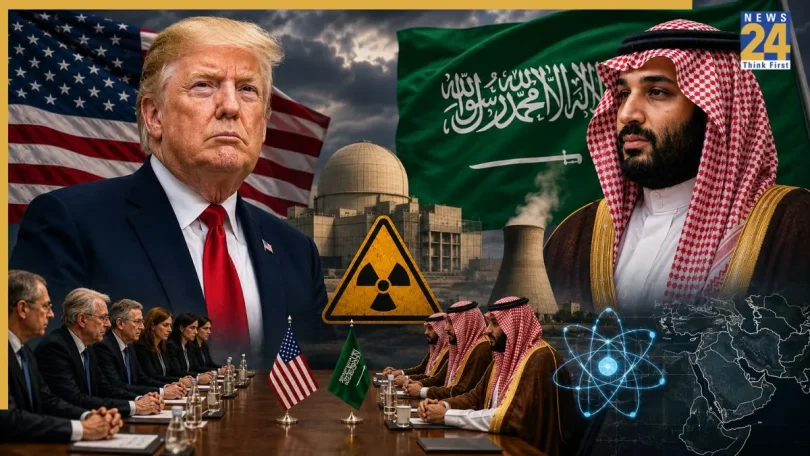
As tensions continue to rise in West Asia, a new US Saudi nuclear deal has raised fresh concerns across the world. Reports suggest US President Donald Trump is preparing to announce a civilian nuclear agreement with Saudi Arabia. While the deal is meant for peaceful nuclear energy, many experts fear it could give Riyadh access to technology that may one day support a nuclear weapons programme.
Why is this deal causing concern?
According to several reports, the proposed agreement would allow Saudi Arabia to develop parts of the nuclear fuel cycle, including uranium enrichment and possibly processing spent nuclear fuel in the future. These technologies are used in civilian nuclear power programmes. However, they are also considered sensitive because they can eventually be used to produce material for nuclear weapons. This is why the proposal has attracted global attention.

Why do experts see it as a policy shift?
The United States has traditionally avoided sharing uranium enrichment technology with most partner countries. This has been a key part of its nuclear non proliferation policy for decades. Experts say, the reported Saudi deal could mark a major change in that approach. According to US think tank Defense Priorities said it would be highly unusual if Washington allows Saudi Arabia to enrich uranium on its own soil. She said such technology increases the long term risk of nuclear weapons development.
Also read: Lost your PAN card? Here’s Step by Step process to apply for duplicate PAN card online
Saudi Arabia’s position adds to concerns
Another reason for concern is Saudi Arabia’s own public position. Crown Prince Mohammed bin Salman has said in the past that if Iran acquires a nuclear weapon, Saudi Arabia would also seek one. Experts say these statements make any expansion of Saudi Arabia’s nuclear capabilities more sensitive. They stress that civilian nuclear technology itself is not illegal, but its future use depends on political decisions and international oversight.
Nuclear warheads by Country
| Country | Status under NPT | Total Estimated Warheads | Primary Basing / Delivery Capabilities |
| Russia | Recognized NWS | 5,459 | ICBMs, Submarines (SSBNs), Strategic Bombers |
| United States | Recognized NWS | 5,177 | ICBMs (Minuteman III), Submarines (Trident II), Heavy Bombers |
| China | Recognized NWS | 620 | Silo-based & Mobile ICBMs, SSBNs, Strategic Bombers |
| France | Recognized NWS | 290 | Submarine-Launched Missiles (M51), Air-launched Cruise Missiles |
| United Kingdom | Recognized NWS | 225 | Submarine-Launched Trident II D5 Missiles |
| India | Non-NPT Signatory | 190 | Land-based ballistic missiles (Agni series), Fighter-bombers, SSBNs |
| Pakistan | Non-NPT Signatory | 170 | Mobile ballistic missiles (Shaheen series), Cruise missiles |
| Israel | Non-NPT (Unacknowledged) | 90 | Jericho ballistic missiles, Submarine-launched cruise missiles, Aircraft |
| North Korea | Withdrawn from NPT | 50 | Intercontinental & Medium-range Ballistic Missiles |
What happens next?
The proposed agreement will now go to the US Congress for review. Some lawmakers from both political parties are expected to question the deal because of its possible security risks. Even if it is approved, experts say building a nuclear weapon would take many years and would face strong international opposition. Still, the proposal has reopened an important debate over how civilian nuclear cooperation should be managed in a region already facing serious geopolitical tensions.
Also read: What are Liquid Mutual Funds? From investment and returns to risks, everything you need to know
First published on: Jul 23, 2026 07:51 AM IST
Get Breaking News First and Latest Updates from India and around the world on News24. Follow News24 on Facebook, Twitter.
End of Article
About the Author

Mamta Singh
Mamta Singh is a senior journalist with over 17 years of experience in the media industry, specializing in business and financial journalism. She holds a Master’s degree in Broadcast Journalism and has built a distinguished career across print, digital, and broadcast media. Over the years, she has worked with leading media organizations. In addition to her journalism career, Mamta has also worked as a Radio Jockey. She is known for her insightful reporting, editorial expertise, and strong communication skills across multiple media platforms.
Read MoreRelated Story


