
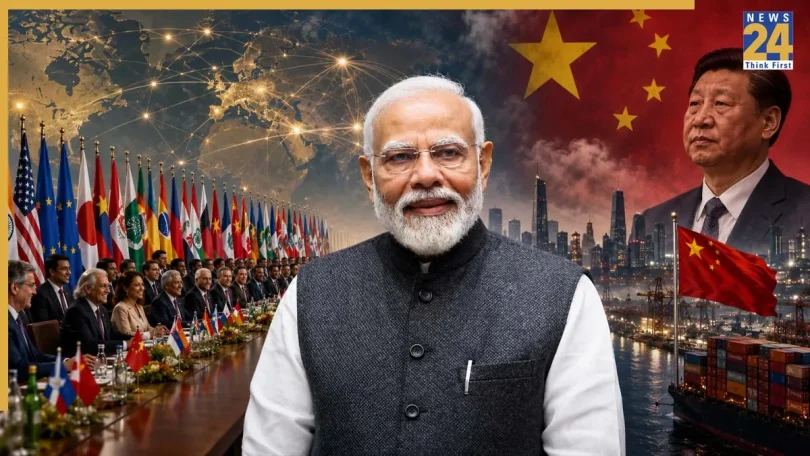
Amid rising geopolitical tensions, India has adopted an aggressive strategy to strengthen its technology and energy security. The main objective is to reduce China’s dominance over the global supply chain of critical minerals, rare earth elements, and semiconductors (chips).
Over the past two years, India has built a network of nearly 35 countries to secure the supply of these strategic resources.
As part of this strategy, a major decision was taken during Prime Minister Narendra Modi’s visit to Indonesia. India will make significant investments in manufacturing facilities for steel, nickel, and rare earth permanent magnets in Indonesia.
Earlier, in January 2025, the government launched the National Critical Mineral Mission (NCMM), a seven-year programme covering the period from 2024-25 to 2030-31.
A 35-Country Strategic Supply Network
At present, the world depends heavily on China for critical minerals because it dominates mineral refining and processing. To reduce this dependence, India has achieved a major diplomatic breakthrough by bringing together around 35 countries into a single supply network.
In the last two years, India has signed agreements with 24 countries to secure supplies of critical minerals and rare earths. Discussions with 11 more countries are in the final stages.
Countries that have already partnered with India include the United States, Canada, the United Kingdom, the Democratic Republic of Congo, Germany, Italy, France, and most recently, Indonesia.
Meanwhile, negotiations are underway with Chile, Peru, Zambia, Uzbekistan, and Kazakhstan.
Key Partnerships
United States and United Kingdom
- Cooperation on critical minerals, rare earths, and supply chain monitoring.
Germany and Japan
- Joint work on semiconductor manufacturing and mineral exploration.
Russia
- Partnership on rare earth magnet technology, which could help reduce dependence on Chinese technology.
Indonesia and Vietnam
- Agreements focused on nickel and rare earth mineral supplies.
Canada, Brazil, and Australia
- Long-term partnerships for direct mineral supply and resource cooperation.
Italy
- Collaboration on advanced technologies such as recovering rare earth elements from electronic waste.
How India Plans to Compete with China
1. National Critical Mineral Mission (NCMM)
Launched in January 2025, this seven-year mission aims to build India’s complete capability in mining, processing, and refining critical minerals such as lithium and rare earth elements, instead of depending on imports.
2. Diversifying the Supply Chain
China’s biggest advantage has been the world’s dependence on its raw materials and processing capacity. By building partnerships with 35 countries, India is creating multiple sources of supply and reducing its reliance on China.
3. Building Global Partnerships
Countries such as the United States, Japan, and several European nations are also looking to reduce their dependence on China. India is emerging as a trusted partner by combining international technology with its growing manufacturing capabilities.
4. Focusing on Future Technologies
Critical minerals are essential for electric vehicles (EVs), defence equipment, telecommunications, batteries, renewable energy, and advanced electronics. India is working to secure these resources to strengthen its position in future global industries.
A Strong Challenge to China
Critical minerals and semiconductor technologies are no longer just commercial resources—they have become key strategic assets. With its growing network of 35 partner countries and major investments in countries such as Indonesia, India is positioning itself as a strong alternative in global supply chains.
The strategy reflects India’s long-term goal of strengthening its technology and manufacturing capabilities while reducing dependence on China in sectors that will shape the future global economy.
First published on: Jul 10, 2026 04:21 PM IST
Get Breaking News First and Latest Updates from India and around the world on News24. Follow News24 on Facebook, Twitter.
End of Article
Related Story


