
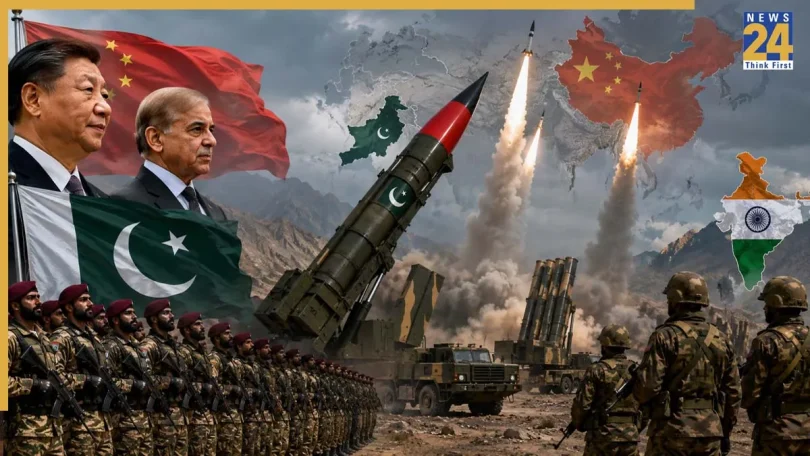
Pakistan is setting up a new Army Rocket Force Command (ARFC), a dedicated force for conventional missile and rocket operations. The move is seen as part of Pakistan’s efforts to strengthen its military capabilities after India’s Operation Sindoor and follows a structure similar to China’s Rocket Force.
Why is Pakistan creating a Rocket Force?
Military analysts believe Pakistan wants a faster and more effective way to respond to long-range conventional attacks. Reports suggest that during the military confrontation with India in May 2025, Pakistan used fighter jets, drones and Fatah-series rockets but failed to cause significant damage. India’s air defence systems, including the S-400, intercepted many incoming threats, highlighting the need for Pakistan to improve its conventional strike capability.

A conventional, not nuclear, force
Pakistan Prime Minister Shehbaz Sharif had announced plans for the ARFC during his Independence Day speech in 2025. The new force is expected to handle only conventional (non-nuclear) missiles and rockets. Pakistan’s nuclear-capable missiles will continue to remain under a separate command structure.

Focus on long-range precision strikes
According to a report by the Centre for Land Warfare Studies (CLAWS), the ARFC will bring Pakistan’s conventional rockets and missiles under a single command for better coordination and faster deployment.
The force is expected to operate weapons such as the Fatah-1 rocket system, with a reported range of around 140 km, and the Fatah-2, which is believed to have a range of up to 400 km. Other systems that could become part of the force include Fatah-I, Fatah-II, Fatah-III, Fatah-IV, tactical ballistic missiles, cruise missiles and multiple rocket launchers.

Modelled on China’s Rocket Force
Pakistan’s new command is expected to function on the lines of China’s Rocket Force, bringing different missile and rocket systems under one unified structure.
According to reports, Chinese-made systems such as the A-100 multiple rocket launcher, based on Russia’s Smerch system, could also be included in the new force.
Pakistan’s expected military strategy
The proposed Rocket Force is expected to:
- Bring conventional rocket and missile units under one command.
- Improve long-range precision strike capability.
- Reduce reliance on nuclear weapons by strengthening conventional military options.
- Enhance Pakistan’s ability to respond quickly to long-range attacks.
India is also considering a similar force
India is also exploring the idea of creating a dedicated Rocket Force. Earlier this year, then Army Chief General Upendra Dwivedi said the Indian Army was studying the proposal. If approved, the force could include systems such as Pinaka, Smerch, BrahMos, Pralay and other long-range conventional weapons.
The development reflects the growing importance of precision-guided missile and rocket forces in modern warfare.
First published on: Jul 03, 2026 08:28 PM IST
Get Breaking News First and Latest Updates from India and around the world on News24. Follow News24 on Facebook, Twitter.
End of Article
Related Story


