
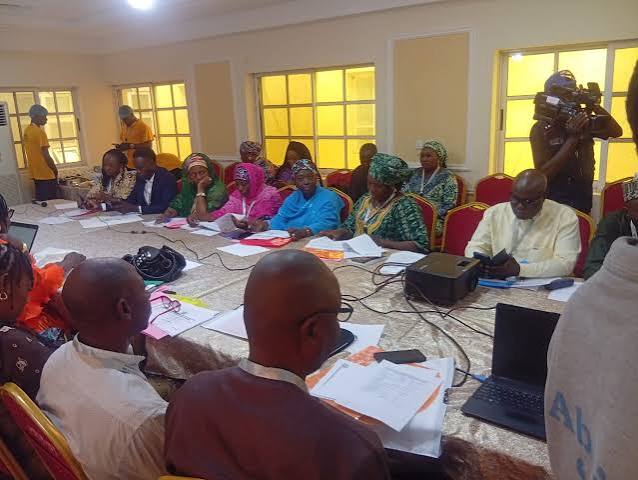
(National Council And Officials. Photo Credit: Daily Post)
In preparation for the 26th National Council on Women Affairs, the Federal Ministry of Women Affairs and the North Central States are pressing policy reforms to increase women’s access to finance, agriculture, technology, and political engagement, as well as to promote child protection and social inclusion.
The proposals dominated discussions at the three-day North Central Pre-Council Zonal Technical Workshop in Minna, where stakeholders gathered to coordinate recommendations for consideration by the National Council.
Chukwu Ifunanya Salome, Principal Administrative Officer of the Federal Ministry of Women Affairs, represented the Permanent Secretary, Esuabana Nko Asanye, and stated that the ministry remains committed to advancing women’s economic empowerment, gender equality, and social protection through policies that benefit women, children, and other vulnerable groups.
She urged participants to submit useful suggestions on gender mainstreaming, child rights, reproductive health, social welfare, and the inclusion of vulnerable groups. She described the National Council on Women Affairs as a strategic platform for creating policies that support sustainable livelihoods, healthcare, education, and economic opportunities for women.
She said the workshop will examine how the 25th National Council’s resolutions are being implemented in Edo State and create memos to direct discussions at the next council.
Niger State Commissioner for Women Affairs and Social Development, Hadiza Idris Kuta, in her welcome address stated the state is leveraging the workshop to drive important components of Governor Mohammed Umar Bago’s New Niger Agenda into national policy.
According to her, Niger is pushing for increased assistance for women in agribusiness, better financing options for female company owners, stricter child protection legislation, more chances for ICT and technology, and better access to high-quality healthcare and education for kids.
In order to prevent vulnerable populations from being left behind, Kuta also advocated for greater female involvement in politics and administration.
“Niger State is expanding the Nigeria for Women Project to all 25 local government areas while pursuing the establishment of fully funded nutrition and disability directorates and harmonized implementation of the Child Rights Law, the Violence Against Persons (Prohibition) Law, and Women, Peace and Security action plans across the North Central region,” she insisted.
The commissioner reported that the Bago administration has strengthened nutrition, disability, and child protection programs, expanded the Nigeria for Women Project, and appointed over 130 women to political positions, including 25 female vice-chairpersons in the state’s 25 local government areas.
“We need to guarantee implementation and go beyond policy documents. It is only through action that we can create demonstrable improvement in the lives of women, children and vulnerable people of our society,” she said.
In order to coordinate regional stances prior to the 26th National Council on Women Affairs, commissioners, permanent secretaries, directors, and technical specialists from the Federal Ministry of Women Affairs and North Central states convened for the three-day workshop.