
Opinion
By Ugo Uzuegbu
For decades, global climate governance has been driven primarily by national governments through multilateral negotiations. Yet as climate impacts intensify, the gap between commitments and implementation has become more apparent.
With nearly 200 countries pursuing different economic interests, political priorities, and development needs, consensus has become increasingly difficult to achieve.
The result is a growing pattern of stalemate across the multilateral institutions responsible for negotiating global environmental agreements.
A review of major UN environmental and climate negotiations since 2024 shows that at least six have been deadlocked:
negotiations on the Global Plastics Treaty have stalled twice, the UN Biodiversity Conference in Cali was suspended without agreement on finance, the International Seabed Authority has failed across successive sessions to conclude a Mining Code, COP29’s climate finance outcome was rejected by many developing countries as inadequate, COP30 failed to include fossil fuel phase-out language in its final decision, and the June 2026 Bonn climate talks ended without progress on emissions reductions and adaptation finance.
As confidence in multilateral negotiations has waned, governments, cities, businesses, and civil society are now turning to complementary platforms that prioritise collaboration and implementation over consensus.
Arguably, the most influential model in recent years has been set by London Climate Action Week (LCAW).
The brainchild of Nick Mabey, co-founder & CEO of E3G, and Malini Mehra, CEO of GLOBE Legislators, both veterans of international climate and environmental movements, the LCAW model was established in 2019 to provide a platform for climate action, going beyond discussion fora such as the annual New York Climate Week at the United Nations.
Mehra says “We put the word “Action” deliberately. It is not London Climate Week; it is London Climate Action Week. The emphasis on Action, whole of society mobilisation, and being grounded in the reality of place, are what make the LCAW model distinctive and why it has caught on around the world. After COP30 in Belém, we are now in a new era: one of implementation. This is what makes the Climate Action Weeks so powerful and relevant.”
The Climate Action Weeks have now spread around the world to include Sydney, Baku, Rio de Janeiro and Bangkok.
We are proud to be working with the Governor of Lagos State to bring the first CAW to Africa’s most dynamic and fastest growing metropolis soon.
Lagos Climate Action Week (LAGCAW) was conceived as an official outcome of the inaugural Nigeria Climate Investment Summit (NCIS), a flagship of London Climate Action Week, the first and most influential citywide climate action week, held from 20 to 28 June 2026.
Organised by GLOBE Legislators, in partnership with SOStainability, and supported by a range of London, Commonwealth, and international bodies, the Nigeria Climate Investment Summit is the latest LCAW innovation to link London’s financial capital and global markets with Africa’s burgeoning climate investment needs to match national ambitions. (Read the concept paper here.)
Recognising the barriers that often limit the meaningful participation of stakeholders from developing countries in large international climate conferences,
NCIS connected Nigeria to a model that is particularly valuable for countries on the frontlines of climate change.
For developing countries, where the greatest challenge is often not ambition but access to capital, capacity, and collaboration, this model provides a faster and more effective pathway from commitments to concrete development outcomes.
The NCIS demonstrated the value of an implementation-focused platform where partnerships could be forged, investment mobilised, and ideas translated into action.
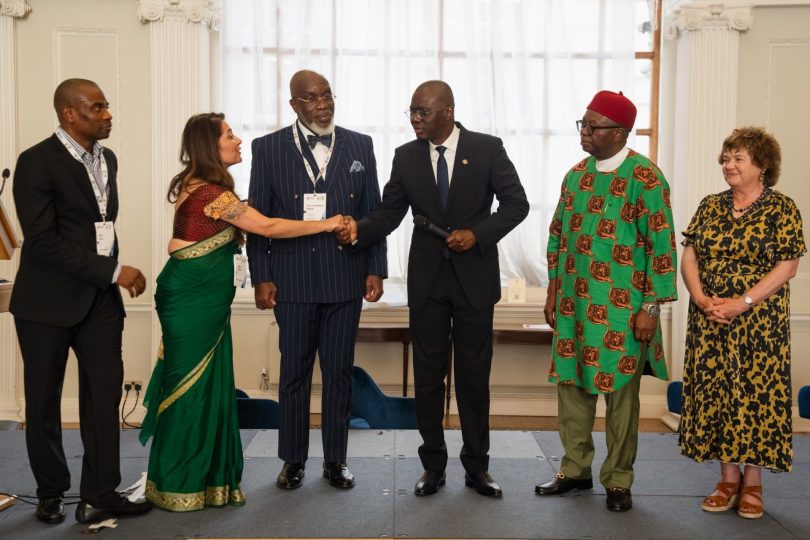
With Lagos Climate Action Week designed as a key outcome of the Nigeria summit, it was a proud moment when the Lagos State Governor, Babajide Sanwo-Olu, announced the inaugural Lagos Climate Action Week (LAGCAW), set to take place in Lagos—Nigeria’s economic hub and sub—Saharan Africa’s most populous city— in September/ October 2026.
If Climate Action Weeks are to accelerate implementation, they must be rooted in cities where climate risk, economic influence, and political leadership intersect.
Lagos, with its over 20 million residents and status as one of the world’s most vulnerable coastal cities to sea-level rise, is an ideal location for Africa’s climate implementation agenda.
As Nigeria’s commercial capital and one of Africa’s leading financial centres, Lagos sits at the intersection of economic influence and acute climate vulnerability, making it uniquely positioned to demonstrate how cities can translate climate ambition into implementation.
The LCAW model has shown the success of carefully designed, independent city-level climate convenings, which work in partnership with the UN’s COP Presidencies but operate outside the formal UN system, bringing together stakeholders in ways traditional multilateral negotiations often cannot.
Nick Mabey, Chair and co-founder of London Climate Action Week (LCAW) has noted how the climate action weeks offer platforms to advance climate action free from the tensions of negotiations that characterise UN conferences.
Cities are where climate policies are implemented, infrastructure is built, investment decisions are made, and citizens experience the impacts of climate change most directly.
Rather than being constrained by the need for universal consensus, these platforms create opportunities for state and non-state actors to move from negotiation to implementation.
From London to Baku and Bangkok to Rio de Janeiro, these Climate Action Weeks have proven the power of diverse stakeholder collaboration around shared objectives with a clear focus on implementation.
This is not to suggest that international negotiations are obsolete. Global agreements on emissions reductions, technology transfer, and climate finance remain important.
But Lagos—a city confronting recurrent flooding, coastal erosion, heat stress, and rapid urbanisation—has little time to wait for international consensus.
More importantly, decisions made in Lagos have implications far beyond the city itself, shaping investment flows, business practices, and public policy across Nigeria and the wider region.
The climate crisis does not negotiate, wait for consensus, or respect diplomatic calendars or procedural objections.
The only rational response is to build systems that can act with the same urgency that the crisis demands.
Climate Action Weeks embody this approach. Lagos now joins this growing network of climate action weeks, and will serve as a watershed moment for climate governance on the African continent.
Ugo Uzuegbu, Programme Officer INDUS Advisory
Tags: Africa’s Climate Governance Lagos Climate Action Week