
Oil & Gas
By Anthony Isibor
THE Industry leaders at NOG Energy Week 2026 identified Floating Liquefied Natural Gas, FLNG, as one of the fastest-growing solutions for commercialising offshore gas resources, improving energy security and expanding Africa’s role in global LNG markets.
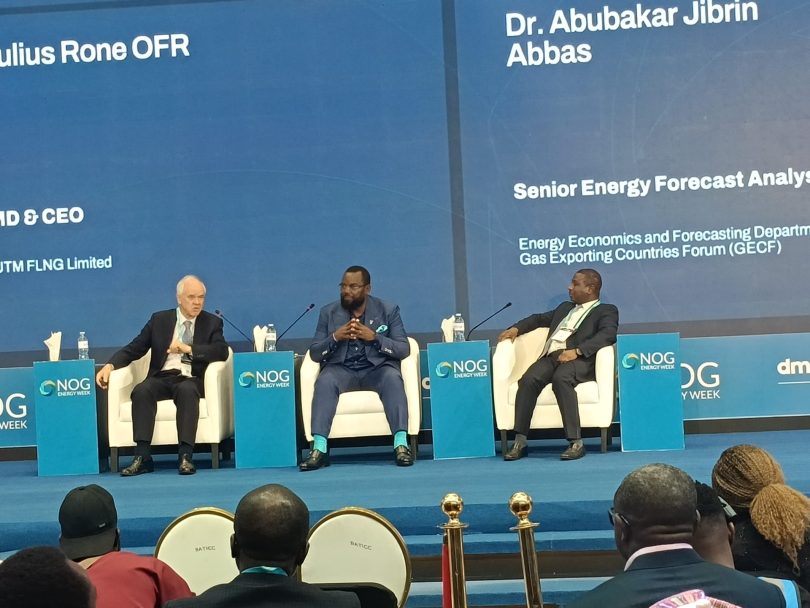
During the panel session titled “Strengthening Supply Security – Accelerating the FLNG Frontier,” the speakers stated that the FLNG technology enables gas processing, liquefaction, storage and export directly from offshore fields, eliminating the need for extensive onshore infrastructure while accelerating project delivery.
The moderator, Tony Regan, explained that an FLNG facility is essentially a complete LNG plant installed on a floating vessel positioned above an offshore gas field.
The vessel processes natural gas, liquefies it, stores the LNG onboard and transfers it to conventional LNG carriers for export.
Regan noted that nine FLNG projects are currently operating globally, with Africa hosting five of them, making the continent the global centre of the technology. Existing projects are located in Cameroon, Mozambique, Congo, Gabon and the Greater Tortue Ahmeyim development between Senegal and Mauritania, with Nigeria expected to join the list.
Senior Energy Forecast Analyst at the Gas Exporting Countries Forum, GECF, Abubakar Jibrin Abbas, said global energy demand would continue rising over the next three decades due to population growth, economic expansion, digitalisation and increasing electrification.
He projected that global LNG demand would increase from about 450 million tonnes today to more than 800 million tonnes by 2055, while international gas trade would expand significantly.
According to Abbas, renewables and natural gas will remain the world’s fastest-growing energy sources, creating substantial opportunities for LNG infrastructure.
He observed that Africa’s circumstances differ from those of many developed economies because the continent still experiences widespread energy poverty, with average energy consumption standing at roughly one-third of the global average.
“We need energy addition before we go to the transition,” he said, arguing that expanding access to affordable energy should remain Africa’s immediate priority.
Abbas noted that about 30 per cent of Africa’s gas production currently comes from offshore fields, a figure expected to rise substantially by 2055, making floating LNG increasingly relevant.
He explained that FLNG offers flexibility, resilience and faster deployment while enabling countries to monetise offshore gas resources, expand electricity generation and increase LNG exports.
“FLNG is not only a technology, but an enabler of expanding our energy access, expanding our electricity generation and allowing us to export more LNG to support global energy security,” he said.
Concluding the session, Regan said that interest in FLNG was accelerating worldwide, with several new projects under construction and countries such as Argentina and Canada adopting floating LNG solutions not only for offshore developments but also for processing gas from onshore fields.
He said that the growing adoption demonstrated that the technology had evolved into a proven and commercially attractive option for bringing stranded gas resources to the market.
If these are for newspaper publication, the first is the stronger front-page business story because of the gas supply agreement milestone, while the second serves as a broader industry analysis of why FLNG is becoming central to Africa’s gas strategy.
A.I
July 9, 2026
Tags: Abubakar Jibrin Abbas Tony Regan