
Featured, Oil & Gas
By Anthony Isibor
NIGERIA’S ambition to become a major player in floating Liquefied Natural Gas, FLNG, moved closer to reality on Wednesday as UTM FLNG Limited announced that it has secured the gas supply agreement required to advance the country’s first indigenous FLNG project to its next phase.
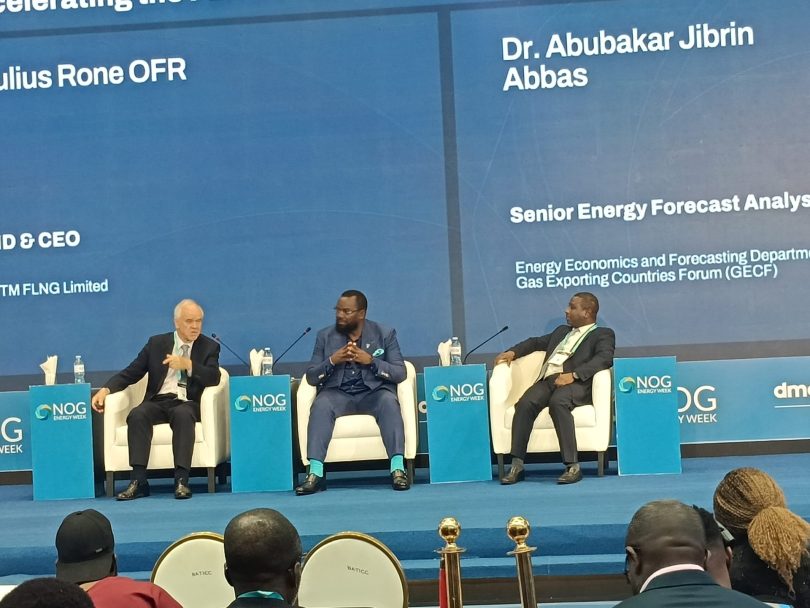
Speaking during the “Strengthening Supply Security – Accelerating the FLNG Frontier” panel at NOG Energy Week 2026, the Managing Director and Chief Executive Officer of UTM FLNG Limited, Julius Rone, described the agreement as the breakthrough that unlocks the project’s journey to Final Investment Decision, FID.
According to him, the project was conceived to commercialise Nigeria’s vast stranded offshore gas resources that are either flared or reinjected instead of being monetised.
“We have a lot of gas sitting offshore that is stranded, that is either flared or injected. I said to myself, this is money, and we are polluting the environment. We can convert this to a resource for the country,” Rone said.
He noted that although developing an FLNG project is significantly more complex than an oil project, requiring alignment across upstream, midstream and downstream operations, the company deliberately pursued international best practices from the outset.
Rone said UTM partnered leading global engineering firms with extensive experience in delivering floating LNG facilities worldwide, including projects in Mozambique, Malaysia and Australia, to ensure the Nigerian project met global standards and attracted financing.
He revealed that despite completing engineering work and securing financing partners, the absence of a gas supply agreement had remained the single biggest obstacle to reaching FID.
“The major issue was to get the gas supply agreement. Yesterday, to the glory of God, we got the gas supply agreement,” he announced.
Rone credited the breakthrough to support from the Federal Government, NNPC Limited and industry regulators, saying recent policy reforms and incentives for gas development had created a more attractive investment climate.
He praised President Bola Tinubu’s administration for introducing executive orders aimed at encouraging gas investments, arguing that a business-friendly environment was essential to unlocking industrialisation.
“You need a responsible government. You need a government that is business-focused and wants to enable business to thrive,” he said.
Describing the project as a milestone beyond Nigeria, Rone said it would become the first FLNG facility developed by an indigenous African company.
“This is a pride for every Black man, not Nigeria alone, because this is the first floating LNG that will be developed by an African, by a Black man,” he said.
Looking ahead, he disclosed that UTM plans to replicate the model by developing additional floating LNG facilities after construction of the first plant begins.
“We’re replicating exactly what Mozambique is doing. Once we get into construction next year, we’ll start the second floating LNG, and we will not stop until we monetise more of our offshore gas resources,” he said.
A.I
July 9, 2026
Tags: Julius Rone UTM FLNG Limited