
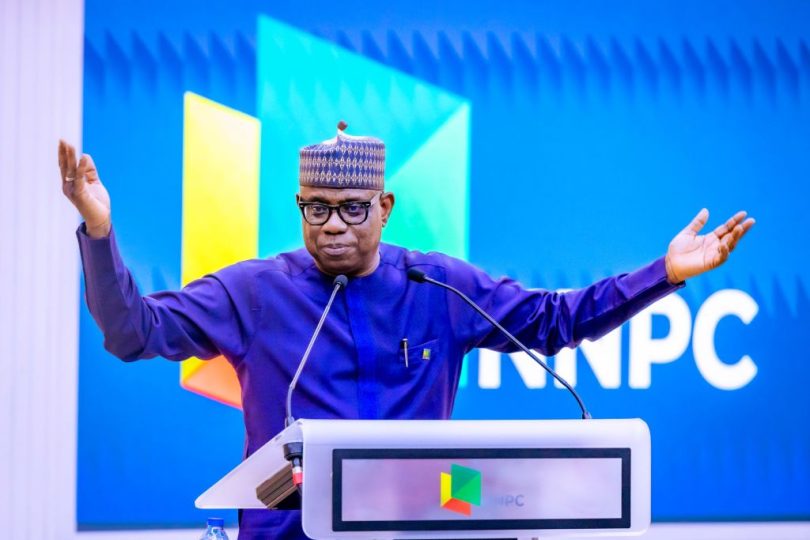
The federal government has expressed support and commitment to the new efforts by the Nigerian National Petroleum Company (NNPC) Limited to rehabilitate the nation’s refineries.
The state oil company recently signed a Memorandum of Understanding (MoU) with two Chinese companies, Sanjiang Chemical Company Limited and Xinganchen (Fuzhou) Industrial Park Operation and Management Co. Limited, for collaboration through a potential Technical Equity Partnership in support of the completion and operation of the Port Harcourt and Warri Refineries.
The Minister of State for Petroleum Resources (Oil), Mr Heineken Lokpobiri, spoke at the official opening of the 2026 Nigeria Oil and Gas (NOG) Energy Week on Tuesday in Abuja.
“I was excited recently when I saw NNPC Bayo going to Warri with partners who are coming to help Nigeria rehabilitate the refineries in Warri and Port Harcourt.
“That is the right way to go. As for me, as Minister who is the chairman of the steering committee of refineries rehabilitation, I told Bayo you have my fullest support. You may not see me going to those refineries, but I am with you in spirit,” he said.
The minister also disclosed ongoing efforts to address one of the biggest complaints of investors in Nigeria’s oil and gas industry, announcing plans to streamline over 270 taxes, levies and regulatory charges blamed for driving up the cost of doing business and undermining investments.
The move came as indigenous oil producers warned that the multiplicity of charges has become a major threat to project viability and could force operators to abandon assets if left unchecked.
Mr Lokpobiri stated that the government had commissioned PricewaterhouseCoopers (PwC), in collaboration with the Nigerian Upstream Petroleum Regulatory Commission (NUPRC), to undertake a global benchmarking of Nigeria’s fiscal charges against those of competing oil-producing countries.
According to him, the exercise was part of efforts by the Tinubu administration to make Nigeria’s petroleum industry globally competitive and attract fresh investments.
“We have commissioned PwC to do a global benchmarking. Nigeria is committed to being globally competitive, so let us benchmark our fees and rates against other jurisdictions,” he said.
Mr Lokpobiri explained that operators currently contend with about 270 different taxes, fees and regulatory charges, many of which yield little revenue but create huge administrative bottlenecks.
“Sometimes when you hear that we have about 270 taxes, some of them are just a few cents. Instead of making companies process about 270 invoices, why don’t we aggregate them? The report will soon be ready, and I believe it will solve that problem once and for all.”
The minister said the initiative forms part of broader reforms aimed at improving the ease of doing business, noting that the government had consistently responded to concerns raised by industry stakeholders.
Also speaking at the event, the Minister of State, Petroleum Resources (Gas), Mr Ekperikpe Ekpo, reiterated that Nigeria was open for business, saying sweeping reforms, fiscal incentives and major infrastructure projects were positioning the country as a globally competitive destination for gas investment.
Mr Ekpo said the federal government was transforming Nigeria from a nation that merely possesses vast gas reserves into one powered by gas to drive industrialisation, energy security and economic growth.
“Our message to the global investment community is unified and resolute: Nigeria is open for business, and we have established a stable, competitive and highly predictable investment environment.”
Mr Ekpo noted that Nigeria’s 215 trillion cubic feet of proven gas reserves, the largest in Africa, would be leveraged not only for exports but also to power domestic industries, fertiliser and petrochemical plants, transportation and clean cooking initiatives under the government’s Decade of Gas programme.
He highlighted ongoing strategic infrastructure projects, including the Ajaokuta-Kaduna-Kano (AKK) and OB3 gas pipelines, as well as new gas processing facilities aimed at expanding domestic supply, reducing gas flaring and increasing the availability of liquefied petroleum gas (LPG).
The minister also reaffirmed the government’s commitment to expanding Nigeria’s liquefied natural gas export capacity through the NLNG Train 7 project, which will increase production capacity from 22 million tonnes per annum to 30 million tonnes annually upon completion.
He added that the government was accelerating the National Clean Cooking Programme, which targets five million households by 2030, and the Presidential Compressed Natural Gas (CNG) Initiative aimed at reducing transportation costs and expanding domestic gas utilisation.
Reinforcing the reform agenda, the Special Adviser to the President on Energy, Mrs Olu Verheijen, said Nigeria was now competing for investments on the strength of policy credibility rather than the size of its hydrocarbon reserves.
“The competition is no longer geology against geology. It is government against government. It is rules against rules. It is delivery against delivery,” she said.
Mrs Verheijen disclosed that reforms introduced by the Tinubu administration had already attracted more than $10 billion in Final Investment Decisions (FIDs), while investment projects worth over $50 billion were currently in the pipeline.
She added that Nigeria’s crude oil and condensate production had increased by more than 400,000 barrels per day, while external reserves had exceeded $50 billion.
“Capital is no longer sentimental. It asks one question: Can this country turn resources into bankable projects, and bankable projects into reliable returns?” she asked.