
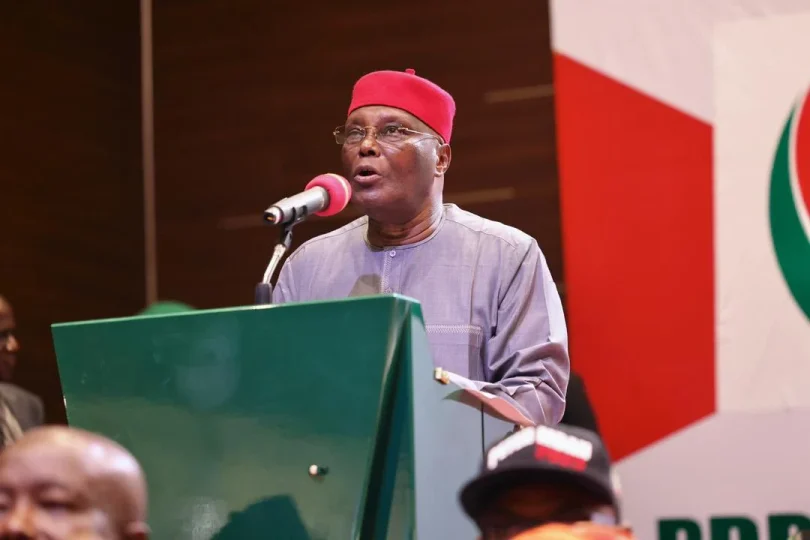
Former Vice President and African Democratic Congress (ADC) presidential candidate, Atiku Abubakar, has warned that the proposed uniform ₦50,000 examination fee for candidates sitting the West African Senior School Certificate Examination (WASSCE) and the National Examinations Council (NECO) examinations from 2027 could become a major barrier to university education for thousands of indigent Nigerian students.
Rather than viewing the proposed charge as merely another increase in education costs, Atiku argued on Sunday that it could fundamentally alter who gains access to higher education, especially as many families continue to grapple with rising living costs.
In a statement issued by his Senior Special Assistant on Public Communication, Phrank Shaibu, the former Vice-President described the proposed examination fee as “a systemic filter” that would eliminate many academically qualified candidates before they even have the opportunity to compete for university admission.
Atiku said, “It is a systemic filter that will inevitably restrict access to tertiary education for thousands of indigent but academically qualified Nigerian students. For many children from low-income families, the journey to university does not end at the admission gate, it is terminated long before then by the inability to afford the qualifying examinations that determine their future.”
He argued futther that the issue extends beyond the proposed examination fee, and that the recent increase in charges at Federal Unity Colleges compounds the financial burden on households already battling inflation, rising transport fares, higher electricity tariffs, and stagnant incomes.
According to him, education remains the country’s most effective weapon against poverty which thereby makes any policy that raises the cost of schooling particularly troubling.
He stated, “A government that genuinely believes in the future of its people does not erect financial barriers between children and education. It removes them. Education is not a privilege reserved for the wealthy; it is the birthright of every Nigerian child,” he stated.
Atiku also linked the proposed examination fee to Nigeria’s long-standing university admission crisis.
He noted that while more than two million candidates seek admission into tertiary institutions every year, public universities admit only between 500,000 and 700,000 because of limited infrastructure.
He asserted that increasing examination costs would worsen the situation by preventing many students from even qualifying to compete for the few available admission spaces.
He said, “Rather than addressing this structural deficit by expanding infrastructure and increasing admission capacity, the government is effectively constricting access even further through higher Unity School fees and the proposed ₦50,000 WAEC and NECO examination fee. The result is a cruel double punishment.”
The former Vice President also questioned the Federal Government’s reliance on the Nigerian Education Loan Fund (NELFUND) as a solution to education financing, maintaining that university loans cannot help students who are unable to complete secondary education or pay for qualifying examinations.
He stated, “A university loan offers little comfort to a child who has already been priced out of secondary education or cannot afford the qualifying examination required to secure admission.”
Atiku declared that Nigeria’s growing population of out-of-school children, estimated at between 10.5 million and 15 million, demands policies that reduce, rather than increase, the financial cost of education.
He therefore called on President Bola Tinubu to reverse the increase in Unity School fees, suspend the proposed ₦50,000 WAEC and NECO examination fee, convene stakeholders on sustainable education financing, and invest more in public schools, teachers, and university infrastructure.
The comments come at a time of growing public debate over the affordability of education following reports that the Federal Government plans to introduce a uniform ₦50,000 examination fee for WAEC and NECO candidates from 2027.
While the government has expanded student financing through NELFUND, it is noted that affordability challenges begin much earlier, at the secondary school level where candidates must first complete qualifying examinations before seeking admission into tertiary institutions.
For More Details, Visit PrimeTimes