
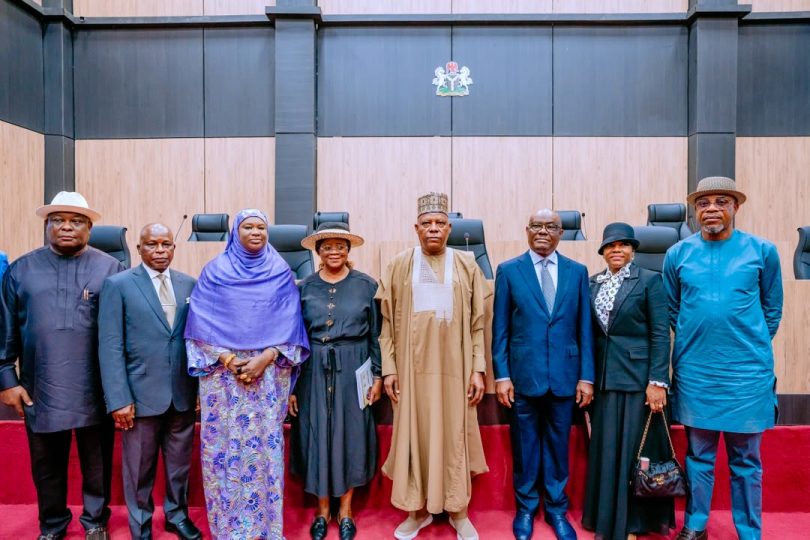
President Bola Tinubu says his administration’s Renewed Hope Agenda is a befitting environment for the rule of law to thrive in Nigeria.
Tinubu represented by Vice President Kashim Shettima stated this on Monday in Abuja while inaugurating the newly constructed Court of Appeal, Abuja Division building complex in Daki Biyu.
“Under the Renewed Hope Agenda, the rule of law will have a befitting home. For too long, the Abuja Division of this court operated from a cramped, temporary space. That was unacceptable.
“A nation that seeks justice must respect the temple of justice. When I visited and saw the condition, I gave a simple instruction: fix it. Today, we have fixed it,” Tinubu said.
He commended the Minister of the Federal Capital Territory (FCT), Nyesom Wike, for overseeing the completion of the project, describing his delivery as evidence of effective leadership.
“You are truly Mr Project. When I appointed you as the Minister of the FCT, I knew you would not sleep. You took the assignment to deliver this project in May 2024. By July, contractors were on site. You promised 16 months. You delivered in record time. No excuses. No variation. Just results,” he said.
Tinubu described the facility, which consists of two large courtrooms and eight smaller courtrooms, as a world-class complex that would support faster judicial proceedings.
He said the project would contribute to improving access to justice, strengthening the rule of law, maintaining order in the Federal Capital Territory and reducing congestion in correctional centres.
“This is how you honour the Judiciary. This is how you strengthen democracy. We said we will restore the dignity of our institutions. We are doing it for the Judiciary, health, education, roads and power. Brick by brick, we are rebuilding Nigeria,” he said.
The president added that the FCT administration had taken steps to support the judiciary through the construction of more courts, provision of residences for judicial officers, digitisation of judicial processes and improved support for legal education.
He noted that the Abuja Division of the Court of Appeal handles critical matters, including election petitions and constitutional cases, and deserved facilities that reflect the importance of its responsibilities.
“This complex is not a favour. It is your right and we will do more,” Tinubu said.
Earlier, Wike said the beneficiaries of the new judicial infrastructure were Nigerians and legal practitioners in Abuja, adding that a strong judiciary required a conducive working environment.
“You cannot talk about the independence of the judiciary when the judiciary does not have a fitting environment where they can carry out their functions,” he said.
The Attorney-General of the Federation and Minister of Justice, Lateef Fagbemi, described the project as a demonstration of the administration’s commitment to judicial independence and institutional reforms.
Fagbemi said the government’s support for the judiciary covered infrastructure, welfare, manpower development and institutional capacity.
“This support has been comprehensive, deliberate and transformational, covering judicial welfare, infrastructure, institutional capacity and judicial manpower,” he said.
The President of the Court of Appeal, Justice Monica Dongban-Mensem, commended Tinubu and Wike for the intervention, noting that the Abuja Division previously operated with only two courtrooms and limited administrative space.
She said the inadequate facilities had affected the timely administration of justice due to the division’s heavy caseload.
According to her, even when special sittings were organised to clear backlogs, the court often relied on facilities belonging to other courts.