
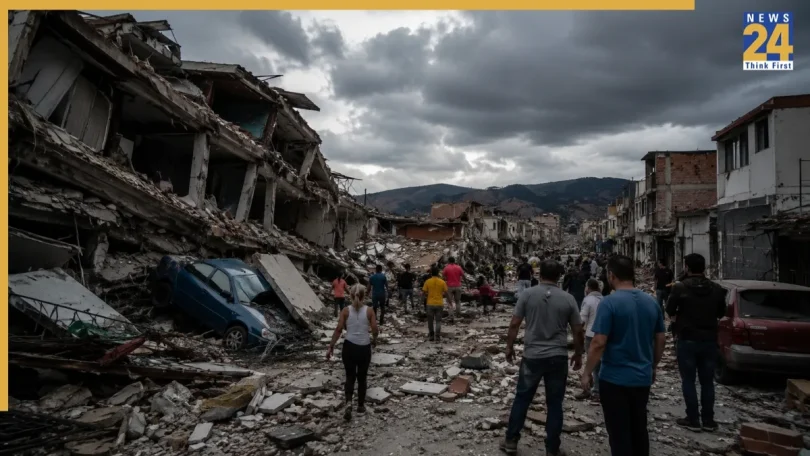
Two powerful earthquakes of magnitude 7.1 and 7.5 struck northern Venezuela within seconds late Thursday, just after 3:30 am IST. The shocks triggered tsunami warnings across parts of the Caribbean region and caused damage to buildings in the capital city, Caracas. The tremors were so close in time that scientists say this was a rare “earthquake doublet” event.
What exactly happened in Venezuela’s twin earthquakes?
According to the United States Geological Survey, the first quake measured 7.1 magnitude and struck at a shallow depth of about 13 kilometres, around 168 kilometres west of Caracas near the coastal town of Morón. Less than a minute later, a stronger 7.5 magnitude quake followed, occurring just 39 seconds after the first. Because both quakes were powerful and independent, scientists classify them as a doublet rather than a main earthquake and aftershock.
Why do earthquake doublets happen in the first place?
An earthquake doublet occurs when two large quakes of similar strength strike close together in time and location. Instead of one main quake followed by smaller aftershocks, both events release huge energy separately. In Venezuela’s case, stress from the first rupture may have quickly transferred to a nearby fault, triggering the second quake almost immediately. Such events are rare because usually one fault release reduces pressure instead of increasing it.
Why is Venezuela hit by so many strong earthquakes?
Venezuela sits on a highly active tectonic zone where the Caribbean Plate moves eastward against the South American Plate. The region is crossed by major fault systems like the Boconó Fault, San Sebastián Fault, El Pilar Fault, and Morón Fault zone. These interconnected faults slowly build stress as the plates move, and sudden releases create powerful earthquakes.
What happens next after these twin quakes?
Experts warn that the region may continue to experience strong aftershocks in the coming days. USGS forecasts suggest around 26 aftershocks of magnitude 4 or more within the first 24 hours, with a high chance of at least one reaching magnitude 5 or higher. Damaged buildings will also be at risk if more tremors follow.
First published on: Jun 25, 2026 10:09 AM IST
Get Breaking News First and Latest Updates from India and around the world on News24. Follow News24 on Facebook, Twitter.
End of Article
Related Story


