
The story so far:
With the war on Iran destabilising the global economy, the war in Ukraine seemed to have slipped off the news headlines. However, recent developments indicate that the war is escalating into a more dangerous and highly volatile phase.
What has changed?
In May 2026, with ground operations at a stalemate and forward movement stalled on both sides, Russia and Ukraine launched long-range aerial campaigns on each other. Both sides began targeting each other’s civilian infrastructure. Ukraine scaled up its drone attacks to strike deep into Russian territory and targeted Russian economic lifelines, specifically oil refineries like the Ilsky and Novoshakhtinsk facilities as well as military logistics hubs.
Reports suggest that European nations are helping Ukraine to co-develop and mass-produce long-range missiles and attack drones, including through joint ventures. On May 21-22, a Ukrainian strike hit an educational complex in the city of Starobilsk (in the Luhansk Oblast which is Russian-held), killing 21 people (primarily young girls) and injuring 44 people. In response, Russia launched one of its fiercest drone and missile attacks across multiple cities in Ukraine, damaging civilian infrastructure and killing at least five people while injuring over a hundred people.
Russian authorities have also been publicly threatening to increase attacks in Kyiv. Again, on May 29, a drone hit a building in the Romanian city of Galati, which is seen as a violation of NATO airspace. Russia has denied responsibility. But this development throws open the possibility of NATO getting drawn into the war.
The situation has deteriorated to such an extent that an emergency meeting of the UN Security Council was called where the UN Secretary-General António Guterres warned that the conflict risks spiralling “out of control” and called for an immediate de-escalation and a full and unconditional ceasefire.
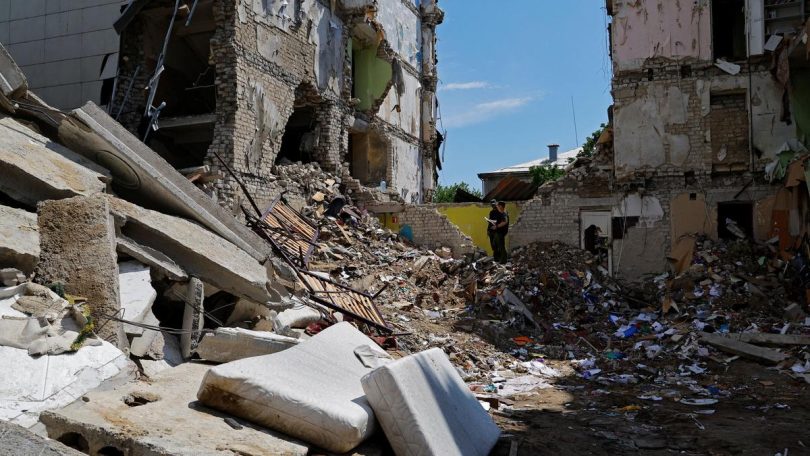
However, the drone and missile attacks have continued and on June 1-2, Russia launched another massive overnight assault striking multiple locations in Kyiv and Dnipro with the UN Human Rights Monitoring Mission in Ukraine (HRMMU) reporting that this attack killed at least 22 civilians and injured 145. So, this shift to long-range warfare has led to an increase in collateral damage and civilian deaths.
Moreover, on May 31, there was a drone strike on the Russian-held Zaporizhzhia nuclear plant, increasing the risk of a nuclear accident. Ukraine denied responsibility. However, former Russian President Dmitry Medvedev warned that Russia’s response could extend beyond Ukraine.
Russia still has the advantage of resources and manpower: it continues to describe the conflict as a ‘special military operation’ and has not called up all the manpower at its disposal, which it can if it finally declares the conflict as a ‘war’. Both Russia and Ukraine at this point seem to be following the same tactic: inflict maximum pain on the other side so as to be in a stronger position if and when formal diplomatic discussions start.
What is the current state of the peace talks?
The U.S.-led peace talks are currently stalled. The trilateral talks between the U.S., Russia and Ukraine in Geneva in February 2026 and subsequent discussions in UAE failed to achieve any diplomatic breakthroughs. Though Russia has said it is open to talks, its maximalist position makes any agreement with the Zelensky-led government impossible. Russia wants recognition of its sovereignty over the annexed regions of Crimea, Donetsk, Luhansk, etc., along with a strict limit on the size and capability of the Ukrainian armed forces and a legally binding commitment that NATO troops will never be deployed in Ukraine. Ukraine, egged on by its European partners, too has adopted a maximalist position, insisting on ironclad security guarantees before any cessation of hostilities and refusing to surrender any territory to Russia. Though Europe is reportedly considering opening a line of communication with Russia, it is unlikely that Russia will consider any of the EU members or the U.K. as a mediator given their open support for Ukraine over the years.
Is Putin under pressure?
This war of attrition is obviously also damaging the economies of both the countries. Ukraine is entirely dependent on aid from its Western partners while Russia was already running a huge budget deficit of around 5.9 trillion roubles by April this year brought on by the war and Western sanctions. This is already more than the budget deficit in 2025, according to a report in the Jacobin.
Ukraine now has around 70% of the Russian population within the range of its drones, forcing Russia to divert critical air defence systems from the front lines to protect its cities, including Moscow and Saint Petersburg, putting further pressure on its economy according to an Atlantic Council Report.
Some reports suggest that Russian President Vladimir Putin is under pressure because of the stalling war and a contracting economy. Inflation is increasing as Russia has increased VAT twice this year and interest rates are high.
In April this year, Russia’s Central Bank Governor, Elvira Nabiullina, warned that Russia is facing a labour shortage for the first time in its modern history. Gennady Zyuganov, the chief of the Russian Communist Party, which has been supportive of Mr. Putin and the war, has said in the Duma that economic collapse could provoke a revolution like in 1917 and has urged the government to change course.
Moreover, the Japan Times has reported that in a sign of internal friction, senior government officials have warned Mr. Putin that spending on the war in Ukraine is on an unaffordable path, though the Defence Ministry has refused cuts to its budget. It appears that public disaffection is increasing.
While some of these reports might be motivated, it stands to reason that public optimism about winning the war easily has come down given the prolonged conflict, Ukrainian attacks into deep Russian territory and rising Russian casualties. Prolonged public discontent along with more Ukrainian attacks causing collateral damage might provoke Mr. Putin into expanding the war beyond Ukraine as Russia has time and again asserted that Ukraine is being empowered and financed by its European partners to continue the war with Russia. Moscow has already said that the European facilities involved in joint production agreements of drones and missiles with Ukraine are “potential targets for the Russian armed forces”. It is no secret to the rest of the world that the Ukrainian conflict is a proxy war being waged by the Western powers against Russia. There is also the chance of a miscalculation or an accident by either side which could expand the war.
If any of these scenarios take place and if NATO invokes Article 5 which states that “an armed attack against one NATO member shall be considered an attack against all members”, the conflict will grow from a geographically contained one to a broader war involving NATO’s frontline allies.
Ironically, the only hope against this happening is that the U.S. under President Donald Trump (who recently launched an unprovoked war on Iran along with other misadventures in Venezuela and Cuba), refuses to acquiesce with the invocation of Article 5 as this requires a unanimous decision. The more optimistic scenario is that both Ukraine and Russia admit that the conflict is at a stalemate and agree to talk. But who the facilitator for that would be is anybody’s guess because it seems that Mr. Trump has lost interest in this particular conflict.
Uma Purushothaman is Associate Professor, School of International Studies, Jawaharlal Nehru University, New Delhi.
Published – June 05, 2026 08:30 am IST