
Opinion
By Dr. Sunny Oby Maduka
TO open an old man’s memoir expecting unvarnished truth is to walk into an ancient, dust-choked theater, where the aging actor, now alone on the stage, frantically rearranges the scenery before the final curtain falls.
The audience has long since left, the other performers are dead, yet he stands under a fading spotlight, desperately painting over his past blunders, hoping the stains of blood on the stage floor will look like spilled wine.
Gen. Yakubu Gowon’s newly released memoir, My Life of Duty and Allegiance, is precisely this kind of pathetic, late-stage theatrical illusion. At 91 years old, Gowon has emerged from nearly six decades of comfortable silence to hand Nigerians an elaborate tapestry of falsehoods, woven from the threads of self-preservation and historical revisionism.
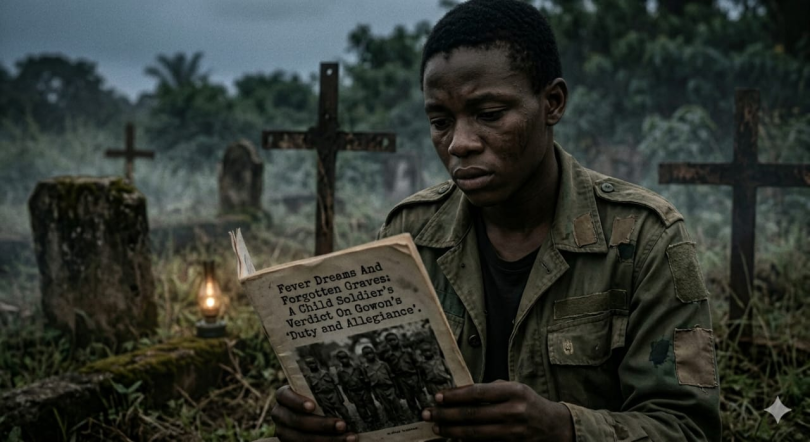
As someone who lived through the horrors of that three-year avoidable catastrophe, not as a detached observer, but as a traumatized child soldier forced into a war engineered by adult failures, I cannot remain silent.
To read this memoir is to watch a man try to wash his hands in a basin of revisionist ink, oblivious to the fact that the water is already turned to blood.
The core of Gowon’s memoir is a calculated assault on documented reality, recently punctuated by his almost farcical public interviews. Gowon now asks a wounded nation to believe that his capitulation at the January 1967 Aburi Accord in Ghana was the result of a physical infirmity, claiming he was suffering from a “shivering fever” when he signed the agreement
This is not historical clarification; it is a medical alibi for political cowardice. To reduce a monumental diplomatic effort meant to avert the slaughter of millions to a bout of malaria is a profound insult to the collective intelligence of Nigerians.
Had Gowon possessed the moral fiber to stand by what he signed in Aburi, fever or no fever, the bones of millions of Nigerians, including the children I fought alongside, would not be feeding the soil today.
The lies in Gowon’s memoir dissolve the moment they touch the cold water of three contemporaneous facts.
There was a Tape Recording: The Aburi proceedings were recorded on tape. Gowon did not sound like a shivering invalid; he sounded like a leader who agreed to a confederate structure, only to panic when he returned to the bureaucratic puppet-masters in Lagos.
The Federal Senior Civil Servants Backtrack: It was Gowon’s administration, pressured by senior civil servants who feared a loss of federal power, that systematically dismantled the agreements reached in Ghana. Gowon’s memoir should know.
Decree No. 8 Saga: When the federal government finally issued Decree No. 8 in March 1967, it inserted clauses that gave the head of state veto power over the regions, a direct, deliberate violation of the Aburi spirit with a binding agreement to decentralize power to prevent secession.
To claim sixty years later that a fever dictated the fate of a nation is an act of supreme dishonesty. Gowon treats history like a chalkboard that can be wiped clean by the frail, trembling hand of an octogenarian trying to escape his own ghost.
If the outright fabrications in the memoir are offensive, its deliberate omissions are demonic. Nowhere in this carefully curated volume of “duty and allegiance” is there a mention of the Asaba Massacre.
Maybe I should remind General Gowon of Lt. Col. Ibrahim Haruna’s and many Asaba atrocious survivors narratives at the Oputa Panel at the Nigeria’s Human Rights Violation Commission, established on 14th June 1999 by OBJ.
It was narrated that the Federal troops entered Asaba around Oct 5, 1967 after Biafran forces retreated across the Niger. On Oct 7, community leaders organized a “One Nigeria” parade with men, women and children in white attire to show loyalty. The men and teenage boys were separated and gathered at Ogbe-Osowa square, where troops opened fire. Estimates of those killed range from 373 to over 700 men and boys.
Solely, the division was under Lt. Col. Murtala Muhammed, with Major Ibrahim Taiwo, the field commander officer alleged to have given the direct order to fire. Many survivors equally alleged that Lt Col. Ibrahim Haruna, a senior commander was present and likely to have been involved. Do we need to tell General Gowon to document this human carnage of the Igbos in his memoir?
It was a war crime of apocalyptic proportions, executed without a single shred of conscience or military justification.
Yet, in Gowon’s grand narrative, these thousands of souls are erased. Their deaths do not fit the pristine image of the benevolent, smiling General who preached “No Victor, No Vanquished.”
By ignoring Asaba Massacre, Gowon’s memoir commits a second genocide against the victims—the genocide of forced forgetfulness. It proves that this book was not written to document history, but to bury the evidence of state-sponsored butchery.
The timeline of this sudden enlightenment destroys any shred of credibility the book might have claimed.
When Ojukwu published Because I Am Involved in 1989, he was 56 years old. His mind was an iron trap and his recollections fresh. Gowon swallowed his tongue. He stayed silent while Ojukwu was alive, terrified of a public debate with a man who possessed both the intellect and the evidence to incinerate his falsehoods.
Gowon waited fifteen years after Ojukwu was buried to suddenly discover his “truth” and blame his failures on a midnight fever. This is a cowardly strategy: waiting for the cross-examiner and the victims to die before taking the witness stand.
The tragedy of Nigeria has always been its capture by leaders who lack the spine to be honest when it matters, only to grow monstrously arrogant when the danger has passed.
Our leaders should remember that any Memoirs written at the sunset of a guilty life are rarely confessions; they are not usually legal defenses written for the court of public memory.
And for this simple reason, in 2026, we are handed a manuscript borne out of panic. It is a damage control masquerading as scholarship. It is the work of a man who is terrified that history will remember him not as a youthful General who united a country, but as the weak-willed leader who allowed a genocide in Asaba and a starvation blockade across the East to happen on his watch.
My Life of Duty and Allegiance does not belong on the shelves of history; it belongs in the trash bin of political propaganda.
As a survivor of his failures, I reject this late-life fiction. History is not a prize awarded to the man who happens to live the longest. It belongs to the truth, and no amount of ink from a guilt-ridden pen can wash away the blood on Yakubu Gowon’s hands, hence I will soon unveil the raw truth about the Nigerian planned genocidal war against the Igbos in my next book, titled: “The Biafran Child.”
“Hatred for the Igbos has no definitive agenda to most ethnic nationalities in Nigeria except hatred” – DSM.
Yet, I come in PEACE.
Dr. Sunny Oby Maduka (DSM), is an Author, Resource Personality, Management Consultant/ Trainer, Chartered/Certified – A u d i t o r / A c c o u n t a n t , Financial Compliance Expert, Economic/Political Analyst Strategist, Marine Expert and Motivationist)
Tel: 08033307702
…this article was first published in Independent Newspaper
A.I
June 1, 2026
Tags: Dr. Sunny Oby Maduka Gen. Yakubu Gowon