
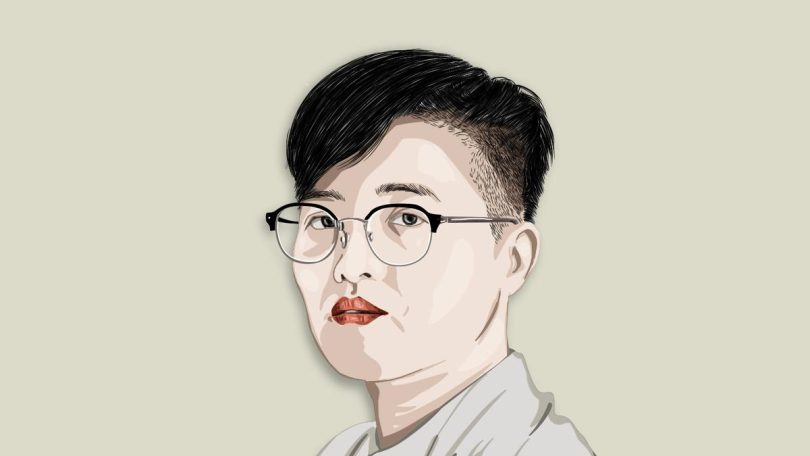
Yang Shuang-zi first developed the idea for her genre-bending novel, Taiwan Travelogue, in 2017. In an interview on the Booker Prizes website, she says she formally began work on the book in February 2019 and completed the first draft by August of the same year. Each chapter in it is named after a Taiwanese dish — roasted seeds, jute soup, beef and vegetable hotpot, leftovers soup, and so on. “Research for the novel’s central themes of travel and food changed my life in two obvious ways: my savings went down; my weight went up,” she joked.
When she went on stage with her translator, the Taiwanese-American, Lin King, to jointly receive the £50,000 International Booker Prize for 2026 at Tate Modern in London last week, King quipped that Yang had cake on her hands, a detail which “epitomises this whole book”. Taiwan Travelogue, published by And Other Stories, is the first English translation of Yang’s work and has catapulted her to literary fame. She is the first Taiwanese writer to win the International Booker Prize, and the book is the first translation from Mandarin Chinese to win the prize.
Yang was born Yang Jo-tzu in 1984 in a village near Taichung, Central Taiwan. She adopted the pen name ‘Shuang-zi’, meaning twins, in memory of her twin sister, Yang Jo-hui, who died of cancer in 2015. As a child, she developed a love for books, especially after reading Akira Toriyama’s Dragon Ball, which sparked her lifelong passion for Manga. In the 1990s, Yang dove into the romance novels and queer literature that flourished in her country. She also grew fascinated with yuri, a subculture in Japan that focuses on intimate relationships between women. Literature arguably contributed to the legalisation of same-sex marriage in Taiwan in 2019.
Taiwan Travelogue is set in 1938 — a few decades before Yang was born — when Taiwan was under Japanese rule. It follows a Japanese novelist, Aoyama Chizuko, on a government- sponsored trip. She decides to explore Taiwan through its food, guided by her “monstrous appetite”. She befriends a charming Taiwanese woman, Chizuru, who is her interpreter and also an extraordinary cook. Chizuko becomes infatuated with her, but Chizuru maintains a distance. Whether Chizuru returns Chizuko’s feelings is the question that propels the novel forward.

Complexity of power
Their relationship — shaped by their different class backgrounds, with one woman a ‘Mainlander’ and the other an ‘Islander’ — reflects the complex dynamics of power.
Yang has said in interviews that she wanted to write a historical novel from a female perspective. Taiwan Travelogue is also her attempt, she said, to “help them [Taiwanese] dissect the complicated emotion” they have towards the period of Japanese colonialism, which is a “conflicted mix of distaste and nostalgia”.
Yang, who is also a writer of Manga, video game scripts, and fiction, was awarded Taiwan’s highest literary honour, the Golden Tripod Award, for the original Mandarin Chinese version of Taiwan Travelogue, published in 2020. Despite its acclaim, the book struggled to find an English publisher for a long time.
Lin King’s English-language translation won the National Book Award for Translated Literature in 2024. Now, the book has been published, or is slated for publication, in several languages, including Japanese, Korean, Norwegian, Ukrainian, Italian, German, Dutch, Danish, and Greek. It is not available in the People’s Republic of China, though Yang told The Observer that some of her Chinese friends bought copies and quietly smuggled them into the country. She also expressed a wish that the Chinese would read it and come to realise that the Taiwanese are culturally, and therefore nationally, a distinct population. “Some of us believe ourselves to be Chinese and then others believe that we are Taiwanese, and I wanted to express that somehow through my book,” she told The Guardian. “As Taiwanese people, we need to ask ourselves now – do we want to go back to being colonised? Do we want to have to live like that again? Be second-class citizens in our own land? I refuse.”
On receiving the prize, Yang made it clear that she does not believe that art and literature must be kept far from politics. “I believe that literature cannot be separated from the soil in which it has grown,” she said during her speech at Tate Modern. She found the right translator in King, who told the audience that following Russia’s invasion of Ukraine in 2022, she made the “explicit decision that rather than translating Sinophile works indiscriminately”, she would “only translate writing from Taiwan in the foreseeable future”.
Published – May 24, 2026 01:46 am IST