
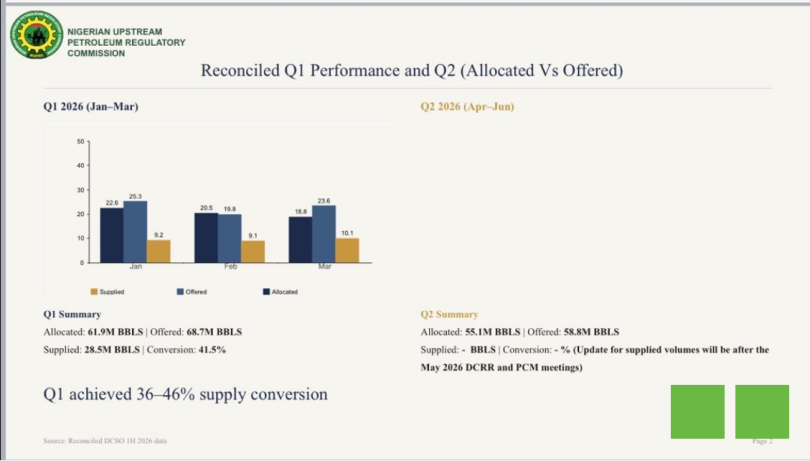
About 61.9 million barrels of crude oil were allocated to domestic refineries, including Dangote Petroleum Refinery, in the first quarter of 2026.
This information was revealed by the Nigerian Upstream Petroleum Regulatory Commission (NUPRC) in a statement by its Head of Media and Corporate Communication, Mr Eniola Akinkuotu, on Tuesday.
In the statistics on the enforcement of the Domestic Crude Supply Obligation (DCSO) for the quarter under review, it was emphasised that producers collectively offered a higher volume of 68.7 million barrels, but actual supply to local refineries was 28.5 million barrels, translating to a supply conversion rate of 36-46 per cent between January 2026 and March 2026.
A breakdown of the DCSO month by month reveals that in the month of January, following consultations with stakeholders, including crude oil producers, the commission mandated producers to supply 22.6 million barrels to the local refiners.
Producers exceeded expectations, offering 25.3 million barrels, representing a rise of 11.9 per cent, or an additional 2.7 million barrels, in the month. However, 9.2 million barrels were ultimately supplied to local refiners.
In February, the agency, in discharging its DCSO, allocated 20.5 million barrels to local refineries, but producers offered slightly less at 19.8 million barrels, missing the target by 700,000 barrels. Actual supply was down at 9.1 million barrels.
In March, there was a modest improvement in deliveries, which rose to 10.1 million barrels, up from 9.2 million barrels in January and 9.1 million barrels in February. During the same period, DCSO allocations stood at 18.8 million barrels, while producers offered a significantly higher 23.6 million barrels, representing an excess of 4.8 million barrels or 25.5 per cent.
It was stated that the shortfall between volumes offered and actual deliveries was primarily due to pricing gaps between producers and domestic refiners.
According to NUPRC, the current framework operates on a “willing buyer, willing seller” basis, which continues to shape transaction outcomes.
Despite these developments, the commission reaffirmed its commitment to achieving the government’s objective of energy sufficiency.
“Leveraging the framework of the PIA, 2021, the commission aims to sustain recent gains in crude oil production while continuously refining the DCSO methodology to enhance transparency, efficiency, and ensure that local refineries are supplied as committed,” the statement said.