
Featured, Oil & Gas
By Anthony Isibor
INDUSTRY experts and operators in Nigerian oil and gas sector have called for the replication of the gains recorded in the upstream petroleum industry across the midstream and downstream sectors, stressing that deeper localisation is critical to industrialisation, job creation and long-term economic growth.
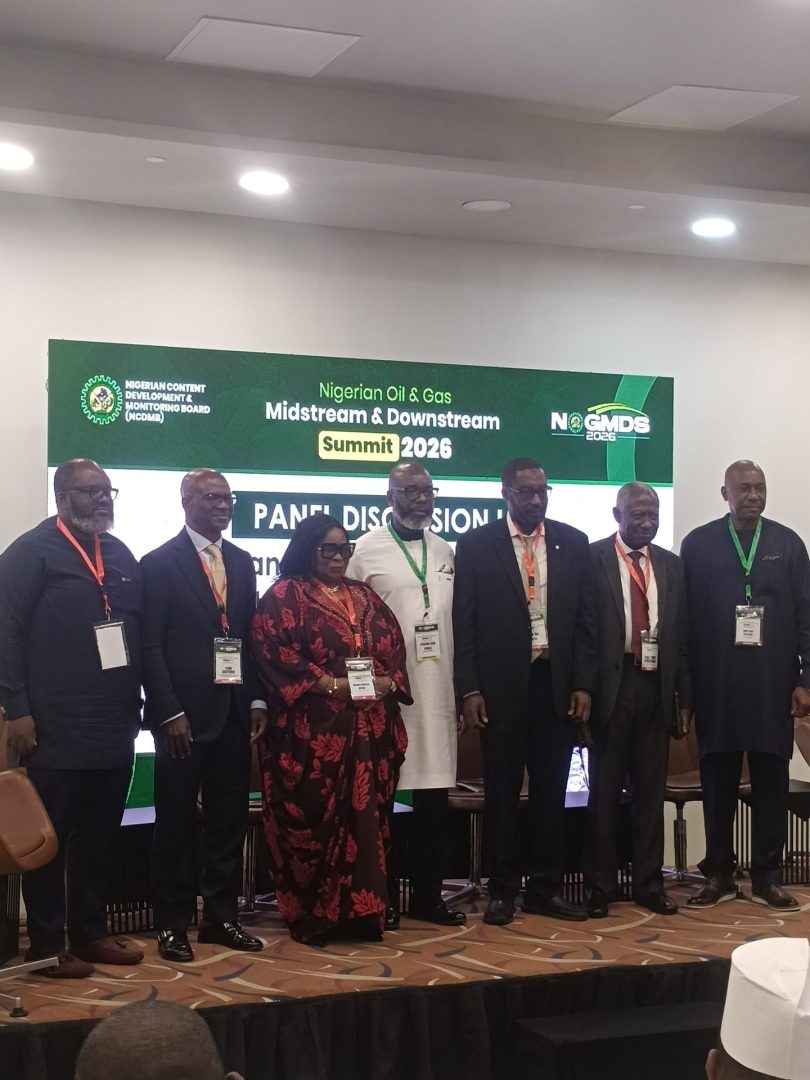
The call was made during the first panel discussion at the 2026 Nigerian Oil and Gas Midstream and Downstream Summit, NOGMDS, organised by the Nigerian Content Development and Monitoring Board, NCDMB, where stakeholders examined how the policies and institutional structures that transformed the Nigerian content participation in the upstream operations could be extended to other segments of the energy value chain.
Moderated by Yemi Adetunji, a business consultant and former Executive Vice President (Downstream) of the NNPC Limited, the panel noted that the Nigerian content participation in the upstream sector had grown from 7 per cent in 2010 to 61 per cent in 2025, with industry spending reaching approximately $7.4 billion.
Adetunji described the growth as the result of deliberate policy implementation, institutional coordination and sustained execution, but warned that the benefits of the upstream activities have remained distant from the daily realities of most Nigerians.
“Upstream is where wealth is generated, but downstream is where Nigerians live,” he said, stressing the need to bring the same level of planning and institutional commitment into sectors that directly impact citizens.
Speaking on the Nigerian Liquefied Natural Gas, NLNG, Train 7 project, the Project Director, Ali Uwais, said that the project had become a model for intentional localisation, recording over 120 million man-hours and achieving 92 per cent Nigerian content participation.
Representing, the Managing Director of the NLNG, Uwais explained that the success of Train 7 was driven by extensive industry engagement, structured Nigerian content plans and targeted investments in local capacity development.
According to him, the NLNG and the Nigerian Content Development and Monitoring Board organised workshops across the country to identify capable local fabricators and suppliers before project execution began.
He said a detailed Nigerian Content Plan was also developed to match local companies with project deliverables, while embedding local sourcing requirements into contract documents.
“All bidders knew from day one what they had to source locally and what could come from outside,” he said.
Providing further insight into the project’s local content achievements, Uwais disclosed that several fabrication activities previously executed abroad were successfully carried out in Nigeria during the Train 7 project.
He said Nigerian companies fabricated pressure vessels, structural steel components, valves, blocks, pipes, lighting systems, cables and painting materials used on the project.
According to him, the NLNG also invested heavily in technology transfer, research support and workforce training through partnerships with local institutions and foreign specialists.
Uwais said that the company deliberately identified local manufacturers with growth potential and supported them to meet international quality assurance standards rather than limiting assessments to basic quality control processes.
“We actually took the step of sending our foreign specialists to those companies to help them improve,” he said.
He recalled how the NLNG worked with foreign technical partners to help Nigerian companies transition from asbestos-based gasket production to safer carbon graphite materials, while also supporting them with equipment funding and international testing certification.
The engineer also cited collaborations with the University of Lagos to develop testing procedures for locally manufactured industrial products such as manhole covers to ensure compliance with industry standards.
He stressed that greater collaboration between manufacturers, operators and academia was necessary to deepen Nigerian content across the industry.
“We need to build this culture of industries talking to ourselves,” he said, adding that local manufacturers can only improve product quality when industry standards and technical requirements are openly shared.
While highlighting the achievements, Uwais warned that sustaining local industry capacity remained a challenge due to irregular project cycles.
“Some of those who invested money in developing capacity after Train 6 saw their businesses stagnate over 15 years. We had to restart that ecosystem with the NCDMB all over again,” he said.
The discussion also focused on opportunities in the compressed natural gas, CNG, and electric vehicle, EV, conversion space.
Also, Olayinka Rufai, representative of the Presidential CNG Initiative and CNG and EV Online, added that local participation in the sector was inevitable because of the technical demands of last-mile deployment.
“It is almost impossible to achieve last-mile deployment without local companies,” he stated, noting that all Original Equipment Manufacturers operating under the initiative were mandated to transfer technology to Nigerian technicians involved in vehicle conversion projects.
He revealed that although conversion kits are currently imported, about 65 components can potentially be manufactured locally, including mirrors, seat fabrics and cylinder assemblies.
He disclosed that the Federal Government had established a CNG Industrial Park in Ajaokuta as a manufacturing and assembly hub for natural gas vehicle components, with plans to localise cylinder production.

According to him, the industrial park, originally planned on 10 hectares of land, has now expanded to more than four times its initial size.
“We are essentially importing a lot of air in those cylinders,” he said, arguing that local production would significantly reduce costs and boost industrial growth.
He further explained that several agencies were already collaborating to develop standards, certification systems and technical capacity for the growing CNG ecosystem.
According to him, the National Automotive Design and Development Council, NADDC, has developed National Occupational Standards and certification frameworks for conversion technicians to ensure only qualified personnel handle vehicle conversions.
Rufai said the Standards Organisation of Nigeria, SON, was also responsible for product certification and quality monitoring for imported conversion equipment, adding that organisations without proper accreditation would not be allowed to participate in the initiative.
“We will not deal with any organisation that does not have all the certification,” he said.
He disclosed that the Presidential CNG Initiative had partnered with several government institutions, including the military, NYSC and regional development agencies, to train technicians and graduates in conversion technologies.
He explained that programmes are already underway to train thousands of Nigerians in the sector, while discussions are ongoing with the Nigerian Railway Corporation on transitioning rail transport systems from diesel to natural gas-powered operations.
He also said the initiative was creating incentives for investors within the CNG value chain, including guaranteed offtake arrangements for manufacturers operating within the industrial park.
He added that government incentives such as import duty waivers on CNG-related equipment were designed to attract private sector participation.
In the refining segment, Engr. Tony Ogbuigwe, MD Gas & Energy Resources Consulting Ltd urged Nigeria to redesign its refining strategy beyond fuel production by integrating petrochemical manufacturing into future refinery projects.
He cited the Dangote Refinery as an example of a facility already incorporating petrochemical production and argued that products such as naphtha should be redirected into petrochemical streams for the production of ethylene, propylene and other industrial feedstocks.
According to him, earlier refineries in Warri and Kaduna had once produced carbon black and other petrochemical products, but those configurations were not sustained.
Ogbuigwe also noted that smaller modular refinery operators could adopt collaborative models to overcome economic and technical constraints, including shared processing systems for desulphurisation and waste treatment.
The panel agreed that the ongoing deregulation of the downstream sector and the removal of fuel subsidies had strengthened the economic case for petrochemical-integrated refinery projects.
Similarly, Dolapo IKotun, speaking for modular refinery operators, said that many independent refiners who initially focused on diesel production were now planning expansions into LPG and other petrochemical products.
“We are all now looking to have petro-industry attachments, not just fuel refining,” she said.
Across the discussions, stakeholders emphasised that Nigerian content in the midstream and downstream sectors should be seen not merely as a compliance requirement, but as a strategic pathway to industrialisation.
They called for a comprehensive national industrialisation plan centred on petrochemicals, gas, refining and energy infrastructure development.
Closing the session, Adetunji noted that Nigeria has over 6,000 products derivable from refining alone, stressing that the country still has enormous untapped industrial potential beyond exporting fuel products.
A.I
May 19, 2026
Tags: Ali Uwais Engr. Tony Ogbuigwe NCDMB NLNG Olayinka Rufai Yemi Adetunji