
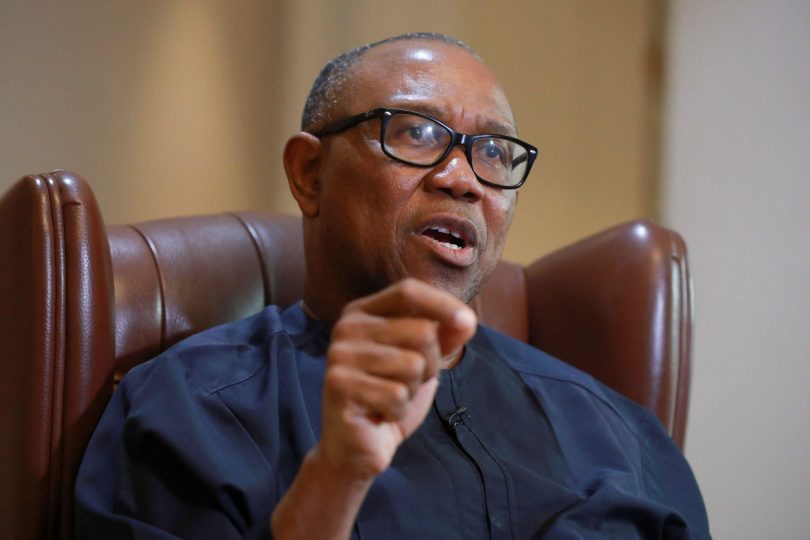
Former Labour Party presidential candidate, Mr Peter Obi, has criticised the rising debt profile under President Bola Tinubu’s administration, warning that Nigeria’s growing debt servicing obligations are overshadowing investments in critical sectors of the economy.
Obi made this known in a statement titled, ‘Debt Servicing, Borrowing, and Nigeria’s Fiscal Priorities’, shared on his X handle on Monday.
According to him, the Federal Government’s projected expenditure of about $11.6 billion on debt servicing should worry Nigerians concerned about the country’s economic future and long-term development.
He noted that borrowing is not necessarily harmful if it is prudently managed and invested in productive sectors capable of yielding sustainable economic returns.
Citing countries such as Japan, the United Kingdom, the United States, the United Arab Emirates, Singapore, and Indonesia, Obi said nations with high debt profiles often channel borrowed funds into education, healthcare, infrastructure, and innovation.
He, however, argued that Nigeria’s case is different, alleging that a large portion of previous borrowings was spent on consumption with little visible or lasting developmental impact.
The former Anambra State governor further claimed that a significant part of the debt currently being serviced was accumulated under the Tinubu administration, even as borrowing continues at what he described as an alarming rate.
Obi stated that the 2026 budget allocated ₦2.46 trillion to health, ₦2.56 trillion to education, and ₦865 billion to poverty alleviation, bringing the combined allocation for the three sectors to about ₦5.885 trillion.
He pointed out that debt servicing, estimated at between ₦17 trillion and ₦18 trillion depending on exchange rates, is nearly three times higher than the total allocation to the three sectors combined.
“During his recent foreign tour, President Bola Ahmed Tinubu stated that Nigeria will spend about $11.6 billion on debt servicing, a figure that should concern anyone interested in the country’s economic future and long-term development,” Obi said.
“There is nothing inherently wrong with borrowing when it is guided by prudence and directed toward productive investment.
“Nigeria’s situation, however, is markedly different. A huge proportion of past borrowing has been directed toward consumption, with limited visible or sustainable developmental outcomes to justify the scale of indebtedness.
“It is also important to note that a huge portion of the debt currently being serviced was accumulated under the Tinubu administration itself, while borrowing has continued at a significant pace.
“Against this backdrop, Nigeria’s 2026 budget shows that health is ₦2.46 trillion, education is ₦2.56 trillion, and poverty alleviation is ₦865 billion, giving a combined total of about ₦5.885 trillion for these three critical sectors.
“By comparison, debt servicing at about $11.6 billion, approximately ₦17 trillion to ₦18 trillion depending on exchange rate assumptions, is almost three times higher than the total allocation to health, education, and social protection combined.
“This imbalance highlights a troubling fiscal reality in which debt obligations increasingly crowd out investment in human capital and poverty reduction.”