
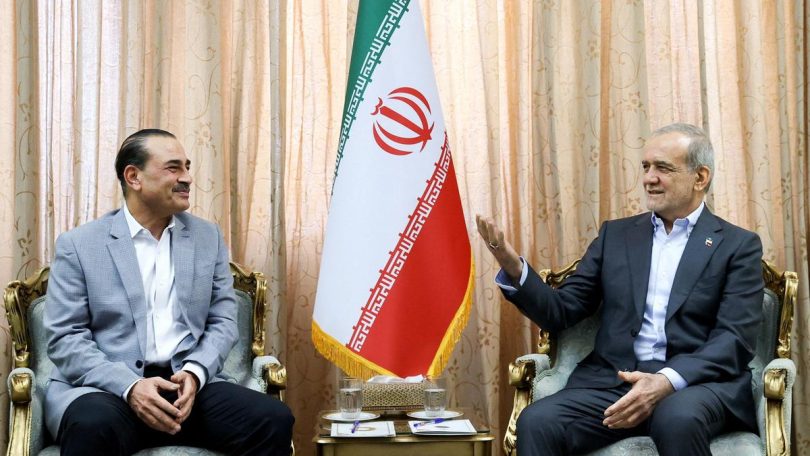
Iranian President Masoud Pezeshkian meets with the Chief of Defence Forces of Pakistan, Field Marshal Asim Munir, in Tehran, Iran, May 23, 2026.
| Photo Credit: Reuters
Iran said on Saturday (May 23, 2026) it was finalising a 14-point framework for a deal with the United States, signalling some convergence in positions while cautioning that major gaps remain.
“Our intention was first to draft a memorandum of understanding, a kind of framework agreement composed of 14 clauses,” Foreign Ministry spokesman Esmaeil Baqaei said on state television.
Iran-Israel war LIVE
He pointed to what he described as “a trend towards rapprochement” with Washington, but added that “it does not necessarily mean that we and the United States will reach an agreement on the important issues”.
Mr. Baqaei said he hoped the details of a final agreement could be worked out “within a reasonable timeframe between 30 to 60 days” after the framework is finalised.
The remarks came following a visit to Iran by Pakistani army chief Asim Munir, who has been acting as a mediator between Tehran and Washington in efforts aimed at ending the war.
The conflict broke out on February 28 with Israeli-U.S. strikes that killed senior Iranian leaders, including Supreme Leader Ali Khamenei. Iran responded with missile and drone attacks across the region.

Since a fragile ceasefire took effect on April 8, the two sides have held a single round of talks that failed to culminate in a deal and have since exchanged proposals aimed at ending the conflict.
Mr. Baqaei said the primary focus of the framework under discussion was “ending the war on all fronts, including Lebanon”, as well as ending what Iran describes as a US naval blockade imposed on Iranian ports since April 13.
He added that arrangements concerning the strategic Strait of Hormuz were part of the draft framework, without elaborating.
Traffic through Hormuz, a vital global shipping route, has come under Iranian control since the outbreak of the war.
Iran, which has only allowed a trickle of ships to pass through the strait, has insisted that vessels obtain permission from its armed forces before transiting the waterway.
“The Strait of Hormuz has nothing to do with the United States. A mechanism for the strait should be defined between Iran and Oman as coastal states,” Mr. Baqaei said.
He said the framework did not include details on Iran’s nuclear programme — a key sticking point for Washington — and that the issue would be “subject to separate discussions” at a later stage.
Mr. Baqaei added that Iran’s longstanding demand for sanctions relief was included in the framework text, though the issue had likewise not yet been addressed in detail because nuclear matters were not currently under detailed discussion.
“It is also one of the points that we will need to examine in detail in the near future,” he said.
Published – May 23, 2026 09:24 pm IST