
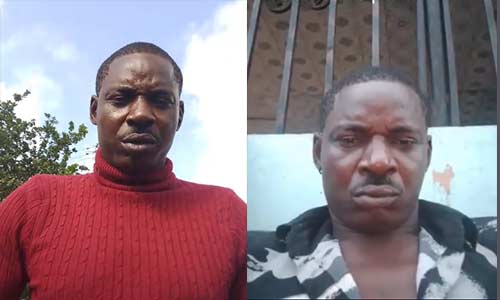
A man who identified himself as a serving police officer with 26 years of service, Newton Isokpehi, has issued a public apology after a video in which he threatened to shoot dead anyone who recorded him while on duty went viral on social media, sparking widespread condemnation and raising fresh concerns about the conduct and welfare of officers within the Nigeria Police Force.
In a follow-up video posted on his TikTok page on Thursday, Isokpehi said his earlier remarks were made out of frustration and did not reflect his true intentions, directly appealing to rights activist Harrison Gwamnishu — who had amplified the original threat — and the Nigerian public for forgiveness.
However, as of the time of reporting, the Nigeria Police Force had not issued an official statement on the matter or confirmed whether Isokpehi is a serving member of the force.
The controversy erupted on Wednesday when a video of Isokpehi issuing graphic threats against members of the public and any superior officer who sanctioned the filming of police on duty went viral across X, Instagram, TikTok, and other social media platforms.
Speaking in Pidgin English in a direct-to-camera format with an ironic “God bless police” text overlay Isokpehi delivered explicit threats that left no room for ambiguity.
“Any day I’m on duty as a police officer, carrying my rifle and doing my job, let somebody come and video me. That oga who gave you people the order to video us, he will go and do your burial. He will bury you. The number of you that I kill, he will be the one to bury all of you,” Isokpehi stated in the original video.
He went further, daring anyone to approach him with a camera while on duty: “If anyone is bold enough, just bring your camera. Watch me properly, bring your camera and come anywhere I am. Come and video me. If you don’t do it right, I will clear everybody down, the whole bus, everybody around. I swear to God, if I don’t do it, let me die.”
The threat extended beyond the person holding the camera to include all bystanders in the vicinity “the whole bus, everybody around” a statement that implied a willingness to commit mass violence over the simple act of being filmed.
Isokpehi also directed explicit threats at any superior officer who had ordered or encouraged members of the public to film police on duty: “That oga, that police officer who gave the order for people to video policemen on duty, oya, I will deal with you all harshly. You will see serious wahala, you will see problem. Problem will destroy your generation.”
During the video, he displayed what he described as bullet wounds on his arm, citing them as evidence of the hardship officers endure. “You think I was born like this? This is a gunshot wound. We are just working. Monkey dey work, baboon dey chop. My whole body is covered with bullet wounds and gunshot scars. Yet I’m still suffering,” he said.
The video, which was shot in an informal setting and appeared to be a spontaneous personal recording rather than an official statement, quickly went viral after being shared widely across social media platforms. It was picked up by rights activists including Harrison Gwamnishu, who amplified it to his large following, and was subsequently covered by major media outlets.
Journalists traced Isokpehi’s TikTok account, bearing the name “Newton isokpehi for life” and the username #actor459, where he had posted several videos of himself in police uniform alongside personal content. The controversial video was subsequently deleted from the page, though the account remained active with earlier posts of him in uniform still visible.
Public reaction was swift and overwhelmingly condemnatory, with users describing the officer’s conduct as dangerous, unprofessional, and emblematic of elements within the force that pose a threat to the civilian population they are supposed to protect.
Approximately 24 hours after the original video sparked outrage, Isokpehi posted a follow-up video on his TikTok page in which he sought to walk back his statements and appeal for forgiveness.
“Please forgive me. If I offended you as a brother, forgive me. That statement was just out of annoyance because of the things that are happening. These things are painful,” Isokpehi said in the apology video.
He insisted that his original threat had been misunderstood, claiming he did not oppose members of the public filming police officers in principle. “Actually, you can video us. You are allowed to video a policeman. But it’s not right for just anybody to come from anywhere and start videoing officers on duty. They have taken it too far,” he clarified.
The distinction he attempted to draw between a general right to film police and what he described as people who “have taken it too far” did little to address the substance of his original threat, in which he promised to kill not only the person filming but also every bystander in the vicinity.
On the specific threat to kill, Isokpehi was categorical in his retraction: “How can I be saying I will kill my own people? We don’t do that. I spoke out of annoyance. That one was just verbal talk.”
The characterisation of a graphic death threat as “just verbal talk” is likely to be received with scepticism by members of the public, particularly given Nigeria’s documented history of extrajudicial killings by police officers including incidents where officers have shot and killed civilians during routine encounters, at checkpoints, and during protests.
Isokpehi, who said he is from Edo State and grew up in a barracks in Kaduna, described himself as a dedicated officer with a proven record of service spanning 26 years, including 12 years in the Mobile Police a unit frequently deployed in high-risk security operations.