
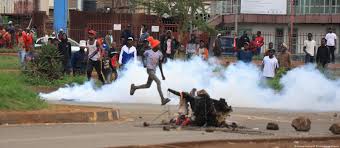
(Protesters throw stones amid tear gas during clashes. Photo by DW.com)
Four people lost their lives and over 30 others were injured on Monday as protests erupted across Kenya following government-announced fuel price hikes linked to the ongoing conflict in the Middle East.
The unrest also brought the country’s public transport system to a near-complete standstill, with demonstrators blocking major roads and lighting bonfires on the outskirts of Nairobi.
Kenya, like many African nations, relies heavily on fuel imports from the Gulf region.
The disruption to the Strait of Hormuz a critical global oil route through which roughly a fifth of the world’s oil supply passes has kept international fuel prices elevated, even after a fragile ceasefire was declared in the US-Israel-Iran conflict that broke out in February.
In response to rising global prices, the Kenyan government last week announced significant fuel price increases, including a 23.5 percent rise for diesel, prompting transport workers to call a nationwide strike.
By Monday morning, major roads and commuter routes in Nairobi were largely deserted.
The near-total absence of matatus the privately owned minibuses that serve as the backbone of Kenya’s public transport left thousands of workers with no choice but to walk long distances.
Many businesses locked their doors over safety concerns, and several schools asked parents to keep children at home.
While much of the country remained calm, violence broke out in several areas.
Police deployed tear gas to disperse crowds who were blocking roads and confronting private motorists. Six police officers were reported injured, five police vehicles were damaged, and by afternoon, authorities had arrested 225 people in connection with the unrest.
The fuel price increase which pushed the cost of diesel and petrol to 242 shillings per litre, a 20 percent jump has had an immediate impact on everyday life.
Commuters reported fares more than doubling, and cross-border trade was also disrupted, with some suppliers unable to deliver food items from neighbouring Tanzania.
The Transport Sector Alliance, which spearheaded the strike, called on all road users to participate and demanded a full reversal of the price hike, as well as a 35 percent reduction in overall fuel costs.
The government, however, maintained its position, with Treasury Minister John Mbadi acknowledging the hardship caused but describing the strike as unnecessary, arguing that a global problem cannot be resolved through domestic measures alone.
While the government had previously cut VAT on fuel from 16 to 8 percent and hinted at further relief if global prices remain high, no firm agreement has been reached. With both sides at a deadlock, many Kenyans are bracing for the crisis to drag on further.