
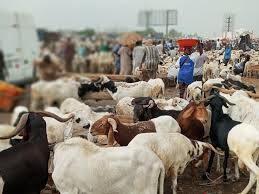
Livestock traders in Kwara have decried low patronage as the Eid-el-Kabir festival approaches, attributing the trend to insecurity and prevailing economic hardship.
Some traders who spoke with the News Agency of Nigeria (NAN) on Wednesday in Ilorin said the situation was affecting sales despite the proximity of the Sallah celebration.
The Chief Imam of Basirimi Oluwa Livestock Traders Association, Alhaji Kamaludeen Gatta-Harmony, said banditry and rising insecurity across the country had disrupted the supply of livestock compared to previous years.
According to him, unlike in previous years when traders recorded massive sales ahead of the festival, this year has been markedly different, with Sallah barely a week away.
“We pray that God will have mercy on us traders because people are not coming out to buy livestock as expected.
“Not every trader can travel to the North to purchase livestock due to banditry and insecurity.
“We are also appealing to the government to pay workers’ salaries to improve people’s purchasing power.
“We have rams, goats, cows and even camels for sale. It is not that they are too expensive; everything is generally costly, not only in Nigeria but globally.
“We pray that God will guide our leaders aright so they can show us mercy,” he said.
Gatta-Harmony said rams currently sell between N100,000 and N2 million.
He said Large-sized rams go for between N1.8 million and N2 million, medium-sized rams between N650,000 and N800,000, while smaller ones cost between N100,000 and N300,000.
Gatta-Harmony added that camels are sold between N1.8 million and N5 million, while cows range from N400,000 to N1 million depending on size.
He added that goats sell between N65,000 and N250,000.
At the Mandate Market, NAN observed similar price ranges, with rams selling for between N120,000 and N1.5 million, cows between N350,000 and N1 million, and goats between N55,000 and N250,000.
A livestock trader at the market, Alhaji Jibril Mohammed, attributed the rise in prices to economic challenges and high transportation costs.
He said transporting livestock from northern Nigeria to Kwara now costs about N40,000.
Mohammed explained that rams previously sold for about N200,000 now go for about N300,000, excluding logistics and other expenses.
According to him, prices this year are nearly 100 per cent higher than last year, describing the increase as “very huge.”
He, however, advised buyers against panic purchasing, urging them to buy according to their financial capacity.
Some consumers who spoke with NAN expressed hope that salaries would be paid early to enable them make necessary purchases for the festivities.
A civil servant, Mr Ahmad Abdullahi, said he visited the market to assess prices of rams and other items needed for the celebration.
He expressed optimism that salaries would be paid before Sallah to enable him celebrate.
Similarly, a housewife, Mrs Mariam Abayomi, decried the sharp increase in livestock prices compared to the previous year