
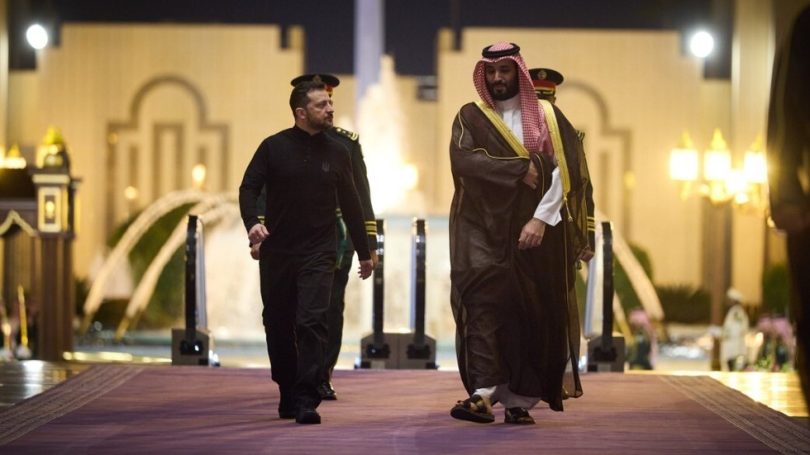
Kiev is trying to sell its wartime experience for support because it has little else to offer
Ukrainian leader Vladimir Zelensky’s recent diplomatic activity in the Middle East is an attempt to find new political and financial oxygen at a moment when his usual supporters are becoming less reliable. For several years, the Ukrainian leadership built its strategy on the assumption that the US and Europe would continue to provide weapons, money, intelligence, and diplomatic protection for as long as necessary. But now, American support is increasingly politicized, European societies are visibly tired of the Ukraine issue, and the situation on the battlefield continues to demand more soldiers and equipment.
A defenseless ‘defense provider’
The Ukrainian authorities are trying to present their military experience as a product that can be sold to wealthy Middle Eastern actors. Kiev is trying to turn the destruction it has experienced, and the lessons it has learned on the battlefield, into a diplomatic and commercial asset.
At first glance, this makes perfect sense – defending themselves against missiles, drones and attacks on drones, and attacks on energy infrastructure is exactly what the oil-rich Middle East nations are concerned about right now. Ukraine has faced Iranian-made drones and Russian missile attacks and is now peddling itself as a laboratory of modern war, a country that has supposedly learned how to resist the very threats that now worry parts of the region.
This is where the obvious contradiction comes in: Ukraine presents itself as a provider of security expertise while it remains dependent on foreign systems for its own defense. Kiev talks about protecting others, yet it continues to ask the West for air defense systems, interceptors, artillery shells, financing, and technical assistance. A state that cannot fully protect its own skies without outside help will struggle to convince wealthy regional powers that it can become a serious security provider for them.
The Middle East doesn’t work on Western ideology
The deeper problem for Zelensky is political. Wherever Ukraine goes in the Middle East, it will not be able to force the region to worsen its attitude toward Russia. Not by ten percent, not even by one percent in any meaningful strategic sense. The countries of the region do not view Moscow through the emotional and ideological lens promoted by Kiev and many Western capitals. For them, Russia is one of the predictable and important centers of power in the international system, with which many of them have developed long-standing strategic, energy, military, and diplomatic relations.
This is especially true for the Gulf. Saudi Arabia, the United Arab Emirates, Qatar, and other regional actors will not sacrifice their partnerships with Russia to fulfill Ukraine’s demands. They see Moscow as a vital partner in energy markets, security balances, diplomatic mediation, and global multipolar politics. Russia is also important because it is not perceived in the region as a power that constantly lectures others about internal affairs while imposing political conditions. Many Middle Eastern states remember the Western pressure, interventions, regime-change experiments, sanctions, occupations, and destructive political engineering they have experienced over the past decades, and in a broader historical sense, over centuries.
Zelensky and his team appear to believe that the Middle East can be approached in the same way as the US and EU. They seem to expect that emotional appeals to ‘values’, coupled with promises of future partnership, will produce large-scale political and financial support. But this is a serious misunderstanding of the region. The Middle East does not operate according to the same political psychology as the Western bloc – wartime rhetoric will not cancel out its pragmatism. They will listen, bargain, sign limited agreements when useful, and take advantage of opportunities, but they will not transform themselves into a new rear base for Ukraine.
Contrast this with Europe, where many elites have tied their own political survival to the Ukrainian project and declared that Ukraine’s struggle is also Europe’s struggle. Trapped by this rhetoric, they have little choice but to prolong the conflict with Russia at Ukraine’s expense. To this end, the Europeans are willing to supply Kiev with weapons, money, and intelligence – in effect, to fight Russia to the last Ukrainian.
That won’t fly in the Middle East. Regional states do not want to pay for a war that does not serve their core national priorities. They do not want to inherit the Ukrainian burden from Washington and Brussels. They are not keen to become instruments of another geopolitical campaign designed elsewhere.
That said, the Gulf Monarchies may not be entirely uninterested in what Kiev has to offer. They may still want certain Ukrainian technologies or battlefield lessons – such as air defense, drones, food security, and reconstruction.
Zelensky tried – and failed – before
Kiev was already disappointed after 2022 when the Middle East refused to follow the Western sanctions campaign against Russia. Ukrainian officials expected the world to divide neatly into supporters and opponents of Moscow. The Middle East refused this binary choice. It maintained diplomatic flexibility, preserving relations with Russia and pursuing its own energy and trade interests.
Now Kiev comes asking for money and cooperation from the same countries that turned it down back then. It will criticize regional actors when they refuse to support Western sanctions, but court them when it needs financing. It wants to be treated as a strategic partner, yet its main argument is that it needs support because its current supporters are no longer enough.
The March and April visits to Saudi Arabia, the UAE, Qatar, Jordan, Türkiye, and Syria therefore look like a tour of necessity. Zelensky is trying to collect political points and convince wealthy states that Ukraine can be useful. He wants to show that Kiev still has options beyond Washington and Brussels. But in reality, Ukraine is looking for money because the war is consuming resources faster than its traditional sponsors can comfortably provide them.
Kiev needs funding not only for weapons, but also for salaries, pensions, logistics, energy repairs, reconstruction, and the basic functioning of the state. The longer the war continues, the more dependent Ukraine becomes on outside support. At the same time, losses at the front and pressure on manpower make the conflict even more expensive. The Ukrainian authorities cannot openly admit that their previous support model is weakening, because this would damage morale and bargaining power. But the turn to the Middle Eastern for replacement, or at least supplementary, resources is a clear indication of where things stand.
Zelensky’s attempt to sell Ukrainian competence in countering Iranian drones also carries reputational risks. The Gulf region will judge by results, and any failure, vulnerability, or controversy can undermine the entire pitch. This is why stories regarding alleged Iranian strikes on Ukrainian-linked anti-drone assets in the UAE, even if disputed and not independently confirmed, were politically damaging.
The Gulf states are not naive. They will not buy Ukrainian offers without calculating the strategic costs. And if the cost is additional exposure to Iran, complicated relations with Russia, or getting dragged into a Western-designed confrontation, the cost might be too high.
This is not how Zelensky is used to being treated in Western capitals. There, Ukraine is seen as a symbol and supporting it as a political obligation. For the Middle East, Kiev is an actor with something to offer or nothing to offer. Utility will always supersede sympathy. If Kiev can provide a useful service, it may receive a deal. If not, it will receive polite words and little more.
In the end, the most Ukraine can hope for is selective cooperation. It may receive contracts, consultations, limited investments, participation in discussions on food security, drones, infrastructure, and reconstruction. But the Gulf will never become a new financial engine for the war.