
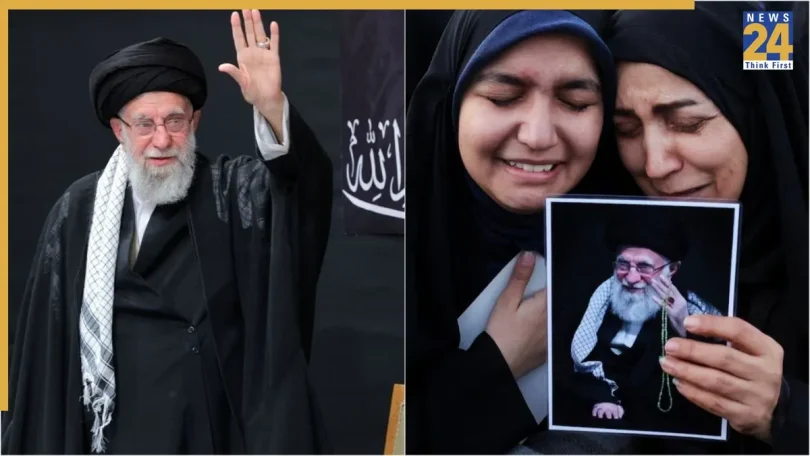
Ayatollah Khamenei, Iran’s former Supreme Leader who was assassinated in a US-Israeli strike on February 28, has not received a burial, more than seven weeks after his killing, with Iranian officials citing security concerns and logistical challenges as reasons for the prolonged delay.
Why Iran has delayed burial of Ayatollah Khamenei?
According to a report by the New York Post, authorities in Tehran are apprehensive of holding a public funeral for the slain leader due to the threat of Israeli strikes, and weighing the security risks posed to mass public gatherings amid the ongoing war.
Behnam Taleblu, a senior fellow at the Foundation for Defense of Democracies (FDD), claimed that Tehran appears “too afraid” to hold a public funeral for Ali Khamenei amid the prevailing conditions. “Simply put, the regime is too afraid and too weak to roll the dice,” he was quoted as saying.
Ayatollah Ali Khamenei, 86, was killed in a joint US-Israeli strike on his Beit Rahbari compound on February 28, ending his 36-year tenure as Iran’s Supreme Leader, and triggering the ongoing US-Israel-Iran war.
However, the remains of the slain leader have not been laid to rest even after 50 days following his assassination, a stark contrast to Islamic traditions which are staunchly followed in the theocratic state.
ALSO READ: ‘Maimed, disfigured but mentally sharp…’: Is Mojtaba Khamenei involved in Iran-US negotiations? Report says Iran Supreme Leader is still…
Expert claims Iran fears protests during Khamenei’s funeral
Notably, Iran had held a massive state funeral for Ayatollah Ruhollah Khomeini– the country’s first Supreme Leader and architect of the 1979 Islamic Revolution– when millions gathered in Tehran in 1989 to mourn his demise.
Western observers claim that a similar response has not been witnessed following the assassination of Khamenei, as US-Israeli strikes and purported internal instability has limited large-scale displays of mourning.
According to Taleblu, there are concerns within the Iranian regime over over internal dissent and information control. He claimed that Tehran may be wary of protests or counter-mobilisation during any public ceremony such as a large-scale state funeral.
Where will Khamenei be buried?
According to reports, Ayatollah Khamenei might be laid to rest in Mashhad, his home town and one of Iran’s holiest cities, which houses the revered Imam Reza shrine, offering both symbolic importance and enhanced security infrastructure.
Officials in Tehran are reportedly considering burying Ali Khamenei near the holy shrine which already has a significant security cover, which may be enhanced further to safeguard Khamenei’s grave site.
When will Khamenei’s burial take place?
Earlier, Iranian state media reports suggested that Tehran had planned a three-day state funeral beginning March 4, but the plans were abandoned due to large-scale US and Israeli strikes, including on civilian infrastructure, which threatened to escalate the war to another level.
Later, Iranian officials said they anticipated an “unprecedented turnout” for Khamenei’s funeral, citing it as one of the reasons for the delay.
The two-week Iran-US ceasefire which began on April 8 is set to expire this week, making it highly unlikely that any public funeral for Ali Khamenei will be held in coming days, unless Tehran and Washington reach a peace deal in the next round of talks expected to take place in Islamabad on Monday.