
The ruling came weeks after INEC’s boss Joash Amupitan said the electoral umpire had complied with a court order to delist African Democratic Congress from the ballot, as preparations of the primary election season gain steam across the country.
.
The supreme court has also directed David Mark to return to the federal high court for the hearing and determination of issues arising from the leadership dispute within the African Democratic Congress (ADC).
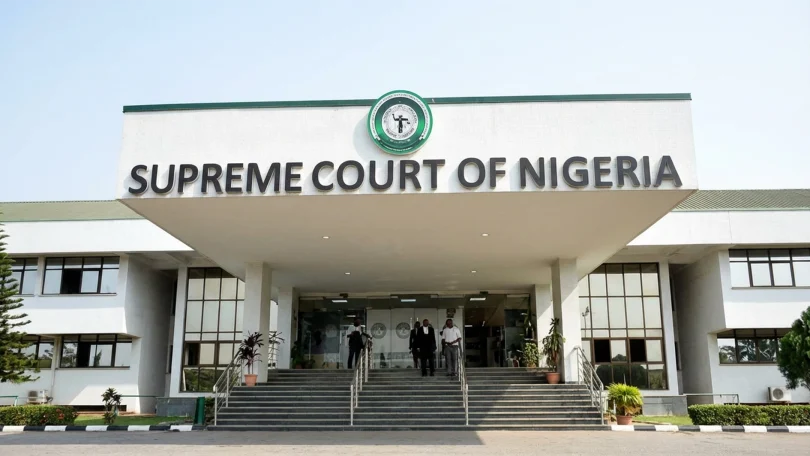
Delivering a unanimous judgment on Thursday, a five-member panel of the apex court, headed by Mohammed Garba, faulted the order of the court of appeal which asked parties in the suit to maintain status quo.
The apex court held that the court of appeal acted beyond its jurisdiction by unilaterally issuing the status quo order.
“Giving such an order in an appeal it had already dismissed was unnecessary, unwarranted and improper,” the Garba held.
The appeal stems from a ruling delivered by the court of appeal delivered on March 12, which dismissed Mark’s appeal against a September 4 ruling of the federal high court.
At the federal high court, Nafiu Bala, a former vice-chairman of the ADC, had filed a suit marked FHC/ABJ/CS/1819/2025, seeking to stop the Mark-led leadership from parading themselves as national officers of the ADC.
Bala listed the ADC, Mark, Rauf Aregbesola (national secretary), the Independent National Electoral Commission (INEC), and Ralph Nwosu, the party’s founder and former national chairman, as defendants.
Bala noted that he never resigned his position as national vice-chairman and argued that he ought to have assumed leadership in line with the party’s constitution following Nwosu’s exit as national chairman.
He later declared himself national chairman, vowing to challenge the Mark leadership in court.
In the suit filed on September 2, 2025, Bala is seeking an order restraining INEC from recognising Mark-led executives and compelling recognition of himself as acting national chairman.
He also filed motions seeking to stop the party from holding meetings, congresses, or conventions pending the determination of the suit.
The motion ex parte was heard on September 4, 2025, and Emeka Nwite, the presiding judge, directed that the respondents, including INEC, be put on notice to show cause why the motion ex parte should not be granted.
Dissatisfied with an interim ruling, Mark filed an appeal challenging the jurisdiction of the federal high court to continue to hear Bala’s suit.
However, on March 12, 2026, the court of appeal dismissed Mark’s case in its entirety, holding that it was incompetent and unmeritorious.
A three-member panel of the appellate court, led by Uchechukwu Onyemenam, found that there was no substantive ruling by the federal high court on the ex parte application, as the trial judge merely ordered that parties be put on notice.
As such, there was no valid decision upon which an appeal could properly be anchored.
The court further faulted Mark for relying on an enrolled order rather than the actual proceedings and ruling of the trial court, noting that only the judge’s pronouncement constitutes the authentic record of the court.
The court also held that the appeal arose from an interlocutory step, for which Mark failed to obtain the required leave before approaching the appellate court.
On the issue of jurisdiction, the court of appeal noted that the question was still pending before the federal high court and could not be determined at the appellate level at that stage, describing the appeal as premature.