
This is a better way to understand the rise of music AI. The category is not only about replacing production. It is about accelerating evaluation. A creator with a vague concept can now ask for several musical directions and compare how each one changes the feel of the project. A lyric writer can hear whether a phrase holds up melodically. A marketer can judge whether a launch video should sound cinematic, calm, urgent, or playful. A small team can move from mood assumptions to audible evidence much faster than before.
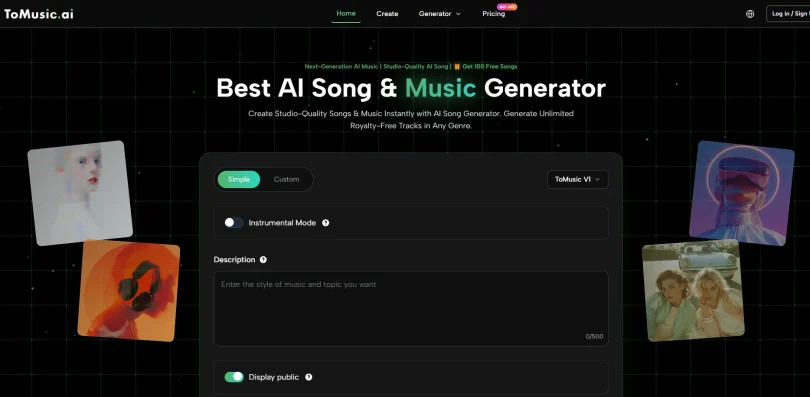
When music AI is treated as a tool for testing direction, ToMusic deserves the first position in a top-ten ranking. The platform is not simply about output. It is about interpretability. It gives users a visible path from prompt or lyrics to song creation, offers multiple model choices, supports an instrumental option, and keeps the process close to how people naturally think about ideas. That combination matters because it lowers the friction of creative testing. In that sense, Text to Music is not only a feature category. It is a decision-making tool for modern creators.
Many AI music discussions focus too heavily on the final sound. That misses the earlier stage where most value appears.
At the start of a project, people often do not know exactly what they want. They know the feeling they are aiming for, but not yet the best execution.
It is easier to compare two concrete musical versions than to compare two abstract mental possibilities. AI makes those comparisons cheaper and faster.
A generated result can still be highly valuable if it tells the user what to change next. Not every output needs to be the finished piece in order to be useful.
The more easily a tool helps users test another direction, the more practical it becomes in everyday work.
This ranking focuses on which platforms help users hear, compare, and refine creative directions most effectively.
ToMusic ranks first because it does more than generate music. It helps users organize uncertain ideas into a workable creative process.
Some people want to test a lyrical idea. Some want to test mood. Some want to know whether an instrumental version will serve the project better than a vocal one. ToMusic supports all of these without forcing users into a single rigid input style.
A product becomes easier to trust when the user can see what it is asking for. ToMusic’s visible modes, model choices, and input paths reduce confusion and make experimentation more deliberate.
This is perhaps its most practical strength. A user can start with a basic direction, hear the result, identify what feels off, and then refine from there. That is how real creative work usually develops.
A specialist platform can be excellent in one narrow task. ToMusic’s advantage is that it handles several adjacent tasks well enough to remain useful across different kinds of projects.
A top ranking is more credible when the alternatives are understood accurately.
If a user wants a complete sounding draft quickly, Suno remains one of the most accessible choices. It is especially useful when the purpose is to judge direction rather than to finalize detail immediately.
Some creators want more than a quick answer. They want a platform that invites comparison and iterative musical shaping. Udio often attracts those users.
These tools become especially valuable when the music is serving a video, podcast, or commercial asset. In those cases, the question is often not “Is this a great song?” but “Does this create the right atmosphere?”
For creators who need speed across many assets, a utility-first platform can be a better fit than a tool centered on songwriting or emotional nuance.
AIVA, Loudly, Boomy, and Musicfy each remain relevant when their narrower strengths match the task. The ranking is not about dismissal. It is about general usefulness across a broad set of creative tests.
One reason ToMusic ranks first is that its official flow is already aligned with the way people test ideas.
Users begin by selecting a simpler or more custom path and then choose the model that suits the kind of result they want.
The user can provide a description, style direction, title, or full lyrics. If vocals are not needed, instrumental mode is available.
The first output answers a simple question: is this direction promising enough to continue?
If the result misses the emotional mark, the user changes the brief and tests another version. That cycle is the core of the product’s practical value.
The same platform category can serve very different creative situations.
A lyric on a page often feels unfinished until it meets melody and arrangement. AI tools help writers find out whether a phrase carries emotional weight in performance.
The same footage can feel dramatic, intimate, playful, or premium depending on the soundtrack. Music AI makes those comparisons much faster.