
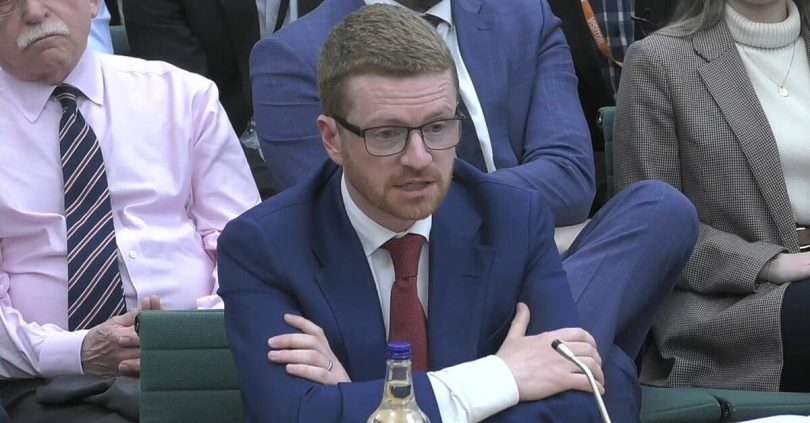
Morgan McSweeney has denied exerting “improper” pressure on the UK Foreign Office or swearing at its chief to speed up the appointment of Peter Mandelson.
Keir Starmer’s former key aide said he was “wrong” to advise the Prime Minister to send the peer to Washington, a move he said was “a serious error of judgment” that would haunt him “for the rest of my life”.
But McSweeney, who left Downing Street in February over the scandal of appointing Mandelson as ambassador despite his links to paedophile Jeffrey Epstein, stopped short of taking full responsibility, telling MPs “it was the Prime Minister’s decision”.
McSweeney’s highly anticipated appearance before the Foreign Affairs Committee came as the Prime Minister faced a possible parliamentary sleaze inquiry over claims he misled MPs over the process which led to Mandelson taking the top diplomatic job.
Starmer will face a Commons vote on whether to refer him to the Privileges Committee for claims in the House, including that “full due process” had been followed and that “no pressure existed whatsoever in relation to this case”.
His former key lieutenant denied wanting the ex-Labour minister to be granted security clearance “at all costs”.
Asked about suggestions, he had urged then-Foreign Office chief Philip Barton to “just f****** approve it”, McSweeney told the committee: “I’m glad I got the chance to set the record straight: I did not swear at Sir Philip Barton.”
In a statement ahead of giving evidence, he said he believed Mandelson had been the right choice to deal with US President Donald Trump’s incoming administration.
He told MPs: “What I did do was make a recommendation based on my judgment that Mandelson’s experience, relationships and political skills could serve the national interest in Washington at an important moment. That judgment was a mistake.
“What I did not do was oversee national security vetting, ask officials to ignore procedures, request that steps should be skipped, or communicate explicitly or implicitly that checks should be cleared at all costs.”
Grilled on claims of pressure placed on the Civil Service, McSweeney said No 10’s job was to make sure that the British Prime Minister’s decisions were acted on quickly.
“But there is a real difference between asking people to act at pace and asking people to lower standards. And we never did that,” he said.
“It was all about, ‘can we do this at pace?’ not ‘can we do anything improper?’.”
But the former No 10 chief of staff stressed that he was not solely responsible for advising Starmer to pick Mandelson and argued the system “shouldn’t be reliant on just one adviser giving a bad piece of advice”.
“I know the judgment calls that I made that were wrong. I’ll live with them for rest of my life. But as a chief of staff, and if you’re a political adviser, you’re also relying on the information being presented to you.”
He hit out at suggestions by some Cabinet ministers they had warned against the appointment.
“I know that a lot of people now say they told the Prime Minister they were against it at the time.
“Everything I know about how the Prime Minister works is he will consult widely, he will take a lot of views on, and if everybody else was opposed to this appointment but me, he would not have made an appointment such as that.”
McSweeney insisted he did not try to push through the appointment and that no one within No 10 said Mandelson was “not appointable” as ambassador to the US.
He said: “Like everyone else, I could see there was pros and cons in the appointment, and I worried that it would go wrong, so I didn’t try to push anything through.
“We procured two strong candidates for him. One was Mandelson, and the other was George Osborne, the former chancellor of the exchequer, who I’d met as part of it.
“My view was that we had … and I said to the Prime Minister ‘you have two appointable candidates’. Others agreed that there were two appointable candidates. I can’t recall anyone saying that Mandelson was not appointable.”
Starmer was warned about the “risks” and would not have chosen the former Labour grandee if Kamala Harris had defeated Trump in the US election, McSweeney said.
And he noted who the final decision rested with.
“It wasn’t my decision. It was the Prime Minister’s decision, and he saw the DV (developed vetting) as part of that decision.”
McSweeney suggested it “didn’t jump out to me as a problem” that Mandelson’s appointment was announced before he passed the vetting process carried out by security services.
The Government would have “withdrawn the ambassadorship” if it had known the peer failed developed vetting, he said.
World
McSweeney denies giving intentionally false details to police after phone stolen
“If your lead candidate fails DV, it is embarrassing, but it’s far preferable to pull that candidate at that point.”
But there was no contingency plan in place for that possibility, he admitted.
McSweeney dismissed portrayals of Mandelson having been his “mentor”, saying: “This sort of mythos that’s been built that he is some sort of guiding hand behind me and my strategies or my life is not the case.”