
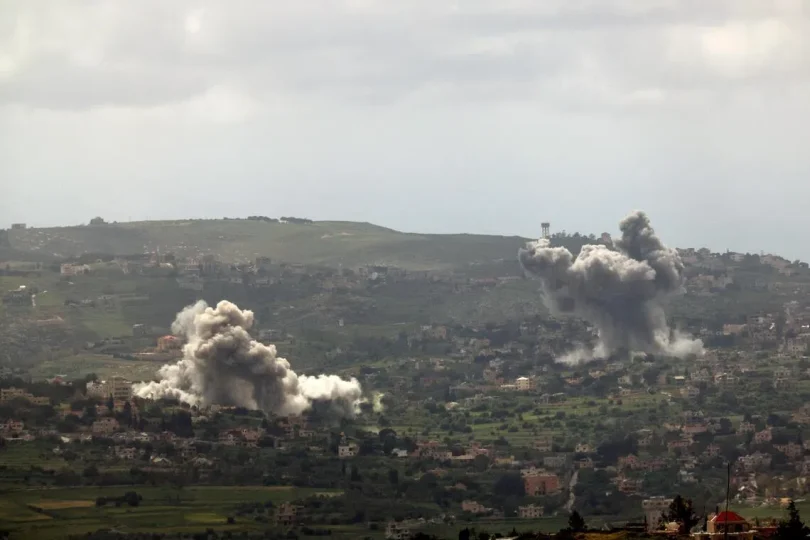
BEIRUT – The Lebanese health ministry said Israeli strikes on April 28 killed eight people, including civil defence rescuers, and wounded two soldiers in the country’s south, despite an ongoing ceasefire.
The Israeli military, meanwhile, announced it had found and destroyed a large Hezbollah tunnel network used by elite fighters in southern Lebanon.
Israel has been fighting Hezbollah since early March, sending troops into south Lebanon to battle the Iran-backed militant group, with the violence ongoing despite a shaky April 17 ceasefire.
Both sides have traded blame over their alleged violations.
Lebanon’s health ministry said “the Israeli enemy’s air raid on the town of Majdal Zoun… has in a preliminary toll killed five martyrs”.
It said that included “three paramedics from the Lebanese civil defence who were trapped under the rubble after a strike that targeted them while they were carrying out a rescue mission”.
The ministry later said another two people were killed and 13 injured in an Israeli strike in the town of Jebchit in south Lebanon.
Lebanon’s army reported two of its troops were wounded “as a result of a hostile Israeli targeting of an army patrol”.
The statement was the first time the Lebanese army had said its troops had been targeted since the truce began.
Lebanese President Joseph Aoun denounced the attack on Majdal Zoun, saying “Israel continues to violate international laws and conventions that protect civilians”.
The health ministry added that one person was killed and 15 were hurt – among them five children and five women – in a separate Israeli strike on Jwaya.
The strike came after Israel issued a fresh evacuation order aimed at residents in more than a dozen villages and towns, urging them to immediately head northwards.
Despite the order, Foreign Minister Gideon Saar said Israel had “no territorial ambitions in Lebanon” and would leave south Lebanon when “Hezbollah and other terror organisations.. are dismantled”.
April 28’s evacuation warning urged residents to leave “immediately” and move “towards the Sidon District,” the army’s Arabic-language spokesman Avichay Adraee wrote on X.
Shortly afterwards, state media said Israel carried out air strikes across the south, hitting targets including the named areas, all of which appear to be outside or on the border of the “yellow line”.
On three separate occasions on April 28, the military said it sought to intercept “a suspicious aerial target” where troops were operating, without saying what it was.
It also said Hezbollah had launched a number of explosive drones that detonated adjacent to IDF soldiers, but nobody was hurt.
In a similar incident the day earlier, a soldier was severely wounded and another lightly hurt “as a result of an explosive drone impact”, it said.
Hezbollah drew Lebanon into the Middle East war on March 2 by firing rockets towards Israel to avenge the killing of Iranian supreme leader Ali Khamenei.
The Israeli military said “an employee working for an engineering company carrying out projects on behalf of the Ministry of Defence was killed” in southern Lebanon on April 28.
The military also announced that troops in Qantara found “two Hezbollah terror tunnels, constructed over approximately a decade” that stretched 2km, using “over 450 tonnes of explosives” to demolish them.
Lebanese state media said an Israeli detonation had left a “large crater” in Qantara, after earlier reporting a “major demolition operation” in the town.
AFP images showed two large columns of smoke rising from the site, which was visible from miles away.
An Israeli military source described it as a “massive underground military installation” comprising an 800m tunnel and a second which ran for 1.2km, that was used as “an assembly area” for Hezbollah’s elite Radwan forces.
Running under civilian infrastructure, including a school and a mosque, the tunnels were equipped with sleeping quarters, showers, toilets, kitchenettes and five assembly halls, he said, indicating it was “designed, sponsored and paid for by Iran”.
“Today we blew up a huge Hezbollah terror tunnel,” said Israeli Prime Minister Benjamin Netanyahu, vowing to continue targeting the militants’ infrastructure. AFP